5 Things to Check Before Signing a Cloud Mining Contract
Before you wire USDT to any cloud miner, verify these 5 things: facility location, fee stack, contract terms, payout custody, and operator track record.
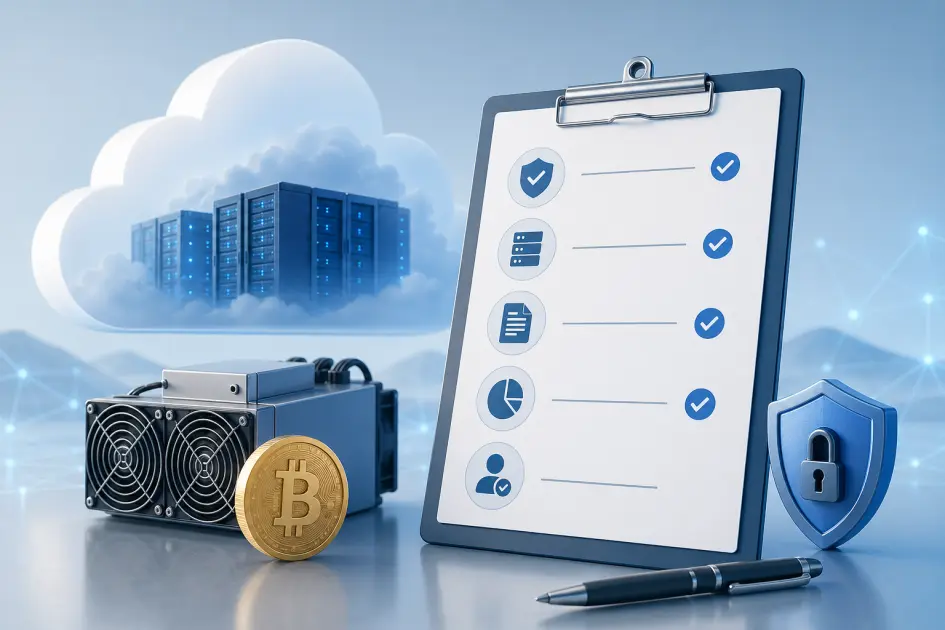
Before you sign a cloud mining contract, verify five things: where the hardware physically sits and what it costs the operator to run, the full fee stack (withdrawal, pool, maintenance), the contract term and how you exit it, how BTC is custodied and paid out, and the operator's verifiable track record. Every claim below is something you can check in under thirty minutes — and every item a provider refuses to answer is a signal.
Why a Pre-Contract Checklist Matters More Than the Hash Rate
Cloud mining contracts compete on the front page using one number — $/TH/month, or sometimes a "120% ROI" claim — and hide everything that actually determines whether you get paid in the footer. The five checks below shift the decision from marketing copy to verifiable facts. They work on any provider, including us. If you apply them to NoxHash and the answers satisfy you, fine; if you apply them to another operator and the answers don't come back, that is the check doing its job.
Work through the list in order: a provider that fails check #1 usually also fails checks #4 and #5, so you save time by starting at the physical layer. The last section rolls the five checks into a printable one-pager you can run through before wiring any USDT.
The 5 Things to Verify Before Signing
Where the hardware sits — and what the operator pays for power
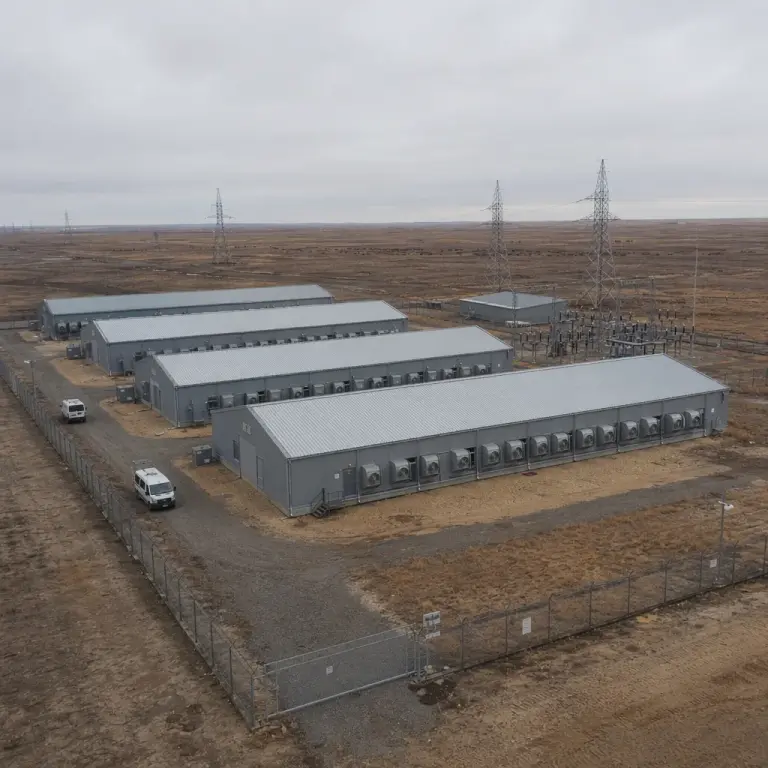
A legitimate cloud miner can name the country and the electricity price. "Global data centers" with no country named is a soft red flag. Ask the specific ASIC models (Antminer S21, WhatsMiner M66S, etc.) and the J/TH efficiency — the 2024-2025 generation runs 12-18.5 J/TH. NoxHash operates in Kazakhstan at $0.03-0.04/kWh industrial electricity, cooled by a winter climate that averages -15 to -30°C. If a provider can't tell you their kWh cost, their margin math can't survive a scrutiny check.
The full fee stack — not just the headline monthly price
Four fees erode a headline contract: pool fee (industry standard 1-2% FPPS), maintenance/electricity fee (sometimes a daily $/TH charged on top), withdrawal fee (typically 1-3% or a flat BTC amount), and conversion spread when payouts are auto-swapped to stablecoin. Add them in a spreadsheet before comparing providers. A $50/month contract with a $0.10/TH daily maintenance fee costs radically more than a $70/month all-in plan. NoxHash's stack is one line: rental price plus 1.5% BTC withdrawal fee, no separate maintenance charge.
Contract term and how you exit it
Read the termination clause before the term length. Some providers offer attractive 15-20% discounts for 12- or 24-month commitments but reserve the right to "pause" contracts if daily earnings fall below the electricity fee — effectively bricking your capacity without refunding the prepaid months. Check: can you stop renewing? Does the contract auto-renew? What happens at the scheduled halving events, which cut block rewards by 50%? NoxHash uses month-by-month renewal with explicit 1-24 month term discounts, so non-renewal is the entire exit path.
Payout mechanics — cadence, minimums, and who holds the BTC
Four payout facts matter. How often is BTC credited — per block, per minute, daily, weekly? What is the minimum withdrawal — a 0.01 BTC minimum on a $50/month plan means months of lockup. What wallet formats are supported (Segwit bc1, P2PKH 1, P2SH 3)? And critically: is withdrawal user-initiated, or does the operator batch it with delays? NoxHash credits BTC every minute via FPPS, minimum withdrawal is 0.00001 BTC, and you initiate the withdrawal yourself — the operator is not a custodian holding your BTC on discretion.
Operator track record — uptime, KYC, and reviewable history
Look for three things: a published uptime figure (industry benchmark is 99.5-99.9%), a KYC/registration footprint in a named jurisdiction, and independent reviews with timestamps — Trustpilot, BitcoinTalk threads, Reddit r/BitcoinMining, not the testimonials on the provider's own homepage. A cloud mining operation old enough to have survived one halving (April 2024 cut block rewards from 6.25 to 3.125 BTC) has proven its economics against the worst single event in a mining business cycle. NoxHash runs at 99.9% uptime with a 24/7 technician team that swaps failed units in 4-8 hours.
Green Flags vs Red Flags — Quick Comparison
The five checks above collapse into a short list of contrasting signals. Use this as your at-a-glance reference while reading a provider's terms page.
| Check | Green flag | Red flag |
|---|---|---|
| Facility location | Named country + named kWh rate | "Global data centers", no country |
| Hardware | Specific ASIC models + J/TH | "State-of-the-art rigs" (no specs) |
| Fee stack | Single rental + single withdrawal % | Daily $/TH maintenance on top |
| Exit | Month-by-month / non-renewal exit | "Pause if unprofitable" clause |
| Payout cadence | Per-minute / daily FPPS credit | Weekly batches, operator-initiated |
| Min withdrawal | ≤ 0.0001 BTC | ≥ 0.01 BTC (weeks of lockup) |
| Track record | Survived ≥ 1 halving, third-party reviews | < 1 year old, only on-site testimonials |
| Uptime claim | 99.5-99.9% with replacement SLA | "100% guaranteed" (not realistic) |
Run the 5 checks on NoxHash before you wire a single USDT
Named country, named hardware generation, single-line fee stack, per-minute BTC payouts, 99.9% uptime. The 2-day Basic Miner trial lets you walk the checklist against a live dashboard without a deposit — including checks #4 and #5, which only become real once you see a payout land.

Where the Checklist Can Mislead You
No five-item checklist catches every bad contract, and a provider that passes all five can still underperform if the market turns. Three honest caveats:
A long operating history doesn't immunise against BTC price risk. Your rental is paid in USD-pegged USDT; your earnings are in BTC. If BTC falls 40% during your contract, a 12-month discount that looked smart on signup day can underperform a month-by-month alternative. The checklist verifies the provider, not the market.
Third-party reviews skew negative. People who are earning as expected rarely post about it; people who lost money always do. Read reviews for specific failure modes (withdrawal delays, silent contract pauses, unresponsive support), not aggregate sentiment. A 3.8-star operator with detailed positive and negative threads is more useful than a 4.9-star operator with only short praise.
KYC cuts both ways. A provider with strict KYC is easier to legally pursue if something goes wrong, but also locks you out of some jurisdictions and requires trusting them with ID documents. Weight this against your personal risk posture and local regulation — not every user wants the same answer here.
4 Tips When You Run This Checklist
Price the fees in a spreadsheet
Build a 12-row sheet with rental, daily maintenance $/TH, pool %, withdrawal %, and conversion spread. Then back-solve for effective $/TH/month. Two providers with the same headline price can differ 30-50% at the bottom line.
Test the withdrawal before you scale
Check #4 (payout custody) only becomes real once a withdrawal lands in your own wallet. Start with the cheapest plan, earn past the minimum, run one withdrawal, confirm on-chain. Only then commit to a longer term.
Screenshot the terms page
Terms and fees change. The version you agreed to is the one that binds the provider. Save a PDF or dated screenshot of the fee page, withdrawal policy, and termination clause on the day you sign. It takes one minute and wins arguments later.
Lock the account before the contract
A signed contract protects the capacity, not the account. Enable TOTP 2FA, store the recovery codes offline, and verify the withdrawal wallet address twice — before the first BTC lands, not after. Account compromise is the one loss no checklist on the provider side can prevent.
For a deeper explainer on how mining pool accounting (FPPS vs PPS vs PPLNS) affects check #4's per-payout math, the original Bitcoin whitepaper describes the block-reward mechanism every pool redistributes, and the Cambridge Bitcoin Electricity Consumption Index is the public source we cross-reference to validate the $0.03-0.04/kWh industrial-rate claim in check #1.
Put the 4 tips into practice — trial, withdraw, then scale
The tips above (spreadsheet, test withdrawal, screenshot, 2FA) are cheaper to run on a live trial than on a paid contract. Start with the 2-day Basic Miner on NoxHash, prove check #4 with a real withdrawal, then pick a term length only once the fee math and the payout cadence both check out.
Frequently Asked Questions
What is the single biggest red flag in a cloud mining contract?
A "pause if unprofitable" termination clause combined with undisclosed maintenance fees. Together they let the operator silently halt your capacity while still keeping the USD you prepaid. If the termination section or the fee schedule is vague on either point, stop and choose a provider with clearer exit terms.
How do I verify a provider's claimed hashrate or uptime?
Use a paid trial period or the smallest plan as your audit tool. Your dashboard should show real-time hashrate and per-minute BTC credits; compare a week of credits against a public calculator using the same hashrate, BTC price, and network difficulty. Deviations over 10-15% are worth questioning.
Should I prefer a long contract for the discount?
Only after checks #1-#4 clear. A 15-20% discount on 12 or 24 months is worth taking if the operator is transparent and the exit terms are clean. If the termination clause is vague or payouts are batched, keep the flexibility of month-to-month and pay the premium. A good term cannot fix a bad operator.
Is KYC a good sign or a bad sign on a cloud mining platform?
KYC is a trust signal on the operator's side — it implies a registered entity you can legally pursue — but it also requires you to trust that operator with ID documents. There is no one-size answer. Jurisdictions, personal privacy posture, and deposit size all factor in. Match the provider's KYC to your own threshold.
What does NoxHash do differently on these five checks?
NoxHash names the country (Kazakhstan), the kWh rate ($0.03-0.04 industrial), the exact ASIC generation (Antminer S21 / WhatsMiner M66S at 12-18.5 J/TH), runs a single-line fee stack (rental + 1.5% withdrawal), credits BTC every minute via FPPS with a 0.00001 BTC minimum, and publishes a 99.9% uptime figure backed by a 24/7 replacement team.
Educational content — not financial or legal advice
This article is a buyer-side checklist for evaluating cloud mining contracts, not a profit forecast or legal opinion. Cloud mining revenue depends on BTC price and network difficulty, both of which are volatile and outside any operator's control. Fees, uptime, and contract terms cited here reflect publicly available information as of April 2026 and may change; always re-read the provider's current terms before signing. Crypto mining is restricted or taxed in several jurisdictions — verify local rules before committing funds. Only commit capital you can afford to lose.