2026 ASIC Miner Comparison — Which Machines Power Cloud Mining?
A market-wide view of the ASICs powering cloud mining in 2026 — top 6 units ranked by efficiency, with the role each plays in NoxHash's fleet.
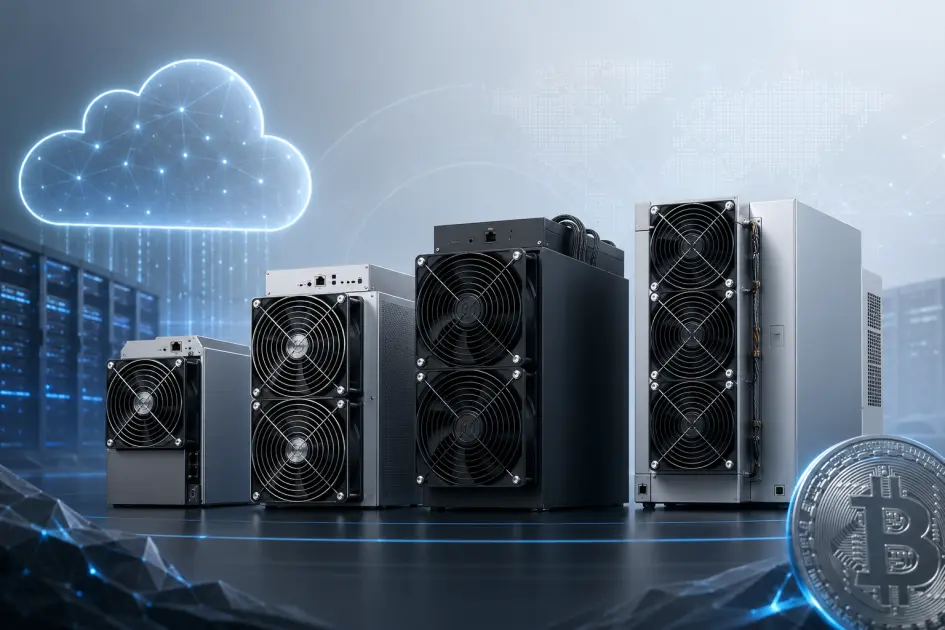
The ASICs powering Bitcoin cloud mining in 2026 are dominated by six units across two manufacturers: Bitmain's Antminer S21 family and MicroBT's WhatsMiner M60/M66 line. The efficiency leader sits at 12 J/TH (Antminer S21 XP Hyd, 473 TH/s), while the fleet sweet spot runs 15–18 J/TH. Cloud mining platforms like NoxHash blend these tiers rather than betting on a single model.

The 2026 ASIC landscape in one view
The Bitcoin ASIC market in 2026 is a two-horse race. Bitmain and MicroBT together ship roughly 90% of new SHA-256 hardware, with Canaan's Avalon line and a handful of smaller brands splitting the remainder. For cloud mining operators, that duopoly simplifies planning: you build around two vendor catalogs, not twenty.
Two cooling paradigms coexist. Air-cooled units (S21, S21 Pro, M60S, M66S in its air variant) are the workhorses — simpler to deploy, serviceable without plumbing. Hydro-cooled flagships (S21 Hyd, S21 XP Hyd) push density higher and shave watts per terahash, but require a closed-loop liquid system and a retrofit that most older sites cannot justify.
The efficiency floor at the very top of the market sits near 12 J/TH — the Antminer S21 XP Hyd. Five years ago that number was 30+ J/TH, so the generational leap from the S19/M50 era into today's S21/M66 fleet is effectively complete. Almost nothing shipped before 2024 stays competitive at industrial electricity prices in 2026.
Efficiency leaderboard — the top 6 ASICs of 2026
The ranking below orders the market's dominant units by J/TH (joules per terahash) — the single metric that matters most at scale. Lower is better: a 12 J/TH miner burns roughly a third less electricity per unit of hashrate than an 18 J/TH miner. The emerald row highlights the current efficiency leader.
| Rank | Model | Hashrate | Power | J/TH | Cooling | Maker |
|---|---|---|---|---|---|---|
| 1 | Antminer S21 XP Hyd | 473 TH/s | 5,676 W | 12.0 | Hydro | Bitmain |
| 2 | Antminer S21 Pro | 234 TH/s | 3,510 W | 15.0 | Air | Bitmain |
| 3 | Antminer S21 Hyd | 335 TH/s | 5,360 W | 16.0 | Hydro | Bitmain |
| 4 | WhatsMiner M66S | 298 TH/s | 5,066 W | 17.0 | Air | MicroBT |
| 5 | Antminer S21 | 200 TH/s | 3,500 W | 17.5 | Air | Bitmain |
| 6 | WhatsMiner M60S | 186 TH/s | 3,441 W | 18.5 | Air | MicroBT |
The gap between rank 1 and rank 6 is 6.5 J/TH — about a 35% efficiency spread. Over a year of 24/7 runtime, that difference compounds into thousands of dollars of electricity per unit at industrial rates. It is why fleet composition strategy matters more than any single hardware purchase.
Pricing and availability in 2026
Retail pricing in 2026 settles into three visible bands. Flagship hydro units (S21 XP Hyd) trade between roughly $7,000 and $10,000 per unit at direct-from-manufacturer pricing — and often sit on multi-month order backlogs because hydro chassis production is constrained. The Pro air-cooled tier (S21 Pro, S21 Hyd) sits around $3,500–$5,000. The base air-cooled tier (S21, M60S, M66S) runs $3,000–$4,000.
Secondary markets add noise. Miners selling off older S19 XP stock can push used prices under $1,500, but those units land around 21–22 J/TH — they no longer pencil in at today's hash price. Most commercial operators skip the used market entirely for new capacity.
Bulk procurement changes the math. Operators ordering hundreds of units at a time — the scale NoxHash operates at — typically secure 15–25% below retail, plus priority slots in production queues. That same quantity discount is unavailable to individual buyers, and it is one of several structural reasons the economics of a shared fleet outperform a one-unit home setup.
Three fleet composition strategies — and what each optimizes for
How an operator mixes the six units above is a strategic choice. Three archetypes dominate in 2026.
Flagship-only
Builds exclusively around S21 XP Hyd. Highest density, best J/TH, but requires a purpose-built hydro loop and has single-point supply exposure. Common in newly constructed 2024+ sites.
Sweet-spot workhorse
Mostly S21 Pro air-cooled at 15 J/TH. Simpler operations — no plumbing, faster swap cycles, easier parts inventory. Slightly higher J/TH than flagship but far lower capex and infrastructure risk.
Diversified mix
Spreads across Bitmain and MicroBT, air and hydro, Pro and base tiers. Hedges against supply disruption from either maker and matches hardware tier to rack cooling zone. NoxHash's approach.
The diversified approach is rarely the most theoretically efficient choice — a pure S21 XP Hyd fleet always wins on paper. But it is the most resilient choice. When one vendor delays shipment, misses a generation, or lands a buggy firmware release, a diversified fleet keeps producing while a single-vendor site scrambles. For a multi-year operation, resilience beats peak efficiency on most days.
How NoxHash maps rental tiers to real hardware
One question customers frequently ask: "Which specific miner do I get when I rent a tier?" The honest answer is that you don't get a specific miner — you get a virtualized share of the pooled hashrate produced by the entire fleet. The rental tier simply defines how much of that pool is allocated to your account.
| Rental tier | Allocated hashrate | Physical equivalent |
|---|---|---|
| Basic | 50 TH/s | ~0.25 × S21 Pro, or ~0.1 × S21 XP Hyd |
| Standard | 150 TH/s | ~0.6 × S21 Pro, or ~0.75 × S21 (base) |
| Pro | 350 TH/s | ~1.5 × S21 Pro, or ~0.75 × S21 XP Hyd |
| Enterprise | 1,000 TH/s | ~2 × S21 XP Hyd, or ~5 × S21 (base) |
Why virtualize instead of assigning a specific physical unit? Three reasons. First, uptime — if one unit fails, your payout is unaffected because the pool absorbs the loss across the fleet. Second, upgrade cycles — when NoxHash replaces older units with next-generation hardware, your allocated TH/s stays constant without a contract renegotiation. Third, fairness — every customer's per-TH economics reflect the whole fleet's blended efficiency, not a lottery on which unit they were assigned.
Rent a slice of the S21 / M66 fleet — from 50 to 1,000 TH/s
Instead of picking a single miner, you get a per-TH share of a diversified fleet running at 12–18.5 J/TH. Start with the tier that matches your budget and upgrade later.

What's coming next — the race toward sub-12 J/TH
The sub-12 J/TH barrier is the next public milestone. Both major manufacturers have previewed roadmaps pointing at it. MicroBT has discussed an M70 series targeting parity with the S21 XP Hyd, and Bitmain's follow-up to the S21 XP is widely expected to cross into single-digit or low-single-digit wins depending on chip process.
The underlying driver is process shrink. Today's flagship hashboards run on 5nm silicon. The 3nm generation is in limited commercial production at foundries, and sample ASIC tape-outs have begun. A full 5nm-to-3nm transition could shave another 15–25% from J/TH — but real-world yields, cost per wafer, and hydro-loop integration will determine whether that potential lands in customer hands at the same retail tiers we see in 2026.
For cloud mining operators, the practical impact is a rolling upgrade cycle. When next-gen hardware improves efficiency by more than roughly 15%, it becomes economic to cycle older units out — the electricity savings pay the capex gap within a forecastable window. That is why fleet hashrate composition looks different in 2026 than it did in 2024, and why it will look different again in 2028.
Key takeaways
Efficiency, not hashrate
J/TH determines long-run economics. A 200 TH/s unit at 15 J/TH can outperform a 250 TH/s unit at 22 J/TH on net margin.
The gap is closing, not widening
Rank 1 to rank 6 spans only 6.5 J/TH. A diversified mid-tier fleet is competitive, not obsolete, versus a flagship-only build.
Single-vendor risk is real
Buggy firmware or a missed generation from one maker can stall an all-Bitmain or all-MicroBT farm for months. Diversification hedges the risk.
Rolling upgrades matter
Sub-12 J/TH is on the near roadmap via 3nm process. Fleet composition in 2028 will look different than today — operators who can cycle hardware stay competitive.
For live hashprice context that determines whether a given J/TH number clears daily costs, public dashboards like Hashrate Index track BTC/TH/day and rig prices across the market. Broader network statistics and share-of-hashrate data are maintained by the Cambridge Centre for Alternative Finance.
Frequently asked questions
Which ASIC miner is the best in 2026?
On pure efficiency, the Antminer S21 XP Hyd leads at 12 J/TH and 473 TH/s. But "best" depends on your constraint. For an air-only site, the S21 Pro at 15 J/TH wins. For supply-chain resilience, a mix of Bitmain and MicroBT units beats either alone — which is how most commercial operators build.
Do cloud mining platforms actually use old ASICs to cut costs?
Serious platforms do not. Pre-2024 units running at 21+ J/TH lose money against industrial electricity at today's hashprice, so operators cycle them out. NoxHash runs only 2024–2025 generation hardware across S21, S21 Pro, S21 Hyd, S21 XP Hyd, M60S and M66S — all between 12 and 18.5 J/TH.
Is there a single most efficient miner I should buy?
The S21 XP Hyd has the lowest J/TH on the market, but it needs a hydro cooling loop and costs $7,000 to $10,000 per unit with long lead times. For a home or small-site setup without liquid cooling, the S21 Pro at 15 J/TH is usually the more practical choice.
Why don't all farms just use S21 XP Hyd units?
Three reasons. Supply is constrained — hydro chassis production lags demand. Infrastructure cost — legacy air-cooled sites cannot retrofit a hydro loop cheaply. Single-vendor risk — a farm entirely on one model and one maker is exposed to firmware bugs and shipment delays. Most operators diversify instead.
When will sub-12 J/TH miners be available?
Both Bitmain and MicroBT have public roadmaps pointing at sub-12 J/TH, driven by 5nm-to-3nm process shrink and improved hydro designs. Initial commercial units are expected on a rolling basis over the next generation cycle, but availability at scale and real-world efficiency always lag the launch headline by months.
Does the specific ASIC model affect my cloud mining payout?
In NoxHash's model, no. You rent allocated TH/s from the pooled fleet, not a specific unit. Your per-TH payout reflects the blended efficiency of the whole fleet, so if one unit fails or gets replaced with a newer model, your contract terms are unchanged.
Informational content, not investment advice
This article compares ASIC hardware for context. Mining profitability depends on BTC price, network difficulty, electricity cost, and hardware reliability — all of which can change quickly and are outside any single operator's control. Past performance does not guarantee future results. Research carefully and only commit funds you can afford to lose.