Cloud Mining vs Crypto Lending — Passive Income Face-Off
Compare cloud mining with CeFi and DeFi crypto lending in 2026. Yield source, custody, lock-up, counterparty risk, and when each option actually fits.
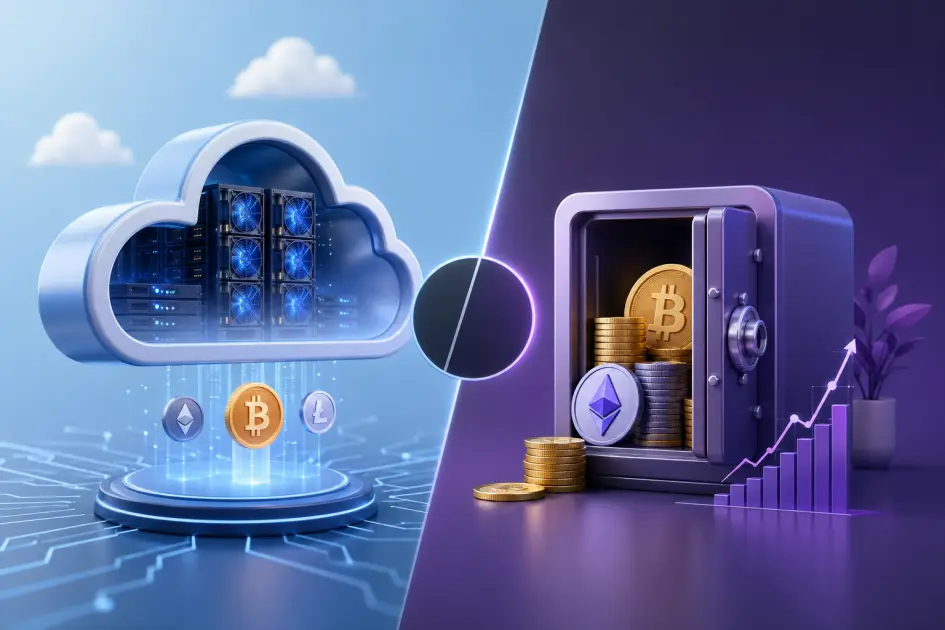
Both cloud mining and crypto lending promise passive income, but they are fundamentally different machines. Lending deposits your USDC, USDT, or BTC with a platform in exchange for interest, typically 3–10% APY. Cloud mining rents external hashrate for a fixed USD fee and pays out in fresh BTC. Here's how the yield, custody, and risks actually stack up in April 2026.
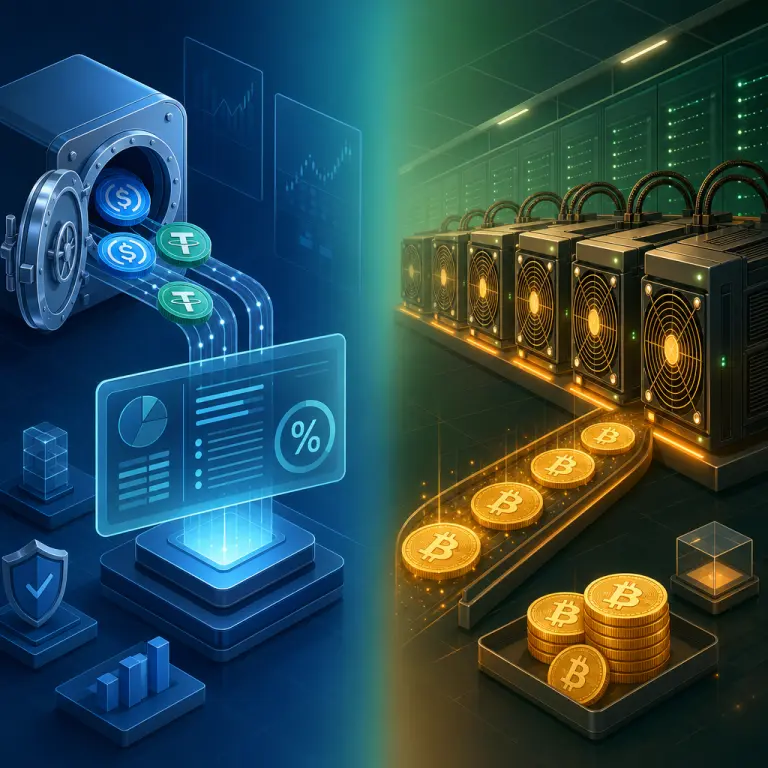
Two Yield Models, Two Different Machines
Before comparing numbers, it helps to see what each product actually is. Crypto lending is a financial product: you deposit an asset, someone borrows it, and you get paid interest from that borrower (minus a platform cut). Cloud mining is an infrastructure product: you pay a data center to run ASIC miners on your behalf, and you get whatever BTC those machines produce, minus the rental fee you already paid up front.
The difference shows up most clearly in what currency you earn. Lending pays you in what you deposited — deposit USDC, earn more USDC. Deposit BTC on a BTC-denominated product, earn more BTC. Cloud mining pays you in BTC regardless of what you used to pay for the rental, because the miners themselves produce block rewards in BTC.
Crypto lending
Deposit USDC/USDT/BTC, earn interest. Typical range: 3–10% APY on stablecoins, 1–4% on BTC. Yield comes from borrowers paying to use your capital.
Cloud mining
Pay a fixed USD/USDT fee, rent hashrate, earn BTC. Output depends on BTC price, network difficulty, and hardware efficiency. No BTC needs to be locked up.
Payout cadence
Lending typically compounds daily or weekly into your deposit balance. Cloud mining on NoxHash credits BTC to your wallet roughly every minute — different rhythm, same idea.
CeFi vs DeFi — Lending Has Two Very Different Flavors
Lumping "crypto lending" into one bucket misses the biggest decision you have to make. The two sub-categories look similar on a marketing page and feel completely different when something goes wrong.
CeFi lending — centralized, custodial, counterparty-heavy
Platforms like Binance Earn, Coinbase, Nexo, and Ledn take custody of your assets in a corporate account. You see a balance and an APY on a dashboard. Behind the scenes the platform decides who to lend your deposits to, how much collateral to require, and whether to rehypothecate — use your assets as collateral for their own business activities.
Yields sit roughly in the 4–10% APY range on stablecoins depending on loyalty tier and lock-up length. Withdrawals are fast because the platform holds the keys — but that same custody means you cannot independently verify what's happening with your capital.
DeFi lending — on-chain, over-collateralized, smart-contract mediated
Protocols like Aave, Compound, and Morpho replace the corporate middleman with a smart contract. You deposit into a liquidity pool; borrowers must post more collateral than they borrow (typically 125–150%) and get liquidated automatically if their collateral ratio falls. Your deposit and the borrower's position are both visible on-chain.
On Aave v3 in April 2026, USDC supply rates are typically 3–6% APY and Compound's stablecoin rates sit near 4.1%, according to Aave's live market dashboard. The upside: no corporate counterparty can freeze withdrawals. The downside: a smart-contract exploit or oracle manipulation can drain the pool, and that loss is final.
The Comparison Matrix — Yield, Custody, Lock-Up, Risk
Same row structure across all three options makes the trade-offs easier to see than any pitch deck. Read across, not down.
| Criteria | CeFi lending | DeFi lending | Cloud mining (NoxHash) |
|---|---|---|---|
| Yield source | Borrower interest + platform treasury | On-chain borrower demand | Bitcoin block rewards + fees |
| Payout asset | Same as deposit (USDC, USDT, BTC) | Same as deposit | BTC (regardless of USDT rental) |
| Typical yield (Apr 2026) | 4–10% APY stablecoin | 3–6% APY stablecoin on Aave/Compound | BTC output depends on price and difficulty |
| Custody of your BTC | Platform holds keys | Smart contract holds deposit | You never deposit BTC at all |
| Lock-up | Flexible or fixed (higher APY locked) | Usually flexible (withdraw anytime) | Rental term (1–24 months); BTC earned is yours |
| Primary risk | Platform insolvency, rehypothecation | Smart contract exploit, oracle failure | BTC price drop, network difficulty rise |
| Transparency | Company reports only | Fully on-chain, auditable | Real hashrate viewable via miner desktop |
Inspect a real miner before you commit any capital
The matrix above says cloud mining never requires you to hand over your BTC. The quickest way to confirm that in practice is to activate the free Basic Miner trial and watch CGMiner output in your browser.
Counterparty Risk — The 2022–2023 Lesson Nobody Should Forget
Any honest comparison of crypto lending in 2026 has to acknowledge what happened three years earlier. Celsius, BlockFi, Voyager, and Genesis all collapsed within roughly eighteen months, and the depositor experience in every case was broadly the same: balances were frozen overnight, bankruptcy proceedings dragged on for years, and recovery rates landed well below one hundred percent — often far below.
The common cause was rehypothecation: depositor funds were lent out multiple times into aggressive trades, propping up yields that looked competitive on the homepage but relied on continuous borrower demand. When one borrower (most famously Three Arrows Capital) went down, the chain reaction exposed how thin the underlying collateral actually was.

The two surviving playbooks
The 2022 wave forced serious lenders to choose one of two models. DeFi lending survived because positions are over-collateralized on-chain — if a borrower's ratio drops, the smart contract liquidates them automatically and depositors don't eat the loss. "Custodied" CeFi lending emerged — products like Ledn's Custodied Loan explicitly prohibit rehypothecation and park collateral with a qualified custodian, according to Ledn's CeFi vs DeFi explainer. The APR on those products is noticeably higher because the lender can't squeeze extra yield out of your collateral.
Cloud mining side-steps this entire debate by design. You never hand your BTC over to the operator. You rent hashrate with USDT, the miners produce BTC, and that BTC credits directly to your wallet. There is nothing in your account that the operator could rehypothecate — because the operator is not holding your deposit in the first place.
When Crypto Lending Actually Makes Sense
Lending is not a bad product — it's a product with a specific shape. It fits particular situations better than mining does, and pretending otherwise would be dishonest.
You're holding idle stablecoins
A 4–6% APY on USDC via Aave or a reputable CeFi platform beats a bank savings account. If your thesis is "store value in USD, not chase BTC upside," lending is the right tool.
You already own BTC and don't want more
If your BTC allocation is already where you want it, a BTC-denominated lending product earns you more coins without adding to stack size through mining. Just verify the platform isn't rehypothecating.
You want predictable returns
Lending APY moves, but it's anchored to borrower demand. Cloud mining output moves with BTC price and network difficulty, which are harder to forecast. For flat predictability, lending wins.
You're comfortable with platform risk
Either you trust the CeFi operator's balance sheet, or you trust a specific DeFi protocol's audited contracts. Both are legitimate — but both mean your capital sits inside someone else's system.
When Cloud Mining Actually Makes Sense
Mining fits a different profile. It's the better tool when your goal is specifically to accumulate more Bitcoin and you're willing to absorb BTC price exposure in exchange for sidestepping the custody question entirely.
NoxHash operates ASIC miners — Antminer S21 series and WhatsMiner M60/M66 series with 12–18.5 J/TH efficiency — in a Kazakhstan data center with industrial power at roughly $0.035/kWh and natural cold-climate cooling. Rentals start at $20/month for a Basic Miner (50 TH/s) and go up to $250/month for Enterprise (1,000 TH/s), with up to 20% discount on 24-month terms. A 2-day free Basic Miner trial is available without a deposit, so you can see a real machine run before committing anything.
You want BTC-denominated growth without buying spot
Mining dollar-cost-averages into BTC through monthly output. If your thesis is long-term BTC accumulation and you don't want to time a single spot buy, hashrate rental spreads the exposure over the rental term.
You refuse to park BTC on a platform
Post-Celsius, some users simply will not deposit BTC into a yield product no matter how well-audited. Cloud mining respects that preference — the only thing you ever send is a USDT rental fee.
You can't self-mine economically
Home electricity at $0.12–0.20/kWh makes modern ASICs unprofitable during normal market conditions. Industrial power at $0.035/kWh changes the math — and renting is the only way to access that rate without moving to Kazakhstan.
You accept BTC price is the main variable
Rental fees are fixed in USD. If BTC drops 40%, your BTC output is worth 40% less in dollars for that period. This is honest price risk, not hidden counterparty risk — but it is real, and it's why rental timing still matters.
If mining fits your profile, start with the smallest tier
The Basic Miner ($20/month, 50 TH/s) lets you see the full rental, BTC accrual, and withdrawal flow without major capital commitment. Scale up only after a full payout cycle matches your expectations.
Frequently Asked Questions
Which pays more on paper — lending or cloud mining?
Neither, inherently. Lending offers a quoted APY (typically 3–10% on stablecoins). Mining output depends on BTC price and network difficulty, so there is no guaranteed APY. In a rising BTC market, mining often outperforms; in a flat or falling market, stablecoin lending is more predictable.
What is rehypothecation and why does it matter?
Rehypothecation is when a platform reuses your deposited collateral for its own trades or loans. It's the mechanism that amplified the 2022 CeFi collapses. DeFi protocols don't rehypothecate by design, and a few CeFi lenders now offer "custodied" products that explicitly prohibit it.
Is DeFi lending safer than CeFi lending?
Different safety, not strictly better. DeFi removes corporate counterparty risk and is fully transparent on-chain, but adds smart contract and oracle risk. CeFi relies on the operator's solvency and disclosures. Your own risk tolerance and audit ability should decide.
Do I need to lock up BTC to do cloud mining?
No. With NoxHash you pay the rental fee in USDT over TRC-20 or BEP-20 and the miners produce BTC that credits to your wallet. No BTC ever leaves your side to the operator. This is structurally different from any lending product, CeFi or DeFi.
What if BTC price falls during my rental term?
The USD value of your mined BTC falls with the price, while the rental fee stays fixed. In a deep drawdown the USD yield may not cover the rental cost. That's why we advise against starting long rentals during obvious BTC downtrends — price timing matters in mining, even when operator risk is removed.
Can I combine lending and cloud mining in one portfolio?
Yes, and for many investors that's the sensible answer. A stablecoin lending position gives you USD-denominated yield while a mining rental gives you BTC-denominated exposure. The two earn from different sources, so their returns are only loosely correlated.
How can I test cloud mining without risking capital?
NoxHash offers a 2-day free Basic Miner trial (50 TH/s, one per account) with no deposit required. You can view the real CGMiner terminal and hashrate through the in-browser miner desktop. Trial earnings don't credit to your wallet, but the infrastructure you see is genuine.
Not financial advice — informational comparison only
This article compares crypto lending and cloud mining as passive income categories. It is not investment advice. Lending APYs shown are approximate as of April 2026 and move with market conditions; cloud mining output depends on BTC price and network difficulty, which can move sharply against you. Past platform solvency does not guarantee future performance — the 2022–2023 collapses are a reminder that even well-known lenders can fail. Only commit capital you can afford to lose, weigh your own tax and legal situation with a qualified professional, and avoid sizing any single platform as a make-or-break position.