Why Bitcoin Remains the Most Profitable Coin to Mine — A Data-Driven Analysis
Data-driven answer to "should I mine altcoins instead?" — hashprice math, market cap stability, and infrastructure leverage put Bitcoin ahead for most miners in 2026.
Bitcoin remains the most profitable coin to mine in 2026 because the math is structural, not sentimental. BTC commands the highest hashprice among SHA-256 assets, the deepest liquidity of any crypto, and a block reward schedule that rewards long-horizon capital planning. Altcoin mining can spike profitable for weeks — but for consistent, capex-justifying returns, BTC wins on the numbers.
The "should I mine altcoins instead?" temptation
Walk into any mining forum and someone is promising 2–5x Bitcoin returns from mining Kaspa, Bitcoin Cash, Zcash, or a freshly launched Proof-of-Work chain. The arithmetic usually looks seductive for a week. Then difficulty adjusts, liquidity dries up, or the coin's price corrects, and the spreadsheet collapses.
The question isn't whether altcoin mining can ever be profitable — sometimes it is. The question is whether it beats Bitcoin consistently enough to justify the switching cost, the hardware reallocation, and the exit risk. At industrial scale, the answer we see across thousands of ASIC units is clear: the math keeps pointing back to BTC. The rest of this article walks through why, one variable at a time.
The three variables that decide mining profitability
Revenue per unit of hashrate is a simple product of three inputs: block reward × coin price × reward frequency, divided by the total network hashrate. Bitcoin leads on every term that matters, and the gap compounds.
Reward predictability
BTC issues ~450 coins per day with a halving schedule fixed in code. No governance vote, no emergency emission change. You can build a 4-year capex model without guessing.
Market cap stability
BTC market cap sits near the top of the global crypto ranking (see CoinGecko). A single whale cannot move the price 30% in an afternoon. Smaller PoW coins routinely can.
Exit liquidity
Mined BTC can be sold in size on any major exchange without moving the price. Thin altcoin books can eat 3–10% of your revenue in slippage alone.
Hashprice: the number that actually settles the argument
Hashprice is the daily USD revenue one unit of hashrate earns — typically quoted as $/PH/s/day for SHA-256. It bakes block reward, price, fees, and network difficulty into one number, which is why it is the cleanest tool for comparing coins sharing the same algorithm.
As of early 2026, BTC hashprice sits in the $30–55 per PH/s per day range, tracked daily by Hashrate Index. Top SHA-256 alternatives — Bitcoin Cash, Bitcoin SV, Namecoin (merge-mined, which we cover below) — consistently pay a small fraction of that per unit of hashrate because their block reward × price × fee stack simply cannot match Bitcoin's.
| Metric | Bitcoin (BTC) | Bitcoin Cash (BCH) | Bitcoin SV (BSV) |
|---|---|---|---|
| Hashprice (2026 est.) | $30–55 / PH/s / day | ~5–10% of BTC | ~3–7% of BTC |
| Market cap rank | #1 crypto asset | Top 30–60 | Top 100–200 |
| Exchange liquidity | Deepest in crypto | Moderate, uneven | Thin, few venues |
| ASIC compatibility | All SHA-256 ASICs | Same hardware | Same hardware |
| Current block reward | 3.125 BTC | 3.125 BCH (much lower $ value) | 3.125 BSV (much lower $ value) |
| Halving schedule | Fixed, ~every 4 years | Inherited from BTC | Inherited from BTC |
| Transaction-fee bonus | Meaningful (Ordinals/Runes cycles) | Negligible | Negligible |
Non-SHA-256 alternatives — Kaspa (kHeavyHash), Litecoin/Dogecoin (Scrypt), Zcash (Equihash) — can't even be compared on the same hardware. Switching from BTC to Kaspa requires new ASICs, new firmware, new cooling profiles, new pool integrations. You are not "switching a coin"; you are buying a different mining business.
Infrastructure leverage: capex is amortized across output
This is the point that forum posts consistently miss. An Antminer S21 XP Hyd costs the same whether it mines BTC or BCH. The power contract, the cooling, the data-center rent, the technician labor — all of it is a fixed cost allocated against whatever that machine produces.
Take one S21 XP Hyd running at 473 TH/s and 12 J/TH. Pointed at Bitcoin, it generates gross mining revenue in the $500–$600 per month range at 2026 hashprice, before electricity. Pointed at Bitcoin Cash at the same hashrate, you collect roughly 5–10% of that gross. Your capex didn't drop 90%. Your power draw didn't drop 90%. Only your output did.
BTC on one S21 XP Hyd
~$500–600/month gross before electricity at 2026 hashprice. Capex gets amortized over the largest possible revenue stream.
BCH on the same rig
~5–10% of BTC gross. Same chip, same J/TH, same electricity bill — but you've diluted your capex recovery for no operational reason.
The operator lesson: hardware capex per TH/s is your denominator; total revenue is your numerator. Bitcoin maximizes the numerator. Altcoins shrink it while leaving the denominator untouched. At industrial scale — where a single pallet of miners represents six figures of capex — that difference is not a rounding error.
Liquidity and exit: the cost nobody puts on the spreadsheet
Mining is only profitable if you can exit. You need to convert the coins you mined into whatever covers your bills — USD, stablecoins, or a different crypto. Most altcoin profitability calculators quietly assume perfect liquidity. In practice, there is no such thing.
Bitcoin trades with the deepest orderbooks of any crypto asset, spread across hundreds of regulated and offshore venues. You can sell hundreds of BTC per day without meaningfully moving the mid-price. Try that with a mid-tier SHA-256 fork and you will watch the book evaporate. Spreads widen, your 1% fee becomes an effective 4–8% loss, and your "profitable" altcoin suddenly isn't.
Liquidity also compounds through downturns. In a bear market, thin coins get delisted; pairs disappear; withdrawals freeze. Mined BTC remains tradable everywhere, which is exactly when you most need the exit to work.
Put the hashprice math to work on Bitcoin
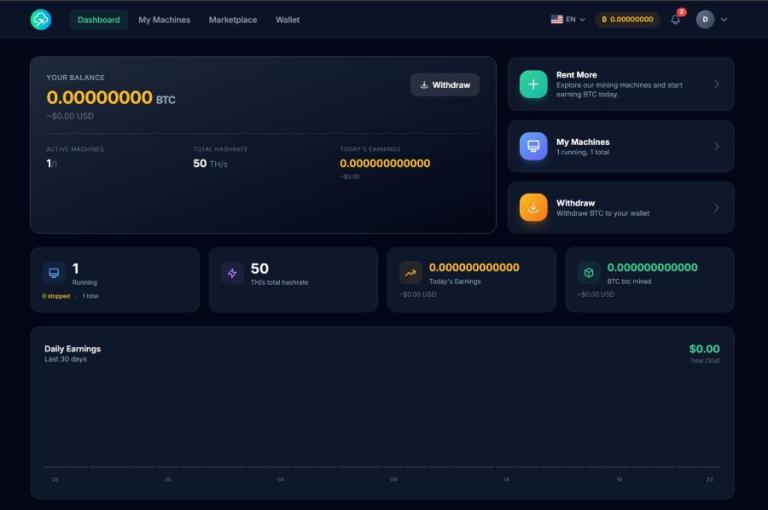
The data in the sections above is exactly how we pick what to mine — and our fleet is optimized end-to-end for BTC. Rent a Bitcoin miner and let the capex-to-liquidity advantage run for you, not against you.
When altcoin mining actually wins
Honesty matters. There are scenarios where an altcoin briefly beats Bitcoin on a revenue-per-watt basis, and ignoring them would undermine everything else in this article.
Post-launch difficulty gaps
When a new PoW coin launches (Kaspa in 2022 is the canonical example), network hashrate lags behind price discovery for weeks or months. Early miners enjoy an outsized reward — until the next generation of specialized hardware arrives and normalizes hashprice back to baseline.
Niche algos without ASIC saturation
A handful of coins — Monero being the notable case — explicitly resist ASICs through algorithm changes. GPU miners there can earn meaningful revenue because the field is not dominated by industrial capital. The trade-off is permanent uncertainty about the next fork.
A conviction bet on a specific chain
If you genuinely believe a chain will appreciate 10x and you want to accumulate the native coin at below-market cost, mining it makes sense as a thesis-driven acquisition strategy. That is a fundamentally different activity than running a mining business for yield, and it should be sized accordingly.
Everywhere outside those three pockets — which is to say, in the steady-state world that drives quarter-over-quarter profitability — Bitcoin is the default. Default, not trivial. The math has to keep working, but it does.
Why NoxHash mines Bitcoin only
Our Kazakhstan facility is optimized end-to-end for SHA-256: power contract, cooling profile, firmware stack, pool integration, technician playbooks. Every one of those optimizations has a marginal cost to maintain. Splitting the fleet across altcoins would dilute that focus without a proportional upside — we would run a worse Bitcoin operation and a mediocre altcoin operation at once.
The alternative we've picked is cleaner: we mine only BTC, pay out only BTC, and let our users decide what to do with those satoshis. If a user wants exposure to LTC, KAS, or any other asset, the BTC payout can be swapped on any major exchange in minutes — at BTC's world-leading liquidity, not at an altcoin's haircut. Mine at the highest-hashprice asset, exit at the deepest-liquidity asset, and convert on demand. That sequence is hard to beat.
Frequently asked questions
Is Bitcoin always the most profitable coin to mine?
Not always — a newly launched PoW coin can briefly outpace BTC on hashprice before difficulty catches up. But across quarters and years, the combination of hashprice leadership, deep liquidity, and predictable issuance makes BTC the consistent winner for industrial miners.
What about Dogecoin or Litecoin?
LTC and DOGE run on Scrypt, a different algorithm. You cannot mine them with a SHA-256 ASIC like an Antminer S21 — you would need Scrypt-specific hardware. They are a separate capital decision, not a coin switch, and they have their own liquidity and hashprice economics to evaluate independently.
Does merge mining change the math?
Merge mining (Namecoin, Elastos, RSK) lets SHA-256 miners earn extra rewards alongside BTC at near-zero marginal effort. It's additive, not substitutive — typically a few percent of BTC revenue in good periods. Welcome bonus, but it does not displace Bitcoin as the primary revenue engine.
Can I still mine Ethereum?
No — Ethereum transitioned to Proof-of-Stake in September 2022 and is no longer mineable. ETH-classic forks like Ethereum Classic still use PoW, but their hashprice and liquidity are a small fraction of Bitcoin's. Former ETH GPU miners have largely migrated to other coins or sold their rigs.
Are private-coin rewards actually higher?
Monero and Zcash sometimes post competitive revenue-per-watt on niche hardware, especially CPU mining for Monero. The catch is exit risk: privacy coins face active exchange delisting, regulatory friction, and thin fiat-pair liquidity, which can trap otherwise-profitable revenue at withdrawal time.
Where can I see live hashprice data?
Hashrate Index publishes a free BTC hashprice tracker with historical charts. For price and market cap, CoinGecko and CoinMarketCap both provide real-time Bitcoin data and orderbook depth across major exchanges — useful for sanity-checking any mining-ROI assumptions before committing capital.
Will halvings eventually make BTC unprofitable to mine?
Every halving cuts block subsidy by 50%, but historically BTC price has risen and transaction fees have grown to offset the drop within 12–18 months. The trend is toward fee revenue becoming a larger share of miner income — planning for that transition is the real long-horizon profitability question.
Not investment advice
This article is informational only. Hashprice, coin prices, and network difficulty change constantly; figures cited reflect early 2026 conditions and will shift. Crypto mining carries market, regulatory, and technical risks. Do your own research and only allocate capital you can afford to lose.