How to Decide When to Rent More Mining Power — A Framework
The 5 signals that mean it's time to add rented hashrate — data maturity, income stability, term discount opportunity, regime shift, and the red-flag checks that say "wait".

Scale your rented hashrate on evidence, not enthusiasm. You are ready to add mining power when five structural signals line up at once: at least two full monthly cycles of clean data, realized output inside the 115–125% target range, cashflow-independence from the rental revenue, a flat-to-rising BTC tape, and an approaching term-discount window. Miss any one, and the right answer is to wait. This article is the decision framework for renters who already have one contract running and are weighing the next step.
The Scale-Up Trap
Most cloud mining losses do not happen at entry. They happen at expansion. The user who quietly ran a $50 Standard rental for 30 days, saw a clean payout, and then doubled — or tripled — the position right into a regime shift is the one who ends the quarter down 25% in USD terms, staring at a long-term contract that cannot be unwound. The entry decision is usually small enough to be a rounding error. The scale-up decision is usually where the real capital goes.
The instinct to scale comes fast. One good month feels like a signal, especially when BTC has been flat or drifting up. But one month is one data point, and mining revenue is noisy enough that one data point above the target range tells you almost nothing about the next one. Professionals distrust single observations. Amateurs treat them as confirmation.
The right question is not "does my gut say scale?" — it almost always does after a green month. The right question is "do the structural signals support scaling, and are any of the red flags present?" This article gives you five green-light signals, four red-light signals, and a concrete incremental path so the next decision is mechanical, not emotional.
The Five Green-Light Signals for Scaling Up
Each of the five below is independently necessary. All five together are a reasonable sufficient condition for a small incremental add. If even one is missing, the correct move is to wait one more cycle — the platform is not going anywhere, and the cost of waiting is at most one month of opportunity.
Green 1 — Two full monthly cycles behind you
At least 60 days of real payout data on the current rental, ideally spanning one difficulty adjustment and a 5%+ BTC move in either direction. One month is a data point; two months is the beginning of a distribution. You scale on distributions, not points.
Green 2 — Realized output in the 115–125% range
Average of the two cycles, in USD-equivalent at period-end price, lands inside or above the target band. If you are below, scale reduces expected value. If you are at 150%, something unusual drove the month and is unlikely to repeat — also not a scale signal.
Green 3 — You don't need the USD revenue
Rent is paid, bills are paid, and you have emergency savings intact — none of them depend on the mining payout. Revenue you rely on is revenue you cannot afford to see halve in a drawdown. Cashflow-independence is the precondition for a longer, bigger commitment.
Green 4 — BTC is flat-to-rising, not in a visible downtrend
Weekly closes above the 50-day moving average, or at worst ranging sideways. Scaling into a confirmed downtrend means you are doubling a USD cost while USD output is falling — the structural opposite of averaging into spot. Wait for the tape to stabilize.
Green 5 — A term-discount window is approaching
Your current 1-month contract is near its end and you are considering whether to re-up. That is the natural moment to evaluate the 6-month (10%) or 12-month (15%) term discount — especially just after a difficulty adjustment has stabilized the network, or well ahead of an expected halving when hashrate supply is still rational. Scaling and term-upgrading at the same natural inflection point is cheaper than doing them separately.
Notice what is not on this list: BTC price being near all-time highs, a viral post about mining, a friend who just scaled, or a new machine generation at the data center. Those are noise. The five above are observable in your own data and your own finances, which is exactly why they are reliable. If all five are green, the incremental add is justified. If four are green, wait.
The Four Red-Light Signals That Mean Wait
These are not the mirror image of the green signals — they are independent disqualifiers. You can have all five greens on paper and still have one of these reds, and the red wins. Scale-up is easy to postpone; bad scale-up is extraordinarily hard to reverse.
Red 1 — You are scaling because of one outlier month
Recency bias is the single most common scale-up mistake. A month that came in at 140% of the target range is not a new normal — it is a favorable tail on a noisy distribution. Mining output reverts to the mean. Sizing up off a tail is the fastest way to overpay at the worst possible time.
Red 2 — You are trying to catch the bottom
BTC has dropped 30% and the pitch you are telling yourself is "hashprice is low, rental fees are the same, this is when miners buy." That is a valid thesis for the industry — and a terrible one for a retail renter locked into a fixed USD cost. Let the bottom form first. The discount does not disappear if you wait a month.
Red 3 — The scale-up requires debt or savings
If you have to put the deposit on a credit card, or pull from an emergency fund, or "just this once" from rent money, the position is already too big regardless of what the signals say. A speculative mining rental financed at 20%+ APR is an almost guaranteed losing trade in nominal terms. Size down until it fits within excess cash.
Red 4 — You lack the monitoring discipline
You barely check the dashboard now. Adding a second contract means tracking two payout streams, two expiration dates, and two sets of running/stopped statuses — a real operational step up. If you have not logged in for 10 days, scaling doubles something you are not watching. Build the habit first.
The shared thread across all four reds: they are all ways that scaling feels cheap from inside the moment — one outlier looks like trend, a drop looks like opportunity, a credit line looks like free money, and an unmonitored contract looks like it runs itself. The cost of each mistake shows up weeks later, when reversing is expensive. Naming them in advance is the cheapest defense available.
Run your own five-green, four-red check on a live account
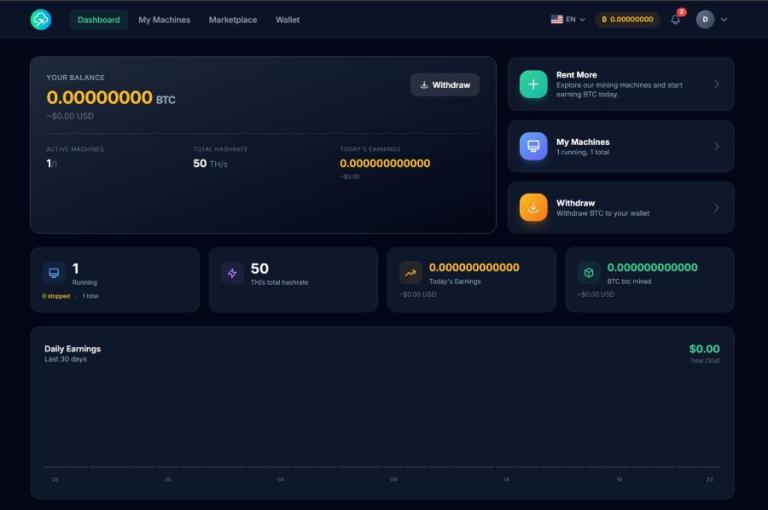
The framework above only works if you can actually pull the numbers — realized output per cycle, average versus 115–125% target, contract expiry date, next term-discount tier. A NoxHash account gives you all of that in one dashboard, including the 30-day payout chart that makes Green 1 and Green 2 visible at a glance. Open the dashboard first, then use it to run the decision — the tool exists specifically to keep scale-up decisions on evidence.
How to Scale Correctly — Layer, Don't Replace
Suppose all five greens are green and no reds are flashing. The next question is not how much more but how to add it. The default instinct is to replace the current contract with a bigger single unit — the $50 Standard becomes a $100 Pro, one rental line on the dashboard, one expiry date. That is almost always the wrong structure.
Prefer layering: add another of the same tier rather than replacing it with a larger one. If you are running one Standard ($50/mo, 150 TH/s), the correct scale-up is adding a second Standard — two units of 150 TH/s, $100 total, staggered start dates. Not a single 350 TH/s Pro. The hashrate totals are similar, the monthly cost is the same, but the risk profile is very different.
Why layering beats replacement:
- Staggered expiry dates — your two Standards end 60 days apart, so every renewal decision is a small one. A single Pro means one big decision once per term.
- Partial exit optionality — if conditions turn mid-quarter, letting one of two contracts expire halves your exposure. Letting half of a single Pro expire is not an option.
- Easier downside sizing — a single 10% BTC drop hits one Standard-sized position in half-steps, not one Pro-sized position in one step. Cognitive load matters when things move fast.
- Same underlying hardware — NoxHash operates the same Antminer S21 class fleet across tiers; what you "give up" by not going Pro is a small efficiency bump on paper that your dashboard will never let you isolate in practice.
The only time replacement beats layering is when you have already been through a full year with two or three staggered contracts and want to consolidate for operational simplicity — a decision you cannot honestly reach from a single completed cycle. If you are still early, count up. If you have run the system long enough that "operational simplicity" is a real concern, then tier-up can follow.
Three Scaling Axes — Tier-Up, Term-Up, Count-Up
Every scale-up decision actually moves along one of three axes, and it helps to name them separately before combining them. Most users should count-up first, term-up second, and tier-up last — the order maps onto increasing irreversibility.
| Axis | What it changes | Risk signature | When to use |
|---|---|---|---|
| Count-up | Volume only — keep tier and term, add another unit | Lowest: same risk profile, more of it | Default scale-up move, first 6–12 months |
| Term-up | Lock a longer term for the 5/10/15/20% discount | Medium: lose reversibility, gain price | After 2+ clean cycles, stable tape, no cashflow dependency |
| Tier-up | Move to a bigger single unit (Standard → Pro → Enterprise) | Highest: concentration + lumpier decisions | Only after multi-quarter experience at lower tiers |
The operational version of the rule: never combine more than one axis in a single step. Going from "1 Standard, 1-month" to "2 Standards, 1-month" is count-up only — safe. Going from "1 Standard, 1-month" to "1 Pro, 12-month" is simultaneously tier-up and term-up — you have taken two irreversibility steps at once, and if either was wrong you cannot unwind. Do one thing, observe a cycle, then do the next.

A Concrete 18-Month Scale-Up Path
Everything above, assembled into one specific example of how a disciplined renter moves from a first $20 position to a multi-unit portfolio. The numbers are illustrative — your own timing depends on your realized data and the macro regime — but the shape is what matters: small early steps, one axis at a time, layered rather than replaced.
Month 1 — Basic $20, 1 month
Single Basic Miner on the shortest term. Full cycle runs, first withdrawal executed, 2FA enabled with recovery codes stored offline. Goal of the month is one clean payout chart and a first feel for variance — not optimization.
Month 3 — Add Standard $50, 1 month (count-up)
Two clean cycles of Basic behind you, realized output inside the target band. Add a Standard at 1-month to scale volume without committing term. Total spend $70/mo, two payout streams, two expiry dates staggered roughly 60 days apart.
Month 6 — Keep Basic, renew Standard as 6-month (term-up)
Basic stays on its 1-month drumbeat. The Standard, now with three good cycles of data, rolls into a 6-month term at the 10% discount — effective $45/mo on that unit. One axis moved (term), one axis untouched (count), tier left alone.
Month 12 — Add a Pro 3-month (careful tier-up)
The 6-month Standard has closed cleanly. Hashprice and on-chain indicators look stable. Add a single Pro on a conservative 3-month term — first tier-up of the journey, but paired with the shortest non-monthly term available. The Basic and the renewed Standard continue alongside it.
Month 18 — Consider a 12-month Pro only if regime supports it
By now you have 18 months of real data across three contract types. If BTC trend is intact, network hashrate is rational, and your cashflow-independence has widened rather than narrowed, a 12-month Pro at the 15% discount is a defensible next step. If any of those has weakened, hold the existing stack and wait. There is no deadline.
The path above is deliberately slow — 18 months from Basic to a long-term Pro, with four distinct decision points. Compare that to the common retail path of month-one Pro on a 12-month term: same end state on paper, but one irreversible step instead of four reversible ones. When something goes wrong, the difference between those two shapes is the entire trade.
Start at Month 1 of the path, not Month 18
The 18-month scale-up above has a first step — a single Basic Miner on a 1-month term, which is also the lowest-risk way to earn the data the rest of the framework needs. You cannot evaluate Green 1 or Green 2 without one completed cycle in the account, and that cycle begins the moment you register and rent your first unit. Every later decision gets cheaper once there is a live payout chart to reason from.
Frequently Asked Questions
For live hashprice context while running the framework, Hashrate Index publishes a daily hashprice curve, and CoinGecko is a reliable source for BTC price and market trend. Both are free and require no account.
Is it ever right to scale aggressively after one great month?
Almost never. One month is one noisy data point; aggressive scaling on it is sizing into a favorable tail that tends to revert. The only defensible aggressive move is a small count-up (one additional Basic or Standard) — never a tier jump plus a long-term lock in the same step, no matter how good the month looked.
What's the "right" total budget for cloud mining once I'm scaling?
A working rule: cloud mining exposure stays inside roughly 5–20% of your investable crypto capital, and the monthly rental cost never exceeds what you can comfortably fund from excess cash. If scaling pushes you past either limit, you are sizing to a market story instead of to your own balance sheet — exactly when the red flags activate.
Should I scale into a halving?
Not right before — block rewards halve overnight, while rental fees do not. Historically the stronger revenue window has been several months after a halving, once difficulty has repriced and hashprice has stabilized. If you want halving-cycle exposure, scale into the stabilization, not into the event itself.
Can I downgrade mid-contract if I scaled too aggressively?
No. Rental terms at NoxHash are locked for the period you committed to at the discounted price — this is precisely why count-up layering on short terms is the safer scaling primitive than a single long-term tier-up. If you over-committed, the only real option is to let the contract run to term without adding further, and learn from it.
How much should I scale in each step?
A useful heuristic: each step adds at most one equivalent unit of the current largest tier in your portfolio. If you are running two Standards, the next safe add is a third Standard or a first Pro — not jumping to Enterprise. Step size grows as the base grows; it does not lead the base.
Do multiple rentals on one account change the risk profile?
Operationally, yes — more expiry dates, more running/stopped toggles, more dashboard attention. Structurally, no — the underlying BTC price, difficulty, and platform risks are the same across units. Layering reduces timing risk on each individual contract but does not diversify away the shared market exposure.
What if BTC goes up 50% while I'm waiting for signals to turn green?
Your existing rental captures most of that move already — mined BTC rises in USD terms regardless of whether you added a second contract. The "missed" upside on the unowned second unit is usually much smaller than the loss would have been had the tape turned and you had scaled early. Patience costs less than it feels like.
Educational content — not financial advice
This article is a decision framework, not a recommendation to scale any specific position. Target ranges (115–125% of rental fee), tier pricing, term discounts, and the 18-month path above reflect April 2026 NoxHash conditions and general risk-management practice — they are not a guaranteed outcome. Cloud mining carries market risk (BTC price, network difficulty, halving events), operator risk, and regulatory risk that vary by jurisdiction. Past performance does not predict future results. Only commit funds you can afford to lose entirely, and consult a qualified crypto-aware accountant about local tax treatment before scaling a position.