When Cloud Mining Loses Money — Real Scenarios Explained
Three month-by-month scenarios where cloud mining goes underwater — cycle-top entry, post-halving difficulty spike, and a locked 12-month bear contract.

Cloud mining loses money when the USD value of mined BTC drops below the fixed rental fee — usually because of a BTC price crash, a network difficulty spike, or both at once. Three concrete scenarios below walk the math month by month: entering at a cycle top, getting caught in a post-halving difficulty surge, and sitting inside a prepaid 12-month contract during a deep bear. Real numbers, no hand-waving.
The Conditions Where Cloud Mining Actually Loses Money
Before walking the scenarios, lock down the mechanics. Cloud mining loses money when monthly gross USD output drops below the monthly rental fee. That is the whole picture. The rental fee is a fixed USD line — $20, $50, $100, $250 depending on tier — and it does not adjust when BTC falls or difficulty climbs. Gross output, by contrast, is a product of three moving parts: your rented TH/s (fixed), the daily hashprice per TH (floating), and the number of days in the month (nearly fixed).
Three independent forces can push gross output underwater. Any one of them is enough. Two in combination is what most losing contracts look like.
BTC price drawdown
The same number of sats is worth fewer dollars. A 40% BTC drop cuts your USD gross by roughly 40%, on a fee line that does not move.
Difficulty spike
Each TH/s mines fewer sats as global hashrate climbs. A 25% difficulty surge shaves roughly 20% off your BTC output with zero BTC price change.
Contract lock-in
A prepaid 12- or 24-month rental cannot be refunded mid-term. Once the market turns, you are paying through the entire drawdown whether you like it or not.
The April 2026 baseline numbers for the scenarios below: global hashrate around 1 ZH/s, difficulty near 135 T, block reward fixed at 3.125 BTC since the 2024 halving, and hashprice trading in a ~$30–$55 per PH/s/day band per the Hashrate Index hashprice chart. The mid-range is about $40/PH/s/day. Scenarios start from that anchor and compress downward.
Scenario A — You Rented at the Cycle Top
Alex opens a Standard Miner rental on day one of month one: 150 TH/s at $50/month, 3-month term, no discount. BTC is $110k that morning. Hashprice reads $42/PH/s/day. The forecast on the dashboard shows roughly $190 gross for the month, a comfortable $140 net after the rental fee, well inside the 115–125% target range. Alex funds $150 in USDT, covering the full three months up front.
The local top was two days earlier. Over the next 90 days, BTC falls 40% — a textbook post-top drawdown — while difficulty and network hashrate hold roughly flat. Hashprice compresses proportionally to around $25/PH/s/day as the USD value of the same mined sats drops.
| Month | Hashprice (USD/PH/day) | Gross USD output | Rental fee | Monthly net |
|---|---|---|---|---|
| Month 1 (BTC −15%) | ~$36 | ~$162 | −$50 | +$112 |
| Month 2 (BTC −30%) | ~$30 | ~$135 | −$50 | +$85 |
| Month 3 (BTC −40%) | ~$25 | ~$112 | −$50 | +$62 |
| 3-month total | — | ~$409 | −$150 | +$259 nominal |
At first glance, the table looks fine — nominally positive every month. This is where the loss hides. The expected outcome, had the contract started in a flat tape, was roughly $420 net over three months ($140 × 3) on $150 paid. What Alex actually realized was $259. That is a $161 shortfall against expectation, or about 38% below the forecast that closed the deal.
There is a second layer too. Alex is holding BTC, not USD. The mined BTC accumulated during those three months was received at progressively lower prices, and if held unsold through the drawdown, its mark-to-market value at the end of month three is lower than its value at each moment of receipt. Nominal USD output was positive; economic return versus initial expectation was deeply negative. A renter who defined "profit" strictly by the monthly net column would call this a winning contract. A renter who defined it by "am I better off than if I had kept my $150 in USDT" would call it a loser — because the $150 in USDT would have bought more BTC at the bottom than Alex's rental generated across the whole period.
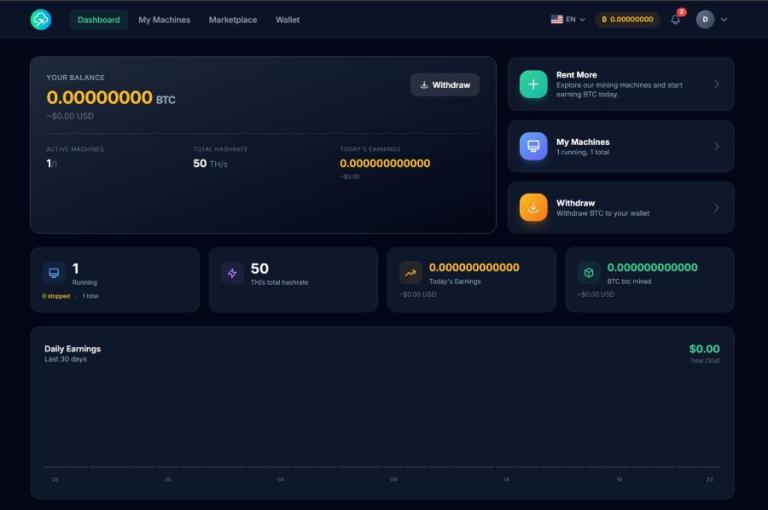
The dashboard experience during Scenario A is psychologically brutal. The BTC balance column grows every minute — the rigs are working fine. The USD equivalent column crawls sideways or falls. The 30-day earnings chart tilts down even though the rental is "performing." This is the specific texture of a cycle-top entry, and it is by far the most common way a cloud mining contract disappoints its renter.
Scenario B — Post-Halving Difficulty Spike, Flat BTC
Blair takes the same Standard Miner but on a 6-month term with the 10% discount — $45/month effective, $270 prepaid. BTC price is flat the entire time, bouncing in a narrow 5% range. Difficulty, however, climbs hard: fresh S21 fleets come online through the period, and global hashrate rises roughly 25%. Hashprice compresses from $42 to $28 per PH/s/day as the network splits the same BTC output among more TH/s.
This is the scenario that surprises people most, because BTC price — the variable everyone watches — never moved. The damage came from the difficulty side of the equation, which most renters do not think to check daily.
| Month | Network hashrate | Hashprice (USD/PH/day) | Gross output | Net (after $45 fee) |
|---|---|---|---|---|
| Month 1 | 1.00 ZH/s | ~$42 | ~$189 | +$144 |
| Month 2 | 1.05 ZH/s | ~$40 | ~$180 | +$135 |
| Month 3 | 1.10 ZH/s | ~$37 | ~$167 | +$122 |
| Month 4 | 1.15 ZH/s | ~$34 | ~$153 | +$108 |
| Month 5 | 1.20 ZH/s | ~$31 | ~$139 | +$94 |
| Month 6 | 1.25 ZH/s | ~$28 | ~$126 | +$81 |
| 6-month total | +25% | — | ~$954 | +$684 (realized) |
Every single month was nominally profitable. Blair never saw a negative row. And yet the contract is still a disappointment relative to expectation. A flat-tape projection at month-one hashprice would have estimated $864 net across six months ($144 × 6) on $270 paid. The realized figure is $684 — a $180 shortfall, almost a full month of expected returns evaporated. Return on rental landed near the low end of the 115–125% target band instead of comfortably above it.
This is the slow-bleed loss. BTC never crashed. The facility never went down. The rental kept "working." But the network around it changed, and the renter absorbed the entire difference because the rental fee is a fixed USD line that does not negotiate with network conditions. Scenario B is the case renters should be most alert to across a multi-month term — especially any term that straddles the year after a halving, when newly-ordered fleets are the biggest single driver of difficulty pressure.
Watch one month of real output before you commit a single USDT
Scenarios A and B both share one lesson: a losing contract reveals itself first on the dashboard, not the spreadsheet. NoxHash's 2-day Basic Miner trial shows live hashrate and USD-equivalent earnings with no deposit. Learn the screens now, so you can recognize a soft month early — before locking into a long term that you cannot unwind.
Scenario C — The Locked 12-Month Contract Through a Full Bear
Casey takes the most aggressive path: a Pro Miner (350 TH/s, $100/month nominal) on a 12-month term with the 15% discount — $85/month effective, $1,020 prepaid up front. The logic on day one was defensible: the 12-month discount is meaningful, Casey is a long-term BTC believer, and the plan is to accumulate BTC through whatever the market does. What the plan did not price in was a cycle-top entry combined with a difficulty-competitive environment — the exact trap for committed long-term renters.
Year opens near the local BTC high. By month 4, BTC has drifted down 25%. By month 7, it is 60% off the opening high as the bear deepens. Hashprice compresses from $42 down to about $22 per PH/s/day — a 48% drop — as both halves of the hashprice equation (BTC price and network activity) work against renters simultaneously.
| Month | BTC vs open | Hashprice (USD/PH/day) | Gross output (350 TH/s) | Net (after $85) |
|---|---|---|---|---|
| Month 1 | flat | ~$42 | ~$441 | +$356 |
| Month 3 | −15% | ~$35 | ~$368 | +$283 |
| Month 5 | −35% | ~$28 | ~$294 | +$209 |
| Month 7 | −60% | ~$22 | ~$231 | +$146 |
| Month 9 | −55% | ~$24 | ~$252 | +$167 |
| Month 12 | −45% | ~$27 | ~$284 | +$199 |
| 12-month realized | −45% | — | ~$3,620 | ~$2,600 net (USD-equiv) |
Summed over 12 months, Casey collected roughly $2,600 net USD-equivalent of BTC on $1,020 rental paid. The forward projection at open, using the month-one hashprice of $42 sustained flat, would have been about $4,272 net ($356 × 12). The realized-versus-expected gap is about $1,670, or roughly 39% below plan. Worse, Casey accumulated the BTC progressively through a drawdown — unrealized gains recovered somewhat by month 12 but not back to opening levels, so the mark-to-market value of the stacked BTC is weaker than the nominal USD-equivalent line suggests.
And here is the defining feature of Scenario C: there is no exit. The $1,020 was prepaid at rental start. Cloud mining rentals are not money-market positions; once committed, the contract runs to term. Casey could stop the miner mid-contract to avoid further output volatility — but the prepaid fee was already consumed, so that is strictly a psychological move, not a financial one. The 12-month term that looked like a 15% bargain on day one became a 12-month lock-in through a bear that a 1- or 3-month renter would have exited and re-entered at much better pricing.

What Losing Actually Looks Like on the Dashboard
One reason loss scenarios surprise renters is that the dashboard never "looks broken" during a losing contract. The hashrate line is steady. The BTC balance still ticks up every minute. The miner card still says "Running." Everything the operator controls continues to work correctly. The loss shows up in places most users do not train their eye to watch.
USD equivalent flat while BTC balance grows
The BTC column keeps climbing, but the "USD" column next to it is sideways or down. Same sats, fewer dollars. This is the earliest signal of a cycle-top-entry scenario.
30-day chart tilts down despite full uptime
The earnings chart trends lower month over month even though the miner never paused. That is difficulty or hashprice compression, not hardware failure. The operator cannot fix this.
Return on rental below 115%
Running your own month-end math and finding that net USD return fell under the lower bound of the target range is the quantitative version of "this month was soft." One soft month is normal. Three in a row is the scenario.
Global difficulty climbs on Blockchain.info
Independent of what your dashboard shows, the network difficulty chart (public data) can confirm a Scenario B condition — rising hashrate is objective, verifiable, and tells you the squeeze is macro, not a platform issue.
Normalize this: losing months are not rare and do not necessarily mean the platform is broken or that you made a catastrophic mistake. The 115–125% target range is a target, not a guarantee — it assumes typical network conditions. Atypical months (cycle tops, post-halving difficulty sprints, hashprice lows) fall outside that band by construction, and it is normal for a multi-month contract to include at least one. The mistake is assuming every month will be 120% and acting shocked when reality delivers 95%.
How to Limit Damage When a Contract Starts Going Underwater
If you are reading this mid-contract because something feels off, the decisions below are the short list. None of them reverses the loss — that is impossible once market conditions have moved against a fixed-fee rental — but each of them prevents the loss from becoming larger than necessary.
Do not add more rented hashrate to "average in"
The temptation during a drawdown is to rent a second plan at lower hashprice to lower your blended cost basis. In practice this doubles your fixed USD exposure to a market that is already moving against you. Averaging in works for holding an asset, not for committing to monthly fees on a declining output.
Switch to a BTC-accumulation mindset, not a USD P&L panic
If your conviction is long-term BTC, your measurement unit during a bear should be sats accumulated, not dollars. The contract keeps delivering the former even when the latter looks ugly. Renters who flip frames during drawdowns usually make the worst decisions of the cycle.
Do not withdraw at the worst moment
Panic-withdrawing BTC at a local bottom, paying the 1.5% fee, and selling to USDT crystallizes the loss. If the original thesis was multi-year BTC accumulation, let the stack sit. The withdrawal decision should be driven by your custody plan, not by the dashboard color that month.
Plan the next contract more defensively
The fix for a cycle-top-entry scenario is not to undo this contract — it is to refuse to repeat the same entry conditions next time. Shorter terms (1–3 months) when the tape is unclear, Basic/Standard tiers instead of Pro/Enterprise until a full cycle of real data is observed, and a rule to wait out the first month of any obvious downtrend before re-renting.
None of these four decisions requires special skill or timing. They require, mostly, refusing to make a second mistake on top of the first. A disappointing contract that is allowed to run to term and feeds into a more disciplined next contract is, across cycles, how serious renters outperform the "just send it" crowd.
Apply the "next contract, more defensively" rule in practice
The lesson from all three scenarios is the same: scale up only after one honest cycle of real data. Start with the 2-day free trial on Basic Miner (50 TH/s, no deposit), then — if the dashboard behavior and math line up with your expectations — step up to a 1- or 3-month Basic or Standard rental. The 12-month Enterprise lock-in is not the starting position.
Frequently Asked Questions
Can I exit a cloud mining contract early if it is losing money?
No. On NoxHash the rental fee is prepaid at contract start and cannot be refunded mid-term. You can stop the miner at any time, but the fee is already consumed — stopping is a psychological move, not a financial one. This is why matching term length to your conviction horizon matters so much on day one.
What if BTC recovers right after my contract ends?
If you kept the mined BTC in your wallet rather than selling at the bottom, a recovery repairs the USD math without requiring any action. The accumulated sats revalue upward. If you already withdrew and sold to USDT, the recovery is out of reach — which is why the custody decision during a drawdown often matters more than the contract decision.
Should I switch to a shorter term in the middle of a bear market?
You cannot convert an existing long term to a short one — the rental is one contract at a fixed length. What you can do is let the current term finish, skip a month to observe the tape, and then re-enter with a 1- or 3-month rental instead of re-committing to 12 months at the same entry point. Short-term rentals give up discount but buy flexibility during uncertain markets.
Does NoxHash refund or adjust the fee if I am underwater?
No cloud mining operator that runs real hardware can adjust rental fees to BTC price moves — the facility cost structure is in USD and does not flex. NoxHash takes hardware, power, and uptime risk; the renter takes market risk. A platform that promises to absorb market losses on your behalf is either misleading marketing or insolvent on the next crash.
How do I tell whether the issue is market conditions or a platform problem?
Cross-check against public data. If BTC is down sharply or global hashrate is climbing fast, the softness is macro — every cloud miner is feeling it, and your dashboard is behaving correctly. If your hashrate line is actually failing or your BTC balance is not accruing while public hashprice is normal, that is operational and worth a support ticket immediately.
Is there a "safe" time to start a 12-month contract?
There is no guaranteed safe window — cycle tops are only obvious in hindsight. A defensible heuristic: avoid opening a 12-month term immediately after a strong rally into new highs, and prefer openings after BTC has already experienced a visible drawdown and stabilized. Short-term rentals during uncertain tape, long terms only after a confirmed base has formed.
If I lose money on one contract, does that mean cloud mining does not work for me?
Not necessarily. A single losing contract during a cycle-top entry or a difficulty sprint is a normal outcome, not a verdict on the model. The honest question is whether the overall sequence of your contracts across a full cycle — including both strong and weak phases — lines up with your goals. Judging cloud mining from a single month is like judging stocks from a single week.
Illustrative scenarios — cloud mining can and does lose money
Every table, hashprice figure, and month-by-month projection in this article is illustrative and reflects April 2026 network baseline conditions (hashrate ~1 ZH/s, difficulty ~135 T, block reward 3.125 BTC, hashprice band ~$30–$55/PH/s/day). Real contract outcomes depend on BTC price, network difficulty, hashprice, and personal timing — all of which are volatile, outside any operator's control, and can move harder against you than the scenarios modeled here. The 115–125% target range is a conservative operator-side target, not a guaranteed return. Past market cycles do not predict future ones. Cloud mining carries genuine market, counterparty, regulatory, and tax risk that varies by jurisdiction. Only commit funds you can afford to lose, consult a qualified crypto-aware accountant about your local tax treatment, and treat every projected number in this article as education, not advice.