What Is USDT (Tether)? A Complete Guide for Crypto Beginners
USDT is the world's largest stablecoin, pegged 1:1 to the US dollar. Learn how Tether works, its reserves, TRC-20 vs ERC-20, and why it powers crypto on-ramps.
USDT (Tether) is a stablecoin pegged 1:1 to the US dollar, issued by Tether Limited and backed by a reserve of cash, US Treasury bills, and other assets. With a market cap near $188 billion as of April 2026, USDT is the largest stablecoin in crypto — used daily for trading, remittances, and funding services like cloud mining deposits without touching a bank.
Why stablecoins exist — and where USDT fits
Bitcoin can move 10% in an afternoon. That volatility is great for traders, but terrible for paying rent, sending a remittance, or parking profits between trades. Stablecoins solve that problem by pegging their value to a stable asset — usually the US dollar. When you hold 1,000 USDT, it stays worth roughly $1,000 tomorrow, next week, and next month, regardless of what Bitcoin does.
USDT was the first mainstream stablecoin, launched in 2014 under the name Realcoin before rebranding to Tether. Today it is the single most-used asset in crypto: according to data aggregators, around 80% of all trades on centralized crypto exchanges involve stablecoins, and USDT alone accounts for roughly 58% of the total stablecoin market. It has quietly become the plumbing of the industry — the rail traders, businesses, and platforms settle on when they want dollar value without touching traditional banking.
Stable value
Each USDT tracks $1 within a tiny band (typically ±0.3%), letting you hold dollar value on-chain without converting back to fiat.
24/7 global transfers
Send dollars anywhere in the world in minutes for under a dollar in fees — no SWIFT delays, no banking hours, no intermediaries.
Crypto on/off ramp
Most exchanges and platforms accept USDT for deposits and pay out in USDT, making it the default bridge between fiat and crypto services.
How USDT actually maintains its dollar peg
The peg is not magic — it comes from reserves plus issuance and redemption. When a verified institutional client wires $1 million to Tether Limited, Tether mints 1 million new USDT and sends it to the client's wallet. When a client redeems 1 million USDT, Tether burns those tokens and wires the dollars back. That two-way flow keeps supply matched to real demand.
Market arbitrage handles the rest. If USDT ever trades at $0.99 on an exchange, arbitrageurs buy it cheap and redeem it with Tether for $1, pocketing the difference until price returns to peg. The opposite works at $1.01. In practice, USDT has held within a few tenths of a cent of $1 for almost all of its history, with only brief dislocations during extreme market stress.
What's actually in Tether's reserves?
According to Tether's Q3 2025 attestation report prepared by BDO, reserves totaled roughly $181.2 billion against $174.4 billion in liabilities — a $6.8 billion excess cushion. The composition skews heavily toward low-risk, short-duration US government debt.
| Reserve asset | Approx. value | Role |
|---|---|---|
| US Treasury exposure (direct + indirect) | ~$135B | Core backing — short-term T-bills and reverse repos |
| Gold | ~$12.9B | Diversification against dollar weakness |
| Bitcoin | ~$9.9B | Funded from retained profits, not user deposits |
| Secured loans | ~$14.6B | Over-collateralized lending to vetted counterparties |
| Other investments + corporate bonds | ~$3.9B | Smaller, less liquid positions |
It is worth flagging that Tether publishes attestations — a point-in-time check of reserves by an accounting firm — not a full audit. The distinction matters: attestations confirm balances on a given date, but do not evaluate internal controls the way an audit does. Critics have pushed Tether to move to full audits for years, and in 2021 Tether paid a $41 million CFTC settlement over past reserve disclosures. The current reporting cadence is a large improvement over that history, but perfect transparency it is not.
USDT runs on many blockchains — here's what that means
USDT is not a single token — it's the same logical unit issued natively on more than a dozen blockchains. Each chain has its own version with its own speed, fee profile, and wallet compatibility. Picking the right one for your transfer can mean the difference between $0.10 and $20 in fees.
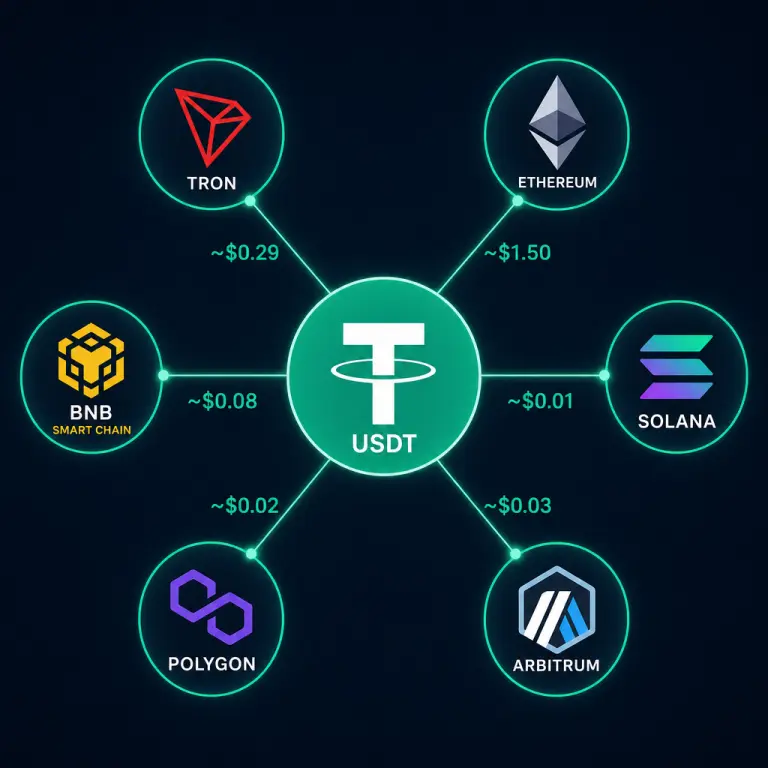
| Network | Token standard | Typical fee | Best for |
|---|---|---|---|
| Tron | TRC-20 | ~$1 | Everyday transfers, exchange deposits — largest share of USDT supply |
| Ethereum | ERC-20 | $2–20 (gas-dependent) | DeFi protocols, institutional settlement |
| BNB Smart Chain | BEP-20 | ~$0.05–0.30 | Cheapest of the mainstream options, Binance ecosystem |
| Solana | SPL | < $0.01 | High-frequency trading, new DeFi apps |
| Polygon / Arbitrum | ERC-20 (L2) | < $0.10 | Ethereum-compatible apps at lower cost |
The single most important rule when sending USDT: the sender's network and the receiver's network must match exactly. If you send TRC-20 USDT to an ERC-20 address, the funds land on Ethereum's address format on the Tron network — usually unrecoverable. Always double-check the network label on both sides of a transfer before confirming.
As of early 2026, Tron hosts the largest share of USDT supply (roughly 46–52% depending on the week), followed by Ethereum in the high 30s percent, with BNB Chain, Solana, and L2s making up the rest. Tron dominates everyday payments because of its low fees and fast finality; Ethereum remains the home of institutional flows and DeFi.
Put your USDT to work in cloud mining
Now that you know what USDT is and which network to send on, fund a NoxHash account in minutes. We accept TRC-20 (~$1 fee) and BEP-20 (~$0.05 fee) — whichever is cheaper for your wallet. Your USDT is converted to BTC mining power the same day.
What people actually use USDT for
USDT is the Swiss Army knife of crypto. Once you have some in a wallet, the use cases are broad:
Trading pair on exchanges
Most top crypto pairs on Binance, OKX, Bybit, and others are quoted in USDT (BTC/USDT, ETH/USDT). Holding USDT between trades avoids fiat conversion fees and keeps funds ready to deploy.
Sitting out volatility
When markets look shaky, traders rotate into USDT to hold dollar value on-chain without moving money back to a bank. You stay liquid and ready to buy the next dip in seconds.
Remittances and cross-border payments
Sending USDT from Vietnam to the Philippines or from Turkey to Argentina settles in under a minute for pennies — versus days and double-digit percentage fees via traditional remittance rails.
Funding crypto services
Cloud mining platforms, trading bots, prediction markets, and DeFi protocols overwhelmingly accept USDT for deposits. It is the fastest way to fund a service without waiting on a bank transfer or card verification.
Dollar access in restricted economies
In countries with capital controls or high inflation (Argentina, Nigeria, Turkey, Lebanon), USDT gives ordinary people access to dollar-denominated savings via a phone — a function traditional banking often cannot provide.
Risks and things to know before holding USDT
USDT is useful but not risk-free. Treat it as a practical tool, not a guaranteed dollar substitute.
Do: match networks on every send
Sending TRC-20 to an ERC-20 address is the most common way users lose USDT. Confirm the network label on both ends every single time.
Counterparty risk is real
USDT's peg depends on Tether Limited staying solvent and honoring redemptions. If reserves were ever inadequate, USDT could lose its peg. Attestations reduce this risk but do not eliminate it.
Freezing capability
Tether can freeze USDT at specific addresses at the request of law enforcement. Well over $2 billion has been frozen historically. This is good for fraud recovery, but it also means USDT is not censorship-resistant like BTC.
Regulation is still evolving
The EU's MiCA regulation and US stablecoin bills are reshaping which stablecoins exchanges can list in which jurisdictions. Some platforms have delisted USDT for EU users in favor of MiCA-compliant alternatives.
USDT vs USDC — a quick comparison
USDC (issued by Circle) is the second-biggest stablecoin and USDT's main competitor. Both track the US dollar; the differences are in transparency, regulation, and regional availability.
| Criteria | USDT (Tether) | USDC (Circle) |
|---|---|---|
| Market cap (Apr 2026) | ~$188B | ~$78B |
| Liquidity / exchange support | Deepest — default quote pair globally | Strong, especially on US venues |
| Reporting | Quarterly BDO attestation | Monthly attestation by Deloitte |
| Regulatory posture | Based outside US, not MiCA-compliant in EU | US-based, MiCA-compliant in EU |
| Strengths | Liquidity, emerging-market adoption, Tron dominance | Regulatory clarity, US banking access |
For most practical purposes — trading, remittances, funding crypto services — either works. Choose USDT when you want maximum liquidity and the widest network of exchanges and services; choose USDC when regulatory alignment matters for your region.
Frequently asked questions about USDT
Is USDT safe to hold?
USDT has held its dollar peg for over a decade and is backed mostly by US Treasuries, but it carries counterparty risk — its value depends on Tether Limited remaining solvent. For short-term holding and transfers it is widely considered safe; for long-term savings, diversify across assets.
What happens if I send USDT on the wrong network?
In most cases the funds are stuck at an address on the wrong chain and are unrecoverable without the receiving platform's cooperation. Always verify the network (TRC-20, ERC-20, BEP-20) matches on both sender and receiver sides before confirming a transfer.
Which USDT network is cheapest to use?
Among widely supported networks, BEP-20 (BNB Smart Chain) and Solana are typically cheapest at under $0.10 per transfer. TRC-20 (Tron) is the most popular at roughly $1 per transfer. ERC-20 (Ethereum) is the most expensive, often $2–20 depending on network congestion.
Can USDT lose its peg?
Yes, briefly. USDT has dipped to $0.95–0.98 during severe market stress events (2018, 2022 Terra collapse, 2023 US banking crisis) but recovered within hours or days. A sustained de-peg would require a reserve shortfall — which reported reserves currently exceed liabilities by several billion dollars.
How do I use USDT to deposit on NoxHash?
Create an account, open the deposit page, choose TRC-20 or BEP-20, enter an amount (minimum $10), and send the exact total shown to the displayed address within 30 minutes. NoxHash converts your USDT to BTC mining power at the market rate the same day.
Educational content — not financial advice
This article explains how USDT works for informational purposes and is not financial, legal, or tax advice. Stablecoins carry counterparty and regulatory risk, and cryptocurrency holdings can lose value. Research Tether's latest attestation reports, check regulations in your jurisdiction, and only allocate funds you can afford to lose.