What Is SHA-256? The Algorithm That Powers Bitcoin
SHA-256 is the cryptographic hash function Bitcoin uses for every transaction, block header, and mining puzzle. Here's how it works and why it stays secure.
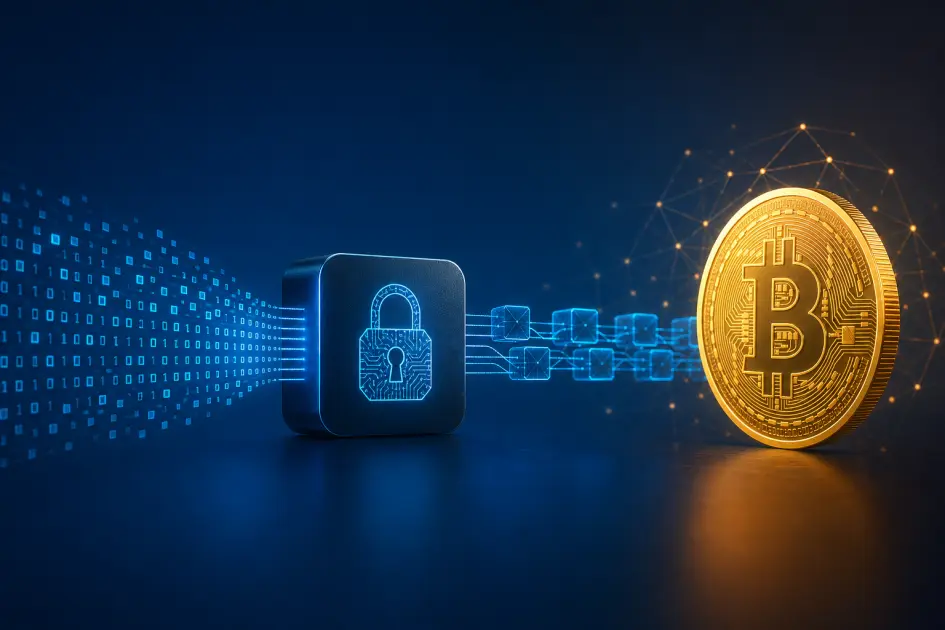
SHA-256 is a cryptographic hash function from the SHA-2 family, used by Bitcoin to turn any input into a fixed-length 256-bit output (64 hex characters). It's the mathematical engine behind every Bitcoin transaction ID, every block header, and every mining puzzle. Designed by the NSA in 2001 and published as a NIST standard, SHA-256 has resisted practical attack for more than two decades.
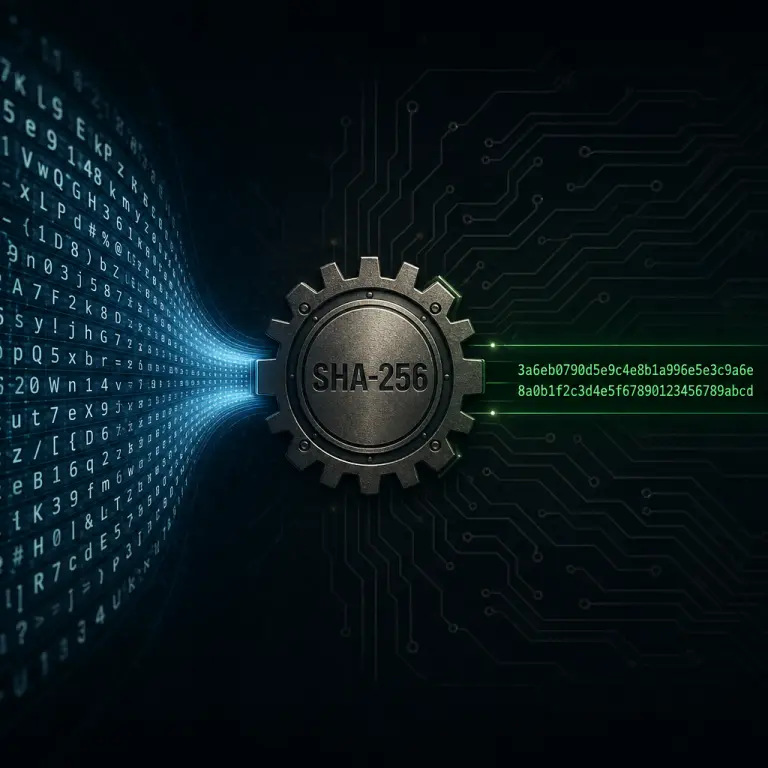
SHA-256 in Plain English
A cryptographic hash function is a mathematical meat grinder: you push data in — anything from a single letter to a 4 GB movie file — and it spits out a fixed-length fingerprint. SHA-256's fingerprint is always exactly 256 bits, which we write as 64 hexadecimal characters for humans to read.
The "256" is the output size in bits. The "SHA" stands for Secure Hash Algorithm. It belongs to the SHA-2 family specified by NIST in Federal Information Processing Standard 180-4, a public standard that tells any two developers on Earth exactly how to compute the same output from the same input.
Here's what it looks like in practice. Feeding the string hello into SHA-256 produces this digest, every time, in every language, on every device:
Input
hello
SHA-256 digest
2cf24dba5fb0a30e26e83b2ac5b9e29e1b161e5c1fa7425e73043362938b9824
Change a single character — feed it Hello with a capital H — and the digest mutates into something that looks totally unrelated. That reliability is what makes SHA-256 useful as a tamper-evident seal: alter even one bit of the input, and the output you get back no longer matches the output everyone else expects.
The Four Properties That Make SHA-256 Useful
Not all hash functions are cryptographic. SHA-256 earns the label by satisfying four properties simultaneously — each one blocks a specific kind of attack. Lose any one of them and the function becomes unsafe for Bitcoin.
1. Deterministic
The same input always produces the same output. Hash hello on a phone in Tokyo or a laptop in Toronto — the 64-character digest is identical. Without this property, network consensus would be impossible.
2. One-way (pre-image resistant)
Given a digest, you cannot reverse-engineer the input. The only known way to find a message that hashes to a chosen digest is brute force — and the search space is 2^256, a number larger than the atom count of the observable universe.
3. Avalanche effect
Flip one input bit and roughly half the output bits change — at random. There's no gradient, no pattern, no way to nudge an input "closer" to a target digest. This is what forces miners to guess one nonce at a time.
4. Collision-resistant
It's computationally infeasible to find two different inputs that hash to the same digest. SHA-256 offers roughly 128 bits of collision resistance per NIST — no known attack has narrowed that in 20+ years of public scrutiny.
Where Bitcoin Uses SHA-256 — Three Places
SHA-256 isn't a minor helper inside Bitcoin — it's the primitive the entire chain is built on. Three specific uses matter, and each one relies on a different combination of the four properties above.
Transaction IDs
Every Bitcoin transaction is identified by the double-SHA-256 of its serialized data. That digest (the "txid") is the unique fingerprint you paste into a block explorer to track a payment.
Block headers & Merkle roots
Every block references the previous block by its SHA-256 digest, creating the "chain" in blockchain. Transactions inside a block are also hashed pairwise up a Merkle tree — the top hash is baked into the header.
The mining puzzle
Mining is the process of running SHA-256 on the block header, twice, over and over, until the result falls below a target number. The winning miner earns the block reward — currently 3.125 BTC.
One detail worth flagging: Bitcoin almost never uses SHA-256 just once. Satoshi chose double-SHA-256 — SHA-256(SHA-256(x)) — for transaction IDs and mining. The doubling adds a modest safety margin against a class of extension attacks and costs almost nothing in compute. From the user's perspective, "Bitcoin's hash function" effectively means "SHA-256 run twice."
Watch SHA-256 run billions of times per second
You've seen the algorithm in theory. The fastest way to see it in practice is NoxHash's 2-day Basic Miner trial — no deposit, no card. Open the CGMiner terminal and you'll watch the real SHA-256 hashrate tick up in TH/s, one double-hash at a time.
The Mining Puzzle in One Sentence
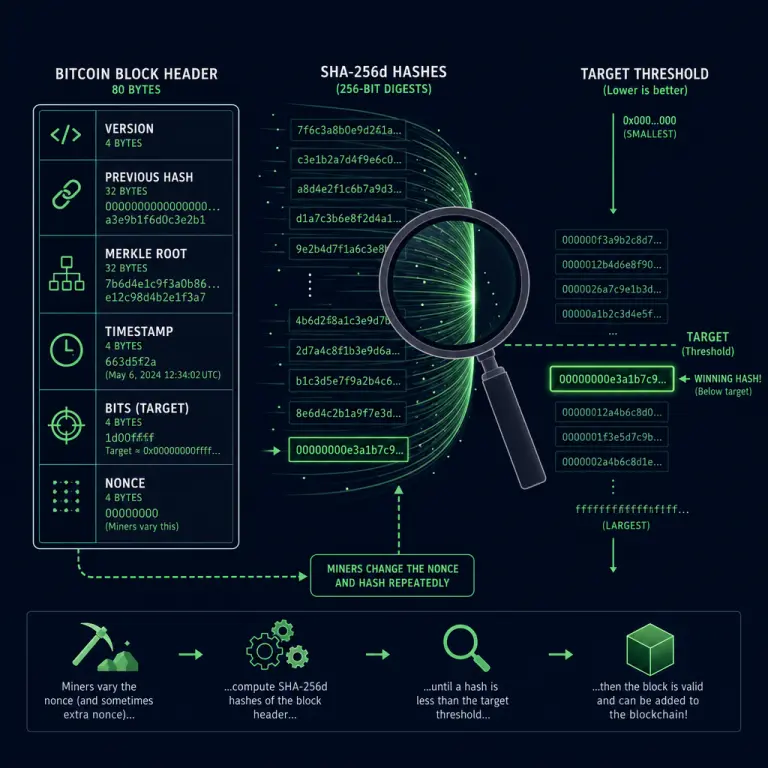
Strip away the marketing and Bitcoin mining boils down to a single arithmetic race: find a number (called the nonce) so that SHA-256(SHA-256(block header)) produces a digest smaller than the current target. That's it. There's no cleverness to it — just guess, hash, check, repeat, faster than anyone else on the planet.
Because of the avalanche effect, there's no shortcut. Flipping one bit of the nonce gives you a completely scrambled new digest, unrelated to the previous attempt. The only strategy is to try as many nonces per second as your hardware allows. That rate is called hashrate, measured in TH/s (trillion hashes per second) — and a modern Antminer S21 does about 200 TH/s while drawing 3,500 W.
The target is a 256-bit number that the network adjusts every 2,016 blocks (roughly every two weeks) so that, across all miners combined, one valid block gets found on average every 10 minutes. More global hashrate joins the network? Target shrinks, puzzle gets harder. Miners leave? Target grows, puzzle gets easier. It's a self-regulating thermostat.
Candidate hash (fails — too large)
8a7b3e19ff4c2a5b9e1d0c8f2a6b4e7d3f1c5a8b9e2d4f7c1a3b5e8d9f2c4a6b
Winning hash (passes — starts with enough zeros)
00000000000000000002a1b8c9d3e4f5a6b7c8d9e0f1a2b3c4d5e6f7a8b9c0d1
A "winning" Bitcoin block hash typically starts with ~19 leading zeros in hex — the exact threshold is set by the network target.
An illustrative order of magnitude: with global hashrate near 800-900 EH/s in 2026 and difficulty around 110-120 T (per public data from the Bitcoin Wiki block-hashing reference), the entire network performs on the order of 10^21 SHA-256 computations per second just to keep producing one block every 10 minutes. That's what "proof of work" means in practical terms: proof that an enormous amount of SHA-256 was genuinely computed.
Is SHA-256 Still Safe in 2026?
The short answer: yes — with no viable attack in over 20 years of public cryptanalysis. The slightly longer answer is worth understanding, because Bitcoin's security depends on it.
SHA-256 was designed by the U.S. National Security Agency and published by NIST in 2001. It has been scrutinized by tens of thousands of academic cryptographers, government agencies, and adversarial researchers. The best known attacks today chip at reduced-round variants (SHA-256 runs 64 internal rounds; attacks exist against ~31 rounds). Against the full algorithm as Bitcoin uses it, brute force remains the only approach.
What about quantum computers? Grover's algorithm theoretically halves the exponent of brute-force attacks on hash functions — dropping SHA-256's effective pre-image resistance from 2^256 to 2^128 operations. That's still astronomically large, and current quantum hardware is nowhere close to running Grover at that scale. Bitcoin's signatures (ECDSA) are more at quantum risk than its hashing.
The real takeaway for miners and holders: Bitcoin inherits SHA-256's security. If a practical attack on SHA-256 ever emerged — a true collision in polynomial time, say — it wouldn't just break Bitcoin. It would break TLS, code signing, most of modern cryptography. The mining industry would be the least of anyone's problems. No such attack exists today, and none is imminent.
Put SHA-256 hashrate to work without buying hardware
The math is the same whether you own the ASIC or rent it. NoxHash runs Antminer S21 series at 12-17.5 J/TH in a Kazakhstan data center on industrial power — you rent the hashrate from $20/month and the BTC it mines accrues to your wallet.
Frequently Asked Questions
What does SHA-256 stand for?
SHA-256 stands for Secure Hash Algorithm, 256-bit. It belongs to the SHA-2 family designed by the U.S. National Security Agency and published by NIST in 2001 under FIPS PUB 180-4. The 256 refers to the fixed output size in bits, or 64 characters in hexadecimal.
Why does Bitcoin hash with SHA-256 twice instead of once?
Double hashing — SHA-256(SHA-256(x)) — defends against length-extension attacks that threaten single-pass constructions. Satoshi adopted it conservatively in 2008. The extra pass doubles compute cost but provides a robust security margin, so transaction IDs and mining both use double-SHA-256.
Can SHA-256 ever be reversed?
Not practically. SHA-256 is a one-way function — given a 256-bit digest, finding an input that produces it would require searching roughly 2^256 possibilities, which exceeds the atom count of the observable universe. No mathematical shortcut to reverse it is publicly known after two decades of analysis.
Will quantum computers break SHA-256 and Bitcoin?
Not SHA-256 directly. Grover's algorithm would halve its effective security exponent, from 2^256 to 2^128 — still far beyond reach. Bitcoin's signatures (ECDSA) face more acute quantum risk, but current hardware is nowhere near that threshold, and post-quantum upgrades are an active research area.
Is SHA-256 the only hash function Bitcoin uses?
No. SHA-256 handles block hashing, transaction IDs, and the mining puzzle. Bitcoin addresses additionally use RIPEMD-160 applied over a SHA-256 digest, producing a shorter 160-bit fingerprint. Signatures use ECDSA over the secp256k1 curve — a separate cryptographic primitive entirely from hashing.
How fast is SHA-256 on modern mining hardware?
Extremely fast. A single Antminer S21 ASIC computes about 200 trillion double-SHA-256 hashes per second at 17.5 J/TH efficiency. The entire Bitcoin network together produces roughly 800-900 EH/s as of 2026 — an order-of-magnitude 10^21 hashes per second, purpose-built silicon running one algorithm.
Educational content — not financial advice
This article explains SHA-256 as a cryptographic concept and its role in Bitcoin. It is not financial, legal, or security advice. Network statistics (hashrate, difficulty, block reward) reflect conditions around April 2026 and will change. Bitcoin mining returns depend on BTC price, network difficulty, and hardware efficiency — all outside any individual's control. Only commit funds you can afford to lose, and consult a qualified professional before making investment or tax decisions.