What Is a Mining Farm? Inside Industrial Bitcoin Mining
A Bitcoin mining farm is an industrial facility running thousands of ASICs on cheap power. See its core components, economics, and a real 2026 farm tour.
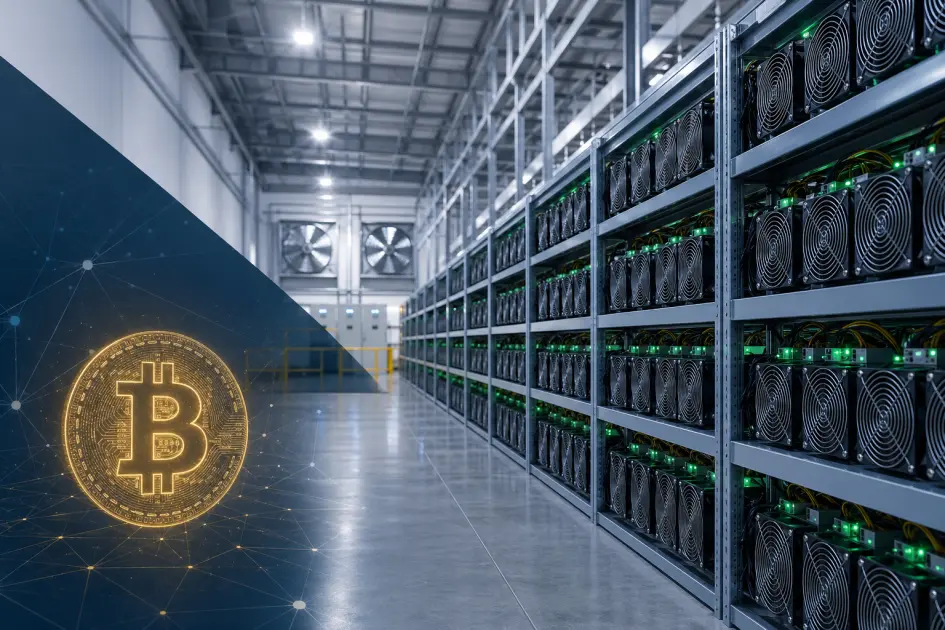
A Bitcoin mining farm is an industrial-scale facility that runs hundreds or thousands of ASIC miners to mine Bitcoin profitably — relying on cheap industrial electricity, purpose-built cooling, redundant networking, and 24/7 technical operations that individual home miners simply cannot replicate. A single Antminer at home is a hobby. A farm is infrastructure.

What Is a Bitcoin Mining Farm, Exactly?
A Bitcoin mining farm is a purpose-built industrial facility — typically a warehouse or shipping-container array — that hosts ASIC miners in large numbers and runs them continuously to earn block rewards on the Bitcoin network. It is functionally closer to a small power plant than to a server room: the building is designed first around electricity and heat, and only second around computers.
Scale is the defining feature. A home miner might run one or two machines pulling 3-6 kW from a residential circuit. A small commercial farm runs hundreds of machines drawing 1-10 megawatts (MW). Large industrial sites — the ones you see ranked in network-share charts — operate at 50-300+ MW, equivalent to the electricity use of a small town. That difference in scale unlocks contract pricing, better cooling, specialist staff, and capital access that a solo operator can never match.
The Four Components of Every Serious Mining Farm
Peel away the marketing and every industrial mining facility — from Texas to Kazakhstan to Paraguay — is built on the same four pillars. If any one of them is weak, the whole site is uncompetitive.
1. Power infrastructure (MW-scale)
Direct industrial power purchase agreements at $0.03-0.05/kWh, a dedicated on-site substation stepping grid voltage down to miner-friendly 415V three-phase, diesel or gas backup gensets, and UPS systems for graceful shutdown. Electricity is 60-75% of operating cost, so this is the single biggest design choice.
2. Cooling (air, immersion, hydro)
An S21 rejects ~3,500W as heat. Multiply by 5,000 machines and a farm generates 17.5 MW of waste heat. Farms use hot/cold aisle air cooling, single-phase immersion in dielectric fluid, or hydro-cooled units such as the Antminer S21 Hyd. Cold-climate sites (Kazakhstan, Canada, Siberia) lean heavily on ambient air to cut HVAC costs 20-30%.
3. Networking (dual-ISP fiber)
Hashing itself uses almost no bandwidth, but a disconnected miner earns zero. Serious farms run redundant dual-ISP fiber with automatic failover, BGP routing to the nearest mining pool, and out-of-band management so technicians can reboot or re-pool thousands of machines remotely when something goes wrong.
4. 24/7 technicians & NOC
A 10,000-machine farm sees dozens of hash-board failures a week. On-site round-the-clock technicians swap bad units, reseat cables, and manage RMA cycles. A Network Operations Center (NOC) watches hashrate, chip temperature, and pool status across the whole fleet — alerting on anomalies within minutes, not days.
Where the World Mines Bitcoin in 2026
After China's 2021 ban, hashrate scattered across the globe. According to the Cambridge CBECI mining map and 2026 industry trackers, the United States now dominates with roughly 35-40% of global hashrate, followed by Russia, Kazakhstan, and a long tail of cold or cheap-power jurisdictions. The table below summarizes approximate 2026 shares — exact figures drift month to month as sites come online or shut down.
| Region | Approx. 2026 share | Why it matters |
|---|---|---|
| United States | ~35-40% | Texas, Georgia, Wyoming — deep capital markets, ERCOT demand-response, public miners |
| Russia | ~12-16% | Siberian gas and hydro, extreme cold climate, low power costs |
| Kazakhstan | ~8-14% | Industrial power at $0.03-0.04/kWh, cold steppe climate, established mining framework |
| Canada | ~7-9% | Québec and Alberta hydropower, clear regulation, sustainable mining narrative |
| Paraguay | ~3-5% | Itaipu hydro surplus, cheap industrial tariffs, emerging Latin American hub |
| Gulf states (UAE, Oman) | ~2-4% | Stranded gas, sovereign-backed projects, immersion cooling for hot climates |
| Other (Norway, Bhutan, Iran, Ethiopia) | Remainder | Hydro surpluses, subsidized power, or grey-market operations |
Two themes run through the list: cheap electricity and cold ambient air. Every country on this map has at least one of them, and the big players have both. Note that Cambridge's published sample captures only 32-38% of total network hashrate, so exact country shares should be read as directional — not precise to the decimal.
Get exposure to a real mining farm without building one
You've seen what a farm is and where they live. Rather than buy a $500,000 substation, rent a slice of a working site — NoxHash's Kazakhstan facility runs Antminer S21 hardware on $0.035/kWh power and offers a 2-day Basic Miner trial with no deposit.
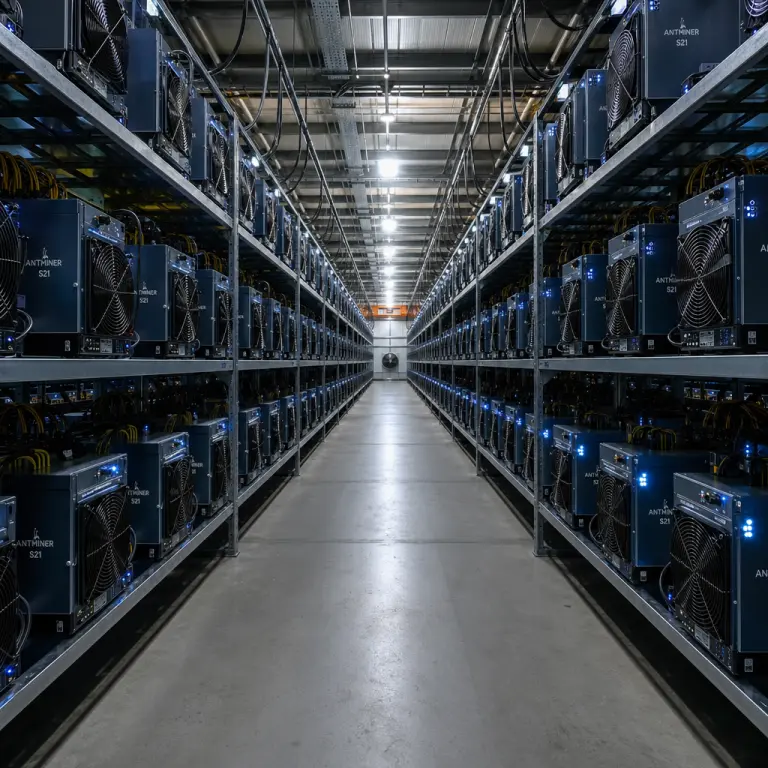
Inside a Real Farm — A Walk Through the NoxHash Kazakhstan Site
Abstract descriptions only go so far. Here is what an actual working farm looks like from the gate to the network operations desk, using the NoxHash Kazakhstan facility as a concrete reference. Our farm sits on the Kazakh steppe, where winter temperatures routinely hit -15 to -30°C — which, for a mining operator, is free cooling.
Substation and medium-voltage yard
The tour starts outside at the fenced substation. Transformers step grid voltage down to site voltage under an industrial contract priced at ~$0.035/kWh. UPS banks and a diesel genset stand by for grid dropouts — the farm is designed for 99.9% fleet uptime, with power behaving like the most critical dependency in the building.
The machine halls — racks of Antminer S21
Inside, rows of steel shelving hold the fleet: Antminer S21 (200 TH/s, 17.5 J/TH), S21 Pro (234 TH/s, 15 J/TH), S21 XP Hyd (473 TH/s, 12 J/TH), and WhatsMiner M60S/M66S. Every machine runs a tuned Windows Server build with non-essential services stripped out so 100% of resources go to hashing.
Cooling — the cold-air trick
Outside walls carry rows of large intake shutters. Sub-zero steppe air flows across the hot side of each miner, with industrial exhaust fans pulling heated air out the opposite wall. For the highest-density S21 XP Hyd units, a closed-loop hydro-cooling skid handles the thermal load. Total cooling OPEX drops 20-30% versus equivalent warm-climate sites.
The NOC — where the farm is actually run
At the back of the building a small Network Operations Center watches every machine's hashrate, chip temperature, and pool status on a wall of dashboards. Technicians staff the NOC 24/7. When a miner drops offline or a hash board faults, the shift team swaps or reboots the unit within 4-8 hours — keeping tenant fleets earning without the user ever seeing the outage.
Why Industrial Farms Beat Home Mining Economically
The gap between a farm and a home rig is not just size — it is a structural cost advantage. The table below compares a single Antminer S21 running in a typical home setup against the same machine hosted inside an industrial facility like NoxHash's Kazakhstan farm.
| Factor | Home mining (1 machine) | Industrial farm (1,000+ machines) |
|---|---|---|
| Electricity cost | ~$0.12-0.20/kWh (residential) | ~$0.03-0.05/kWh (industrial PPA) |
| Monthly power bill (S21, ~2,520 kWh) | ~$300-500 | ~$88 |
| Cooling | DIY fans + AC, extra utility cost | Ambient cold air + hydro units |
| Hardware purchasing | Retail single-unit pricing | Bulk orders 15-25% cheaper per unit |
| Breakdown response | You fix it — or ship it back | On-site tech swap in 4-8 hours |
| Noise & heat footprint | ~75 dB at home, needs dedicated room | Zero — you're 3,000 km from the fans |
| Uptime | Depends on home grid and your schedule | 99.9% with UPS + genset backup |
The headline gap is power. A home operator paying $0.15/kWh burns roughly $300+ per month just to run one S21, while the same machine inside a farm costs about $88/month to power. That $200+ monthly delta is the difference between profit and loss in most BTC-price scenarios — which is exactly why professional farms dominate the global hashrate chart, and why home mining is a hobby rather than a business.
Rent farm capacity instead of building your own
Cloud mining is the shortcut: you rent a slice of a real farm's hashrate at industrial power prices, and the operator handles the other three components. NoxHash exposes its Kazakhstan fleet from $20/month — the same Antminer S21 hardware and $0.035/kWh electricity described above.
Frequently Asked Questions
How many ASIC miners does a typical Bitcoin mining farm have?
Small commercial farms run a few hundred ASICs drawing 1-10 MW of power. Mid-size industrial sites host 2,000-10,000 machines at 10-50 MW. The largest public Bitcoin mining campuses in Texas, Kazakhstan, and Russia operate fleets of 50,000-100,000+ ASICs at 100-300 MW.
How much electricity does a Bitcoin mining farm use?
A 10 MW facility consumes roughly 7,200 MWh per month — about the same as 7,000 average US homes. Industrial operators negotiate direct power purchase agreements in the $0.03-0.05/kWh range, compared to residential prices of $0.12-0.20/kWh.
Which country has the most Bitcoin mining farms in 2026?
The United States leads with roughly 35-40% of global hashrate in 2026, concentrated in Texas, Georgia, and Wyoming. Russia, Kazakhstan, Canada, and Paraguay follow, each hosting multi-hundred-megawatt facilities. Cambridge's CBECI mining map publishes month-to-month country shares based on mining pool geolocation data.
How do mining farms stay cool?
Most farms use hot-and-cold-aisle air cooling with large industrial fans. Cold-climate sites in Kazakhstan, Canada, and Siberia rely heavily on ambient air. Higher-density deployments use immersion in dielectric fluid or hydro-cooled ASICs like the Antminer S21 Hyd, cutting thermal overhead further.
Can I visit or tour a Bitcoin mining farm?
Most industrial farms restrict on-site access for security, insurance, and noise-safety reasons — a working hall hits 90+ dB. Legitimate operators typically share photos, video tours, and hardware specs instead. If a platform refuses to disclose even its country and hardware model, treat that as a red flag.
Can an individual access a mining farm without building one?
Yes — cloud mining platforms let individuals rent a share of a farm's hashrate on a monthly contract. You pay a fixed USD fee, the operator runs the hardware at industrial power prices, and the BTC produced by your share of the fleet accrues to your account. No substation or 24/7 staff required.
Educational content — not financial advice
This guide is for education. Global hashrate shares, country rankings, electricity rates, and hardware efficiency figures reflect public data and market conditions in April 2026 and will change. Bitcoin mining economics depend on BTC price, network difficulty, and regulatory conditions — all outside your direct control. Past performance does not guarantee future results. Consult a qualified professional before committing capital, and only invest what you can afford to lose.