What Is a Blockchain Transaction Fee (Gas Fee)? Simple Explanation
Gas fees explained simply — the car-engine analogy, BTC sats/vB vs ETH gwei vs TRON energy vs BSC, plus a 4-chain comparison table for 2026.

A blockchain transaction fee — often called a gas fee — is a small amount of crypto you pay the network to process and record your transaction. Think of it like fuel for a car: no gas, no movement. Every blockchain prices its "fuel" differently — Bitcoin charges by sats per virtual byte, Ethereum by gwei, TRON by energy and bandwidth, BNB Chain by gas in BNB. Fees change by the minute based on how busy the network is.
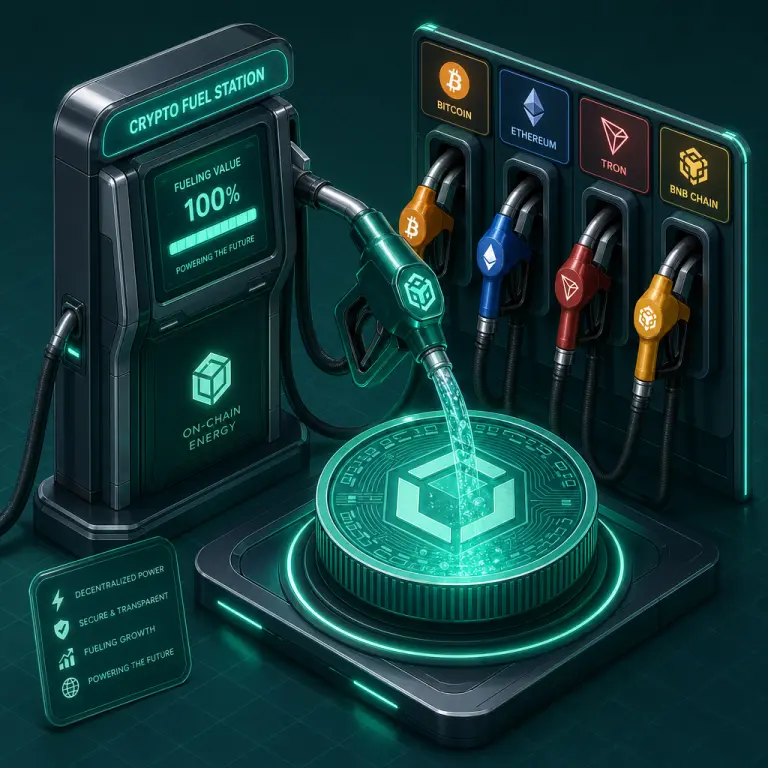
The Simplest Way to Think About It — Fuel for the Network
Imagine you drive from home to a friend's house. Your car burns gasoline along the way, and you pay for that gas at the pump. Blockchain transactions work the same way: every transaction consumes "fuel" in the form of computing resources, and the network charges you for it.
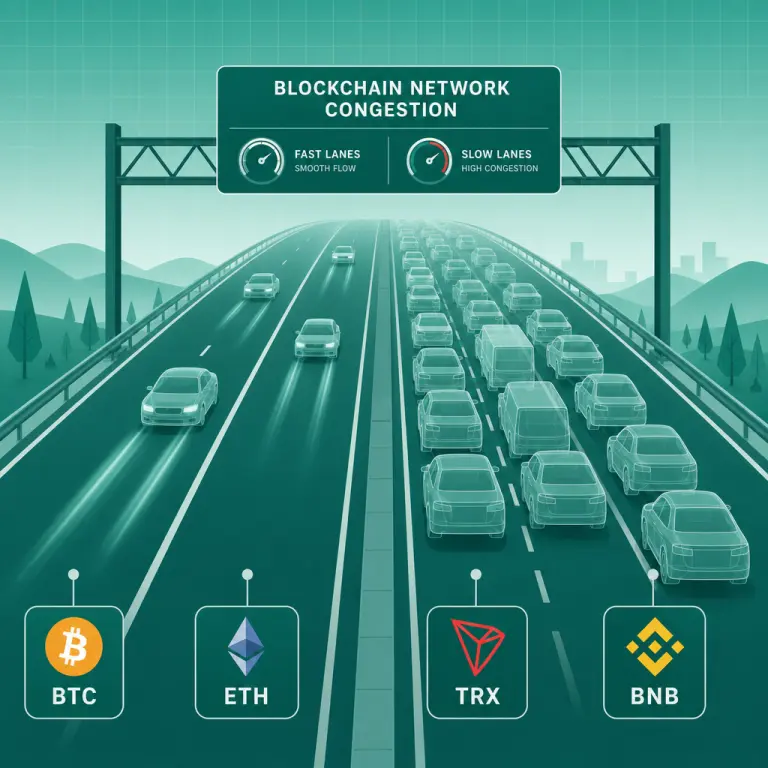
The fuel in this case is network capacity — block space, computation, storage. It is finite. When many people want to send transactions at the same time, the network is crowded, and whoever offers to pay more gets served first. When the roads are empty, even a small fee gets you through quickly. That is why the same transfer can cost five cents on a quiet Tuesday and five dollars during an NFT frenzy.
The fee is not paid to a company. It is paid to the miners or validators who secure the chain. That is their incentive to keep honest machines running 24/7. No fees, no security, no blockchain — which is why every chain has them in some form.
Why Every Chain Calls Its Fee Something Different
Bitcoin, Ethereum, TRON, and BNB Chain all charge fees — but each one measures "fuel" in its own unit. Understanding the unit is the difference between reading a fee tracker confidently and squinting at numbers that look like a foreign language.
Bitcoin — sats per virtual byte (sat/vB)
You pay per byte of block space. A standard send is ~140 vB, so at 10 sat/vB that's 1,400 sats. Fee rates typically swing from 5 to 50 sat/vB, spiking past 200 in peak congestion.
Ethereum — gas units priced in gwei
Every operation costs "gas units". A simple ETH transfer uses 21,000. You bid a price per unit in gwei (one billionth of an ETH). A normal transfer lands in the $0.50 to $5 range; complex DeFi calls cost much more.
TRON — energy & bandwidth
TRC-20 transfers burn two resources: bandwidth (cheap, for data) and energy (expensive, for smart-contract logic). A USDT transfer consumes ~65,000 energy and costs about $1.50 to $4 paid in TRX — most of it energy.
BNB Chain — gas priced in BNB
BEP-20 uses the Ethereum model (gas units × gas price), but gas prices hover near 0.1 gwei of BNB, so transfers typically cost a few cents — often under $0.10, rarely over $0.50 even under load.
Different units, same underlying idea: the chain measures how much work your transaction takes, multiplies by a market price, and you pay the total. Once you know the unit and the ballpark price, reading any chain's fee becomes routine.
Gas Fees Across Major Chains — 2026 Snapshot
The table below compares the four chains most relevant to crypto beginners, focused on the single most common action — sending a stablecoin like USDT. Values reflect typical April 2026 conditions; rates shift constantly, so treat these as orders of magnitude rather than exact quotes.
| Chain | Fee unit | Typical USDT send | Speed | Congestion spike |
|---|---|---|---|---|
| Bitcoin | sats/vB | Not used for USDT | ~10 min / block | $20+ during peak |
| Ethereum (ERC-20) | gas units × gwei | $2 - $15 | ~12 sec / block | $50+ during peak |
| TRON (TRC-20) | energy + bandwidth | $1 - $2 | ~3 sec / block | Rarely above $4 |
| BNB Chain (BEP-20) | gas × gwei (in BNB) | $0.05 - $0.30 | ~3 sec / block | Rarely above $0.50 |
Two patterns jump out. Bitcoin and Ethereum run the most valuable networks but charge the highest fees because block space is scarce and demand is global. TRON and BNB Chain process stablecoin transfers at a fraction of that cost — which is exactly why most modern crypto platforms, including NoxHash, default to TRC-20 and BEP-20 for USDT deposits. You get the same dollar on-chain, for pennies.
Why Do Fees Change So Much? The Three Drivers
If gas fees felt random the last time you sent crypto, you are not imagining things — but they are not random either. Three forces push fees up and down, sometimes within minutes.
Network demand — how many people want in right now
Every chain has finite capacity per block. When demand exceeds that capacity, senders bid against each other for the slots. A token launch or big market move can 10x Ethereum fees in under an hour.
Transaction complexity — how much work it takes
A simple transfer is cheap. Calling a smart contract, minting an NFT, or swapping on a DEX uses far more computation — and you pay per unit of work. A Uniswap swap can cost 5 to 10 times a plain ETH send on the same chain at the same moment.
Native-token price — fees are in crypto, not dollars
Bitcoin fees are paid in BTC, Ethereum in ETH, TRON in TRX. When those tokens pump, the dollar value of the same fee rate climbs even if the network itself is quiet. A 10 sat/vB fee at a $50k BTC is half what it costs at $100k BTC — same sats, different USD.
When Fees Spike — Congestion Periods to Watch
Most of the year, gas fees sit in a sleepy baseline range. A handful of recurring events drag them sharply higher. Knowing when they happen lets you time non-urgent transfers.
Market crashes & flash rallies
When BTC moves 5 to 10% in hours, everyone tries to move, trade, or liquidate at once. Mempools flood, fees rocket. Avoid non-urgent transfers during volatile news windows.
NFT mints & token launches
A hyped Ethereum NFT drop or a new token going live pulls bidders willing to pay anything to land in the first blocks. Fees can 50x within minutes on affected chains, then collapse an hour later.
Weekday US business hours
Ethereum and BNB Chain show predictable activity cycles, peaking Tuesday to Thursday, roughly 13:00 to 21:00 UTC. Weekends and early Asia hours are consistently the quietest and cheapest windows.
Bitcoin "ordinals" & runes waves
Since 2023, inscription protocols periodically flood Bitcoin blocks with data-heavy transactions. When a new collection trends, sat/vB rates can triple for days. Check mempool.space before a large BTC send.
How to Pick the Right Fee — Without Overpaying
Most wallets offer three preset tiers — typically labeled "slow / normal / fast" — that auto-fill a fee rate based on current mempool data. For 90% of users, the "normal" preset is correct 90% of the time. But knowing how to override it pays off on both ends of the curve.
- Check a live fee tracker (mempool.space for BTC, etherscan gas tracker for ETH, bscscan for BNB) before large transfers.
- For non-urgent sends, pick the "slow" tier — often 50 to 80% cheaper than "fast" for a 30-minute delay.
- Batch multiple sends into one transaction when your wallet supports it.
- Prefer TRC-20 or BEP-20 for stablecoin transfers — it saves real money per transaction.
- Don't blindly click "fast" every time — on a quiet network you are paying 5x the required rate.
- Don't set a rate far below the mempool floor — your transaction can sit unconfirmed for hours or be dropped.
- Don't send ERC-20 USDT when TRC-20 or BEP-20 is an option — the fee can eat 5% or more of a small transfer.
- Don't panic-send during volatile market hours if you can wait one to two hours.
Put the low-fee networks to work
NoxHash deposits run on TRC-20 and BEP-20 USDT — the two cheapest networks in the table above. Withdrawals are a flat 1.5%, paid in BTC. No Ethereum mainnet fees eating your balance.
How This Applies to NoxHash — Real Fee Numbers
Because NoxHash runs on USDT and BTC — never native ETH — our users only ever touch three fee surfaces. Here is exactly what to expect, which is why choosing the right network at deposit time matters more than almost any other setting in your account.
| Action | Network | Fee you pay | Paid in |
|---|---|---|---|
| Deposit USDT | TRC-20 | ~$1 - $2 | TRX (from your wallet) |
| Deposit USDT | BEP-20 | ~$0.05 - $0.30 | BNB (from your wallet) |
| Withdraw BTC | Bitcoin mainnet | Flat 1.5% of amount | BTC (deducted from withdrawal) |
The flat 1.5% withdrawal fee is deliberately predictable — it insulates you from Bitcoin mempool chaos. Whether sat/vB rates are at 5 or 250 on the day you withdraw, your fee stays 1.5%. NoxHash absorbs the variance; you get a number you can plan around.
On deposits, the pattern is simple: use BEP-20 if your exchange supports it (most do), fall back to TRC-20 otherwise. Either network works; avoid sending mainnet ERC-20 USDT — the fee alone could exceed the minimum deposit for smaller amounts.
Frequently Asked Questions
Why are Ethereum gas fees so much higher than other chains?
Ethereum secures hundreds of billions in value across DeFi, NFTs, and stablecoins, yet processes only about 15 transactions per second on mainnet. High demand plus tight capacity forces an aggressive fee auction. TRON and BNB Chain run many times more transactions per block, keeping per-user fees low.
Who actually receives the gas fee I pay?
On Bitcoin, the miner who includes your transaction in a block keeps the fee. On Ethereum post-merge, validators earn the priority tip while a base fee is burned (destroyed), reducing ETH supply. On TRON and BNB Chain, fees go to validators who process blocks. No company or platform collects them.
Can I pay a zero-fee transaction?
Technically you can broadcast a very low or zero-fee transaction, but miners and validators will ignore it — they prioritize fee-paying transactions first. In practice, zero-fee sends sit in the mempool until they expire (usually 14 days on Bitcoin) and never confirm.
What happens if I set a fee too low and the transaction gets stuck?
Most modern wallets support "replace-by-fee" (RBF) on Bitcoin or "speed up" on Ethereum — you rebroadcast the same transaction with a higher fee, and miners pick the newer version. If your wallet lacks this feature, the transaction eventually drops from the mempool and the funds return to your balance.
Why does NoxHash charge 1.5% on withdrawals instead of a variable fee?
A flat percentage keeps your planning simple — you know the cost before requesting. It also smooths out Bitcoin mempool volatility, which can swing real sat/vB fees by 10x in a week. On average, 1.5% lands close to typical network rates while protecting users from peak-congestion spikes.
Information only — not financial advice
Fee numbers in this article reflect typical April 2026 conditions and change constantly. Always verify live rates on a reputable fee tracker such as mempool.space before sending large transactions. Crypto involves market, legal, and technical risk — only move amounts you can afford to lose.