What Is the Bitcoin Mempool and Why Miners Should Care
Understand the Bitcoin mempool, how fee rates work, and why cloud mining earnings and BTC withdrawals both depend on its real-time state.

The Bitcoin mempool is the pool of pending transactions that full nodes have validated but not yet included in a block — essentially a waiting room for miners to choose from, sorted by fee rate. Every node runs its own mempool (the Bitcoin Core default caps around 300 MB), and when you broadcast a transaction it propagates across those mempools until a miner selects it for the next block.
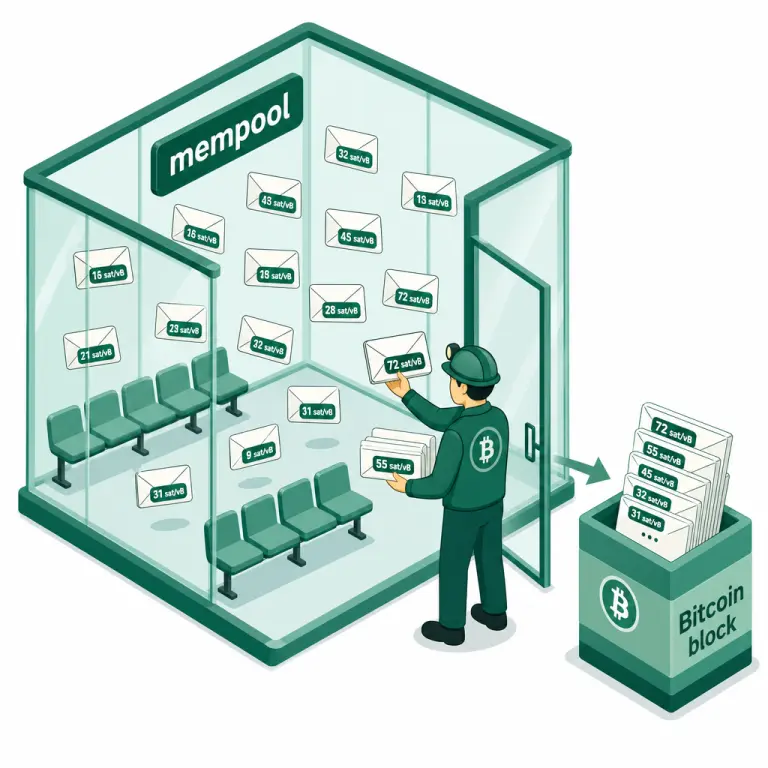
The Mempool in Plain Language
Think of Bitcoin as a bus system where buses leave every ten minutes. The mempool is the queue of passengers waiting at the stop — except this bus has limited seats (about 1 MB of transaction data, plus witness space for segwit), and the driver picks passengers in order of how much they are willing to tip.
Technically, the mempool is an in-memory data structure on each Bitcoin node. When you broadcast a transaction, your wallet sends it to a node; that node checks the signatures, checks for double spends, then gossips it to peers. Within seconds it reaches most of the network — and sits there, indexed by fee rate in satoshis per virtual byte (sat/vB), until a miner scoops it into a block.
Per-node, not global
Each node maintains its own mempool — Bitcoin Core defaults to 300 MB. Propagation is fast but not instant, so mempools can differ slightly across the network.
Validated but unconfirmed
Transactions in the mempool have passed script and signature checks. They just have not yet been included in a block — they carry zero confirmations.
Ranked by fee rate
Miners are profit-maximising — they pick the highest sat/vB transactions first. Fee rate, not absolute fee, is what determines who boards the next block.
How a Transaction Enters and Exits the Mempool
The full journey from "send" button to confirmed block takes between ten minutes and several hours, depending on fee rate and congestion. Here is the sequence that happens behind the scenes.
Wallet broadcasts the signed transaction
Your wallet attaches a fee (chosen by you, or estimated from current mempool conditions) and sends the raw signed transaction to at least one Bitcoin node.
Node validates and relays
The node checks signatures, verifies no double-spend, confirms the fee clears the minimum relay threshold (usually 1 sat/vB), then gossips the tx to its peers.
Propagates into thousands of mempools
Within a few seconds the tx sits in tens of thousands of mempools worldwide, including those of large mining pools. It is now a candidate for inclusion.
Miner selects by fee rate
A mining pool's block template algorithm packs roughly 1–1.5 MB of transactions starting with the highest sat/vB — a greedy knapsack that maximises fee revenue per block.
Block is mined — tx leaves the mempool
When the pool hashes a valid block, the included transactions are removed from every node's mempool. Your transaction now has 1 confirmation and starts ageing into deeper finality.
Mempool Size vs Fee Rate — A Cheat Sheet
Because block throughput is fixed at roughly 1–1.5 MB every ten minutes, the only way demand can exceed supply is for fees to rise. The table below maps typical mempool conditions to fee-rate expectations. Values are illustrative of ranges seen across 2023–2026 cycles — for live numbers always check the mempool.space live dashboard.
| Congestion level | Mempool backlog | Next-block fee rate | Typical wait |
|---|---|---|---|
| Quiet | < 5 MB | 1–2 sat/vB | Next 1–2 blocks |
| Normal | 5–30 MB | 3–15 sat/vB | 10–60 minutes |
| Busy | 30–100 MB | 20–80 sat/vB | 1–6 hours |
| Congested | 100–300 MB+ | 100–500+ sat/vB | Hours to days |
For context, in mid-April 2026 the network sat closer to the quiet end: blocks ran at roughly 94% fullness while the median fee rate held at 1 sat/vB — the relay floor. Periods of elevated demand, such as the 2023 inscription wave and the 2024 rune launch, briefly pushed next-block fees above 500 sat/vB and sent the mempool backlog over 300 MB.
Want to see a live miner react to the mempool?
You have seen the queue, the fee ranking, and the congestion ladder. NoxHash runs real ASIC miners against that same mempool 24/7 — the 2-day Basic Miner trial lets you watch a live CGMiner terminal and see BTC accrue as blocks get packed.
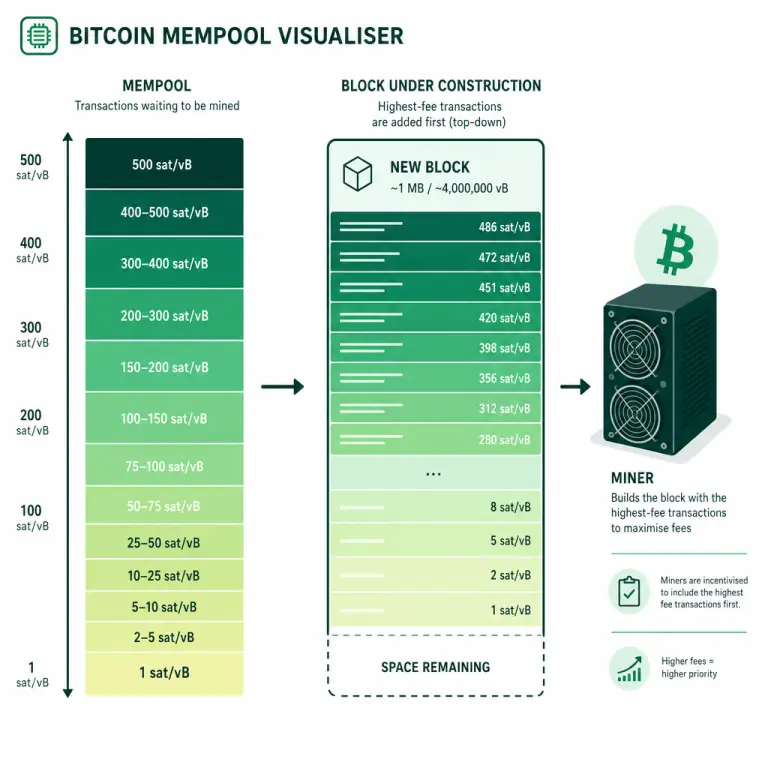
Why Miners Watch the Mempool Every Minute
For a miner, the mempool is a forward-looking revenue signal. Block subsidy is fixed (3.125 BTC per block since the April 2024 halving), but transaction fees are variable and come entirely from what sits in the mempool right now. When the mempool bulges, the next few blocks will carry fat fee payloads; when it drains, fee revenue thins to the relay floor.
Pool operators and professional miners run their own full nodes specifically to see the freshest mempool state and build the best possible block template. A few percentage points of extra fee revenue per block compounds over thousands of blocks a year — enough to matter at scale.
Mempool awareness also drives tactical decisions. When fee rates spike, operators may defer maintenance windows, spin up reserve hashrate, or pause optional firmware updates so no hash-second is wasted. When fees drop to 1 sat/vB for days on end, they scrutinise efficiency numbers more closely because block subsidy is doing almost all the work.
What the Mempool Means for Cloud Mining Users
If you rent hashrate through a cloud mining platform like NoxHash, the mempool affects you on both sides of the ledger — what you earn and what it costs to withdraw it.
Earnings side — a bulging mempool lifts block rewards
Your rented TH/s is paid from the same block reward that miners collect — subsidy plus fees. When the mempool is packed with high-fee txs, each block pays out more BTC than usual, and the FPPS pool passes that surplus through to your account. A congested week can quietly lift BTC output 5–20% above the baseline.
Withdrawals side — same mempool, higher network fee
When you withdraw BTC from the platform to your own wallet, the transaction enters the same mempool as everyone else. During congestion your network fee can jump from a few thousand sats to tens of thousands — and confirmation may drag if you underbid. Timing withdrawals for quiet periods (often late-night UTC on weekends) is a free optimisation.
Quiet mempool — steady but slimmer blocks
In a low-fee environment like April 2026 (median 1 sat/vB), block rewards lean almost entirely on the 3.125 BTC subsidy. Your FPPS payouts still arrive every minute, just without the fee-revenue bonus. Upside: withdrawing costs almost nothing.
Post-halving context — fees matter more every cycle
Each halving cuts the subsidy in half — the 2028 event will take block reward to 1.5625 BTC. Over time, fee revenue becomes a larger share of what miners (and rental platforms) collect. Mempool-watching is not a nice-to-have, it is structural.
Put the theory to work — mine and withdraw on NoxHash
Now that you can read the mempool like a miner, try doing it from the rental side. NoxHash uses FPPS so fee-revenue spikes pass through to your account, and withdrawals from 0.00001 BTC let you time the quiet windows on your own.
Frequently Asked Questions
Is there one global Bitcoin mempool?
No. Each full node runs its own mempool — Bitcoin Core defaults to a 300 MB cap. Propagation is fast, so most mempools converge within seconds, but they are never perfectly identical. Explorers like mempool.space publish their node's view, which is a close approximation of the network state.
What happens if my transaction sits in the mempool too long?
Bitcoin Core evicts unconfirmed transactions after 14 days by default. Before that, you can speed things up by using Replace-by-Fee (RBF) to bump the fee rate, or Child-Pays-for-Parent (CPFP) to attach a high-fee child tx that pulls the parent through with it.
What is sat/vB and why is it the right unit?
Sat/vB is satoshis per virtual byte — fee per unit of block space a transaction consumes. Miners maximise fees per block, and block space is finite, so they sort by fee rate, not absolute fee. A small high-rate tx can confirm ahead of a larger low-rate one paying more total.
Does a busy mempool always mean higher miner revenue?
Usually yes — more pending transactions bidding for limited block space pushes fee rates up, and miners keep all the fees in each block they find. But a mempool full of low-fee spam does not help. What matters is the shape of the fee histogram, not just the raw byte count.
When should I withdraw BTC to minimise the network fee?
Check mempool.space before broadcasting. Weekends and late-night UTC hours tend to be quieter. If the next-block fee is above 20 sat/vB and you are not in a rush, waiting a day often drops the cost significantly. For small amounts, timing matters more than for large ones.
Will the mempool matter more after future halvings?
Yes. Each halving cuts the fixed subsidy in half — from 3.125 BTC today toward 1.5625 BTC in 2028 — so fee revenue becomes a larger share of miner income each cycle. Mempool monitoring is increasingly central to miner economics and, by extension, to anyone renting hashrate.
Educational content — not financial advice
This article explains how the Bitcoin mempool works and why it affects miner economics. Mempool state, fee rates, and BTC output figures reflect network conditions in April 2026 and will change. Cloud mining returns depend on BTC price, network difficulty, mempool fee revenue, and operator reliability — all outside your direct control. Past results do not guarantee future performance. Only commit funds you can afford to lose and verify local legal and tax rules with a qualified professional.