What Is a Bitcoin Block Reward? How Miners Get Paid
Bitcoin block reward explained: 3.125 BTC subsidy plus fees, halving schedule, how cloud mining users get their share. Clear 2026 guide with real numbers.

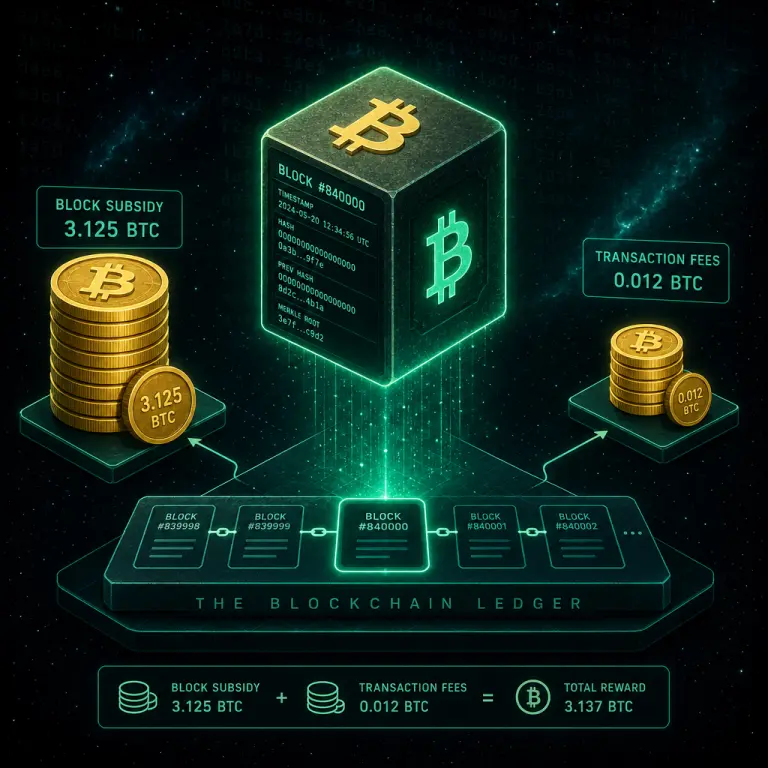
A Bitcoin block reward is the BTC a miner receives for successfully adding a new block to the blockchain — currently 3.125 BTC (post-April 2024 halving) plus any transaction fees from the block. It is the only way new bitcoin is created, and it is how every miner on earth — solo operators, industrial farms, and cloud mining renters alike — ultimately gets paid.
The Plain Definition — What a Block Reward Actually Is
Every ten minutes, on average, the Bitcoin network produces a new block — a bundle of recent transactions confirmed and permanently recorded on the blockchain. Whoever produces that block collects the block reward, paid to a Bitcoin address of their choosing in the very first transaction of the block (the "coinbase" transaction).
The reward has two parts bundled together. The first, the coinbase subsidy, is newly created BTC minted out of thin air by the protocol — this is how new bitcoin enters circulation. The second, the transaction fees, is paid by users who want their transactions included in that specific block. Both go to the same miner, in the same on-chain payment.
Component 1 — Coinbase subsidy (3.125 BTC)
Newly minted BTC created by the protocol itself. Hard-coded to halve every 210,000 blocks (~4 years). Currently 3.125 BTC per block after the April 2024 halving, and the only source of new bitcoin supply.
Component 2 — Transaction fees (~0.05–0.3 BTC)
Paid by users sending BTC who want their transaction confirmed. Varies with network demand — typically 0.05–0.3 BTC per block in 2026, but spikes to 1+ BTC during fee auctions around ordinals, ETF rebalancing, or mempool congestion.
Put simply: the miner who wins a block receives 3.125 BTC + whatever fees the block's transactions happen to carry. On a quiet day that total sits near 3.15 BTC; on a congested day it can clear 3.5 BTC or more. Multiply by ~144 blocks per day and you get the network-wide ~450 BTC issued daily figure quoted by the Blockchain.com supply chart.
The Halving Schedule — How the Subsidy Shrinks Over Time
The coinbase subsidy is not a fixed number — it halves every 210,000 blocks, roughly every four years. This is Bitcoin's built-in disinflation: each halving cuts new supply issuance in half, pushing the network closer to its 21 million BTC cap. The table below tracks every halving to date and the two we can reasonably project ahead.
| Era | Year | Block subsidy | Daily issuance |
|---|---|---|---|
| Genesis era | 2009–2012 | 50 BTC | ~7,200 BTC/day |
| 1st halving | Nov 2012 | 25 BTC | ~3,600 BTC/day |
| 2nd halving | Jul 2016 | 12.5 BTC | ~1,800 BTC/day |
| 3rd halving | May 2020 | 6.25 BTC | ~900 BTC/day |
| 4th halving (current) | Apr 2024 | 3.125 BTC | ~450 BTC/day |
| 5th halving (projected) | ~Apr 2028 | 1.5625 BTC | ~225 BTC/day |
As of April 2026, roughly 19.9 million BTC have already been mined — about 94.7% of the 21 million cap — leaving only ~1.1 million BTC to be issued across the remaining ~114 years. The reason that last trickle stretches so far out is exactly this halving curve: each four-year era mints half as much as the previous one.
See a real block reward flow into your wallet
You have the math — now watch it happen live. NoxHash's 2-day Basic Miner trial assigns you 50 TH/s on the production fleet, routes your share of every block reward through our pool, and credits BTC to your account minute by minute. No card, no USDT.
How a Block Reward Flows to a Cloud Mining User
A solo miner who wins a block keeps the full 3.125 BTC + fees. In practice almost nobody mines solo any more — the odds of a single machine finding a block are too long. Instead, miners join pools that combine hashrate and share rewards proportionally. Cloud mining users are one step removed from that: they rent hashrate from an operator whose machines sit inside the pool.
A block is found by the mining pool
The pool's collective hashrate solves the SHA-256 proof-of-work. The winning block carries the 3.125 BTC subsidy plus transaction fees, paid to the pool's coinbase address.
The pool distributes by hashrate share (FPPS)
Under Full Pay Per Share, every miner is paid for the work they contributed, smoothed across all blocks the pool finds. NoxHash's Kazakhstan fleet, like every reputable operator, is one contributor among many in the pool.
The operator receives pooled payouts
The pool sends BTC to the operator's wallet on a regular cadence. This payout is simply the sum of every share the operator's fleet contributed, minus the pool fee (typically 1–2%).
Your slice lands in your platform wallet
The operator splits the payout across every active rental. If you rented 150 TH/s out of a 500,000 TH/s fleet, you receive 0.03% of the fleet's pool payout. On NoxHash this is credited to your BTC balance every minute, ready to withdraw once you clear 0.00001 BTC.
So when someone asks "where does my BTC come from?", the full answer chains all the way back to a block reward: block → pool → operator → you. No step is magic. Each one is observable, and reputable operators let you inspect the pool connection and the per-minute credits on a live dashboard.

Why Solo Mining Is Impractical in 2026
In Bitcoin's early years, a single CPU could realistically win a block. Today the global network produces over 1 zettahash per second (1,000 EH/s), and a modern Antminer S21 running 200 TH/s represents roughly 0.00002% of that total. At that share, a solo S21 would be expected to win a block about once every 34 years on average — before factoring in variance.
That variance is the real killer. Even with the full 3.125 BTC + fees waiting at the finish line, betting thousands of dollars in electricity on a three-decade lottery ticket is not a business model. Pools exist precisely to turn that lottery into a steady wage: instead of one 3.15 BTC jackpot every 34 years, you get a smooth trickle of fractional BTC every block the pool finds. Cloud mining compresses this further — you skip the capex, the power contract, and the technician rotation, and receive the same smoothed payout as a service.
The Fee-Only Era — What Happens After the Subsidy Ends
The halving schedule does not run forever. Around the year 2140, the subsidy will shrink to zero satoshis and all 21 million BTC will be in circulation. From that point on, miners will be paid entirely by transaction fees — no more newly minted BTC, only the market value of securing each block.
That is a long way out, but each halving already shifts the balance incrementally. In 2020, fees made up roughly 2–5% of the average block reward; in busy periods of 2024–2026, they have repeatedly exceeded 10% and briefly spiked to 50%+ during fee auctions. Every cycle, the fee component becomes a larger share of what miners earn — the network is slowly rehearsing the fee-only equilibrium that will take over in 2140.
Claim your slice of the next block reward
You now understand exactly what you are buying into when you rent hashrate: a proportional share of every block reward the pool wins. NoxHash's Antminer S21 fleet in Kazakhstan hashes inside FPPS pools 24/7 — rent from $20/month and watch the per-minute BTC credits accumulate on a live dashboard.
Frequently Asked Questions
What is the current Bitcoin block reward in 2026?
As of April 2026, the Bitcoin block reward is 3.125 BTC of coinbase subsidy plus transaction fees (typically 0.05–0.3 BTC per block). The 3.125 subsidy has been in effect since the fourth halving in April 2024 and will halve again, to 1.5625 BTC, around April 2028.
How much Bitcoin is issued per day?
Bitcoin targets one block every ten minutes, or roughly 144 blocks per day. At 3.125 BTC per block, the network issues about 450 BTC of new supply daily, plus transaction fees. That figure halves again at the next halving in 2028, dropping to ~225 BTC per day.
Does a cloud mining user actually receive a block reward?
Yes — proportionally. Your rented TH/s contributes to a pool; the pool wins a share of block rewards; the operator receives those payouts and credits your account for your slice, minus pool and operator fees. You do not win the full 3.125 BTC — you receive your fractional share every minute.
How much of the 21 million BTC has been mined?
As of April 2026, roughly 19.9 million BTC have been issued — around 94.7% of the 21 million cap — according to Blockchain.com supply data. About 1.1 million BTC remain to be mined across the next ~114 years, as halvings stretch the final issuance deep into the 22nd century.
What will miners earn after 2140 when the subsidy ends?
Only transaction fees. Once all 21 million BTC are in circulation, the coinbase subsidy drops to zero and miners will be paid entirely by the fees users attach to their transactions. The fee share of block rewards has been growing each cycle, so the transition is gradual rather than sudden.
Why do pools exist instead of every miner going solo?
Variance. A single 200 TH/s machine would win a block roughly once every 34 years on average against today's network hashrate — far too unpredictable to cover operating costs. Pools bundle hashrate and distribute smoothed payouts, turning a 34-year lottery into a steady fractional income miners can actually plan around.
Educational content — not financial advice
This article is for education. Block reward figures, supply statistics, and halving projections reflect Bitcoin network conditions in April 2026 and will change as the next halving approaches. Cloud mining payouts depend on BTC price, network difficulty, pool performance, and operator reliability — all outside your direct control. Past results do not guarantee future performance. Only commit funds you can afford to lose and consult a qualified professional on tax treatment in your jurisdiction.