What Is an ASIC Miner and How Does It Work?
An ASIC miner is a chip purpose-built for Bitcoin's SHA-256 hash. See how it works, real 2026 models, and why most people rent instead of buy.
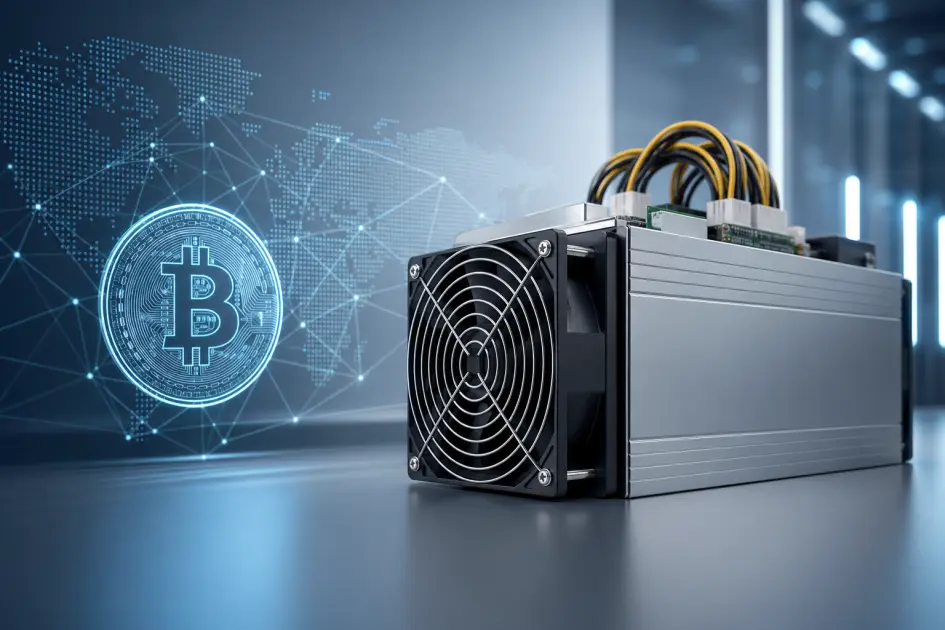
An ASIC miner is a specialized computer designed to do one thing: run Bitcoin's SHA-256 hash function as fast as possible. ASIC stands for Application-Specific Integrated Circuit — a chip etched for a single job, nothing else. Unlike a CPU or a GPU, it cannot browse the web, render a game, or train a model. It just hashes, billions of times per second, and it does it more efficiently than any general-purpose processor on Earth.
What "ASIC" Actually Means
Every computer chip sits somewhere on a spectrum between flexible and fast. A CPU is at the flexible end — it can run a spreadsheet, a game, or a neural network. An ASIC is at the opposite end — it's burned in silicon to execute one algorithm, and it does that single algorithm orders of magnitude faster than anything else.
A useful analogy: a CPU is a Swiss Army knife — dozens of tools, none of them great. A Bitcoin ASIC is a chef's cleaver — it only chops, but it chops through bone while the Swiss Army knife is still unfolding. The trade-off is total: the cleaver cannot open a bottle of wine, and the ASIC cannot run Windows. If SHA-256 is ever retired, every ASIC in the world becomes a doorstop overnight.
Concretely, a 2026-generation Bitcoin ASIC computes 200–500 trillion SHA-256 hashes per second while drawing 3–6 kilowatts. A top-end GPU managed maybe 1–2 GH/s (gigahashes — thousand times smaller units) at similar power. That gap is what killed GPU Bitcoin mining in 2013 and why no hobbyist CPU has earned a block in over a decade.
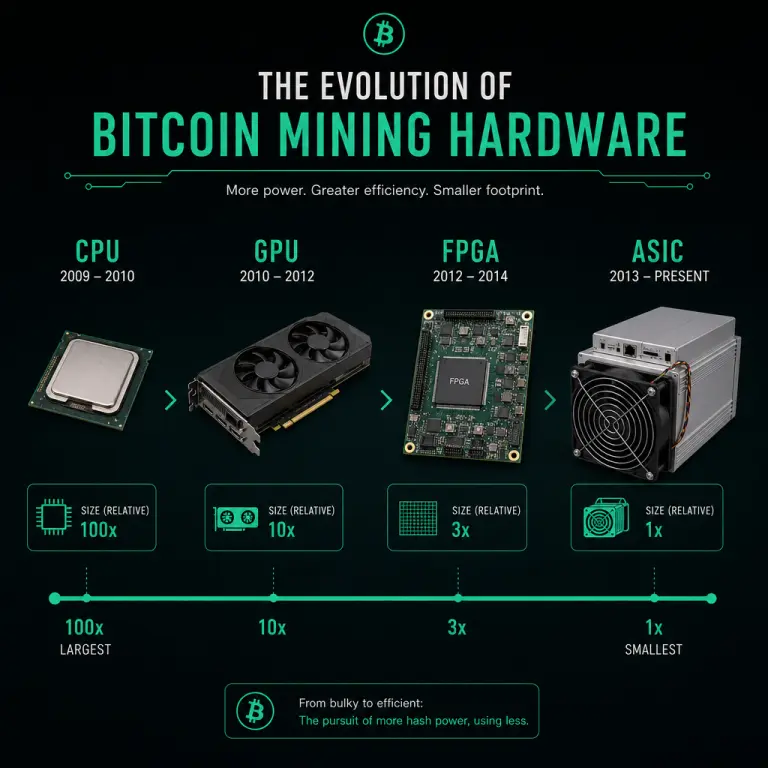
From CPU to ASIC — How Mining Hardware Evolved
Bitcoin mining hardware went through four generations in five years. Each generation made the previous one economically extinct — not slower, but unprofitable, because difficulty scales to match the fastest machines on the network. The arc below is why today's Bitcoin network is an ASIC-only arena.
| Era | Hardware | Typical output | Efficiency |
|---|---|---|---|
| 2009 | CPU (laptop/desktop) | ~5–10 MH/s | Hobby-grade only |
| 2010 | GPU (AMD Radeon HD) | ~200–400 MH/s | ~40× faster than CPU |
| 2011 | FPGA (reprogrammable) | ~800 MH/s | Lower power than GPU |
| 2013+ | ASIC (purpose-built) | ~200–500 TH/s (modern) | ~1,000× better than GPU |
The jump from FPGA to ASIC in 2013 was the inflection point. Avalon shipped the first commercial Bitcoin ASIC in January 2013, and within 18 months every GPU farm on the planet had either re-tooled or shut down. Since then the race has been ASIC-vs-ASIC — each generation squeezing more hashes per joule through smaller transistor process nodes (28 nm → 16 nm → 7 nm → 5 nm → 3 nm today).
Inside an ASIC Miner — The Four Components
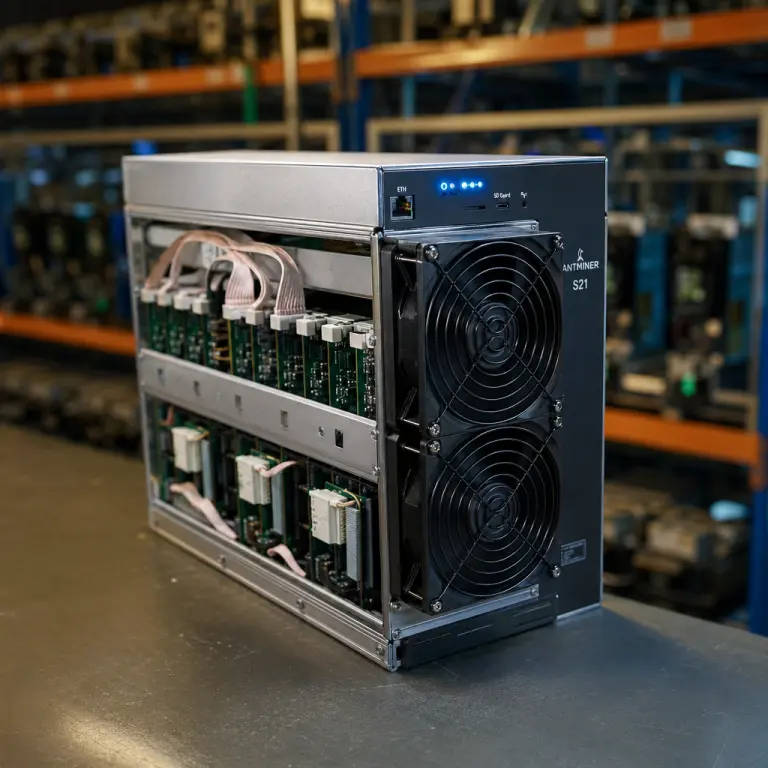
Crack open a modern Antminer or WhatsMiner and you'll find essentially the same layout every manufacturer uses. Four subsystems, each doing one job. Understanding what's in the box demystifies the product — and makes it easier to evaluate whether a "cloud mining" provider actually runs real hardware.
Hash boards (×3)
The hashing workhorse. Each board holds dozens of SHA-256 ASIC chips wired in series. A modern unit has three boards delivering the total TH/s. Replace one and the rest keep mining.
Control board
A small ARM Linux computer that talks to the mining pool, feeds work to the hash boards, runs the web UI, and monitors temperature. The "brain" — tiny compared to what it coordinates.
Power supply (PSU) & cooling
A 3,000–6,000 W PSU — roughly a small electric kettle running 24/7 — plus four 6,000 RPM fans or hydro-cooling loops to pull heat off the chips before they throttle.
The chip itself is where the real engineering lives. A single Bitmain BM1398 or MicroBT ST-V3 die contains thousands of tiny SHA-256 compute cores etched at 3–5 nm process, each one executing the same fixed 64-round hash pipeline in lockstep. That's all they do. That's all they can do. And that's precisely why they do it so well.
Watch an ASIC hash in real time — from your browser
Instead of just reading about hash boards and control boards, NoxHash's 2-day free trial puts you on a live Antminer S21 remote desktop with the CGMiner terminal streaming. You'll see the hashrate tick, temperatures rise, and shares submit to the pool — the actual signals an ASIC produces while it works.
Real ASIC Models in 2026 — What's Actually on the Racks
Two manufacturers dominate the Bitcoin ASIC market: Bitmain (Antminer brand) and MicroBT (WhatsMiner brand), who together control roughly 90% of global hashrate shipments. The table below shows the current flagship lineup — the same models NoxHash runs in its Kazakhstan data center — so you can see what "modern ASIC" means in concrete spec terms. Numbers come from each manufacturer's official product pages and public ASIC Miner Value listings.
| Model | Hashrate | Power | Efficiency | Cooling |
|---|---|---|---|---|
| Antminer S21 XP Hyd | 473 TH/s | 5,676 W | 12.0 J/TH | Hydro |
| Antminer S21 Pro | 234 TH/s | 3,510 W | 15.0 J/TH | Air |
| Antminer S21 | 200 TH/s | 3,500 W | 17.5 J/TH | Air |
| WhatsMiner M66S | 298 TH/s | 5,066 W | 17.0 J/TH | Immersion |
| WhatsMiner M60S | 186 TH/s | 3,441 W | 18.5 J/TH | Air |
The number that matters most is the one on the right: J/TH (joules per terahash) — the watts needed to produce one TH/s. Think of it as the calorie count per unit of work: the lower the number, the more BTC you mine from each kilowatt. A 2026 hydro ASIC at 12 J/TH is roughly twice as efficient as the 21 J/TH S19 XP from 2023, and almost three times more efficient than the 30 J/TH S19 Pro from 2021. At industrial electricity rates, that gap is the entire margin.
Why Hardly Anyone Buys Their Own ASIC
On paper, buying a new Antminer S21 Pro and pointing it at a pool sounds straightforward. In practice, there are four frictions that turn most home-mining plans into garage-shelf decorations within a year. Here's the honest rundown.
Upfront cost: $3,000–6,000
A new S21 Pro retails around $4,500; the hydro XP pushes past $6,000. That's before shipping, import duty, and the 240 V PDU most homes don't have installed.
Noise: 75 dB sustained
That's a vacuum cleaner running 24/7, measured at one meter. Apartment? Impossible. House with a partner? Marriage-ending. A dedicated outbuilding is realistically the minimum.
Power draw: 3–6 kW continuous
At $0.12/kWh residential rates, a single S21 costs $300+ per month in electricity alone. In regions at $0.20/kWh or higher, it simply cannot break even against a well-run industrial facility at $0.035/kWh.
Obsolescence: 2–3 years
A new generation drops every 18–24 months at 20–30% better J/TH. The S19 Pro that cost $10,000 in 2021 sells used for under $400 today. Your ASIC is depreciating the moment it ships.
Add it up: $5,000 of capital, a $300/month utility bill, a 75 dB outbuilding, and a three-year ticking obsolescence clock — before you've earned a single satoshi. This is why professional mining consolidated into large industrial facilities in places like Kazakhstan, Paraguay, and west Texas, where the economics actually work.
Skip the $5,000 gamble — rent one of ours instead
If the four frictions above rule out home ownership for you, cloud mining is the shortcut. NoxHash runs the exact S21 and M66 models from the table above in a Kazakhstan data center at $0.035/kWh industrial power. You rent hashrate from $20/month, BTC accrues to your wallet automatically, and we handle noise, power, and hardware swaps.
Frequently Asked Questions
What does ASIC stand for?
ASIC stands for Application-Specific Integrated Circuit — a chip designed for one fixed task rather than general computing. A Bitcoin ASIC is built to compute SHA-256 hashes only, trading flexibility for enormous speed and energy efficiency compared to CPUs or GPUs.
Can I still mine Bitcoin with a GPU in 2026?
Technically yes, economically no. A modern ASIC hashes roughly 1,000 times faster per watt than a high-end GPU. GPU Bitcoin mining became unprofitable in 2013 and has not been competitive since. For GPUs, altcoins like Ravencoin or Ergo remain options.
How much does an ASIC miner cost in 2026?
New units run $3,000–6,000 depending on model. An Antminer S21 sells around $3,500–4,000; the S21 Pro near $4,500; hydro-cooled S21 XP Hyd flagships exceed $6,000. Used previous-generation hardware is cheaper but offers worse J/TH efficiency and shorter remaining lifespan.
How long does an ASIC miner last?
Physically, 3–5 years with proper cooling and airflow. Economically, closer to 2–3 years before newer models at better J/TH push the older unit below break-even on all but the cheapest electricity. Industrial operators rotate fleets aggressively; home miners ride them to end-of-life.
What's the difference between an ASIC and a mining pool?
An ASIC is the physical hardware doing the hashing. A mining pool is a coordination service where thousands of ASICs combine hashrate and share the block rewards proportionally. You need both: an ASIC to produce hashes, and a pool to turn those hashes into steady payouts.
Is cloud mining better than buying my own ASIC?
Better for most people — unless you have sub-$0.06/kWh electricity and a soundproofed outbuilding. Cloud mining removes the upfront cost, noise, and obsolescence risk, in exchange for a monthly rental fee and counterparty risk in the operator. Pick based on which trade-offs fit your situation.
Educational content — not financial advice
This article is for education only. Hardware prices, hashrates, J/TH figures, and power specs reflect public manufacturer data as of April 2026 and will change as new generations ship. Bitcoin mining profitability depends on BTC price, network difficulty, electricity cost, and hardware efficiency — all of which move independently. Past results do not guarantee future performance. Only commit funds you can afford to lose, and verify local legal and tax treatment before purchasing hardware or renting hashrate.