Start Small — Why You Shouldn't Go All-In on Cloud Mining
The right progression for cloud mining beginners — free trial, Basic 1-month, observe one full cycle, then scale. Why "go big or go home" is the wrong instinct.

Start cloud mining the same way a professional sizes any new position: tiny, reversible, and measured before scaling. The correct sequence is free 2-day trial first, then a Basic or Standard rental on a 1-month term, then one full monthly cycle of observation, then — and only then — a decision to scale up tier or lock a longer term. Going all-in on day one trades optionality for a discount that rarely survives contact with a real drawdown.
Why the All-In Instinct Is Almost Always Wrong
Most newcomers don't arrive at cloud mining looking for a cautious ramp. They arrive already convinced — they have read about the halving cycle, they have watched BTC run up, and they want to move meaningful capital now before the move continues without them. Three stories drive that urgency, and each one is subtly wrong.
Story one: "FOMO on the halving cycle." The assumption is that the post-halving window is a short, narrow opportunity you either catch or miss. In practice halving-cycle effects unfold over 12–18 months historically, and nothing about your personal position size needs to be settled in week one. A small starter position lets you participate in any upside while the rest of the capital waits for better information.
Story two: "Compounding math says bigger is better." Compounding only works on realized returns. A large first rental that runs through a BTC drawdown compounds nothing — it just increases the absolute loss. Compounding favors the position that was still alive a year later, which is the small one.
Story three: "The long-term discount is free money." A 24-month contract at 20% off looks like a discount until you remember the discount is paid for with loss of optionality — you are locked through any market move, good or bad, for two full years. The discount is a real benefit after you have lived through one cycle with the platform. Before that, you are buying a discount on a product you have never used.
The rest of this article is the constructive alternative: a specific four-phase progression, a sizing framework that works inside your crypto allocation, and the signals that actually mean "now it's safe to scale."
The Correct Four-Phase Progression
Every phase has a job. The job of phase one is to cost nothing. The job of phase two is to cost little. The job of phase three is to produce data. The job of phase four is to scale only if the data earned it. Skipping any phase means you are acting on a story instead of a signal.
Phase 1 — Free 2-day trial on a real Basic Miner
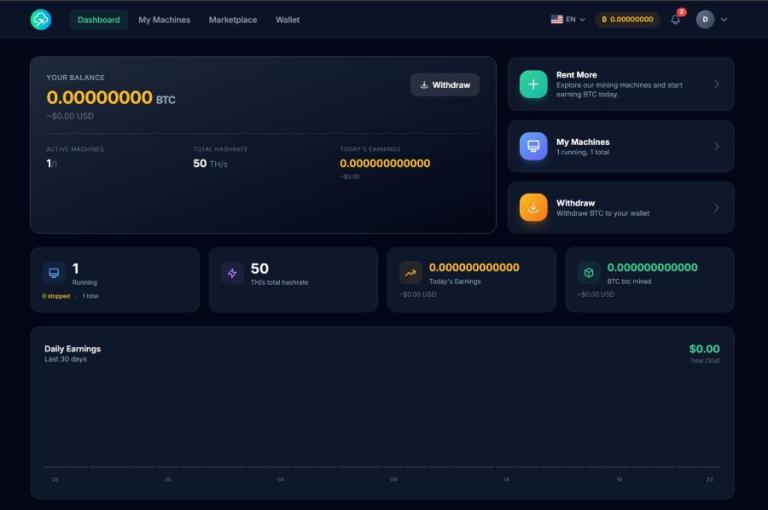
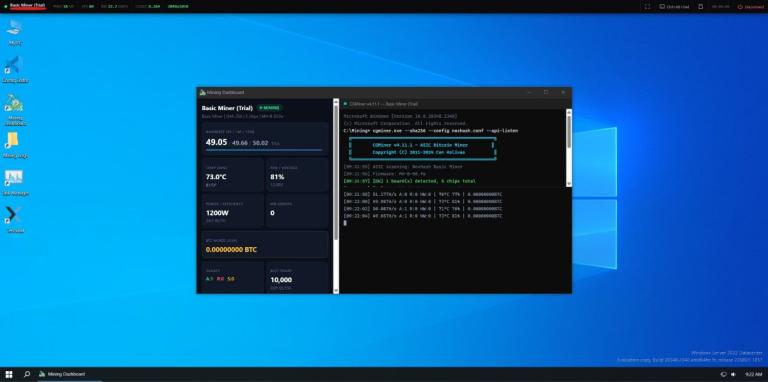
Activate the 2-day trial of the Basic Miner (50 TH/s) with no deposit required. You are not here to earn — trial BTC is displayed on the dashboard but not credited to the wallet. You are verifying that the dashboard works, the hashrate curve behaves sensibly, 2FA can be enabled, and the UI matches what you expect from an operator running real hardware. Cost: $0. Time commitment: about 48 hours of low-touch observation.
Phase 2 — First paid rental, Basic or Standard on a 1-month term
Deposit the minimum that covers one month — as little as $20 for the Basic Miner or $50 for the Standard. Choose the 1-month term explicitly — no discount, full flexibility, easy to exit. This phase is about two things: producing BTC you can actually withdraw, and experiencing one minimum-viable payout cycle end-to-end, including the 1.5% withdrawal fee and the 0.00001 BTC minimum.
Phase 3 — Observation window, one full monthly cycle
Let the contract run from day one to day thirty without intervening. At the end, compare realized BTC output (converted to USD at period-end price) against the 115–125% target range. Note how BTC price moved during the month, whether a difficulty adjustment hit mid-cycle, and how the mined amount responded. You are building a personal baseline, not reading someone else's chart.
Phase 4 — Scale-up, intentional and signal-driven
Only now do you consider moving up — a Pro tier ($100/350 TH/s), a longer term with the 3-month (5%), 6-month (10%), 12-month (15%) or 24-month (20%) discount, or both. The decision is informed: you know the platform, you have one real cycle of output data, and you know your own tolerance for the payout rhythm. Use the discount as an intentional choice, not a default — longer terms sacrifice reversibility for price.
Most people who blow up on cloud mining skip phases two and three entirely — they read marketing copy, jump straight to a large long-term Enterprise rental, and then try to learn the platform while USD is already at risk. The cost of doing it properly is one month of patience. The cost of doing it wrong is whatever the first adverse move takes from the oversized position.
Do phase one before you think about tier or term
The four-phase ramp starts with the free 2-day trial — a real 50 TH/s Basic Miner on the Kazakhstan fleet, the same dashboard you would use as a paid renter, and zero USDT at risk. This is the cheapest piece of due diligence available, and it is the precondition for every later decision about tier, term, or position size.
How Much to Start With — A Sizing Framework
The right starting number is not a fixed dollar amount — it is a fraction of your already-sized crypto allocation. This article assumes you have already decided, separately, how much of your broader net worth belongs in crypto at all. Within that crypto bucket, cloud mining is one instrument among several, and it should be sized accordingly.
A useful working range for most people: cloud mining exposure of roughly 5–20% of investable crypto capital, with the specific number dropping toward the low end if this is your first cycle, and rising toward the higher end only after multiple cycles with visible realized data. That is a wide range on purpose — it should be narrow only once you have personal experience to narrow it with.
| Your situation | Reasonable starting share | First tier / term |
|---|---|---|
| First time on any cloud mining platform | 3–5% of crypto capital | Basic $20 · 1 month |
| Comfortable with crypto, new to mining | 5–10% | Standard $50 · 1 month |
| Completed one cycle, positive experience | 10–15% | Standard or Pro · 3 months |
| Multiple cycles, high conviction | Up to ~20% | Pro or Enterprise · 6–12 months |
This is deliberately a within-crypto framework. The wider question — what percent of your total net worth should be in crypto at all — is a separate decision that depends on your age, income stability, and other assets, and sits outside the scope of a single article. The one rule that crosses both framings: you should be able to lose the entire cloud mining allocation and continue your normal life without disruption. If you cannot, the position is too big regardless of which framework you use.
Term Choice Matters as Much as Tier Choice
Most sizing conversations focus only on how much hashrate — the tier. The term decision is quieter but equally consequential, because it sets how long you are locked in if conditions change. A 1-month Basic is radically different from a 12-month Enterprise even if the total dollar commitment is similar, because the first is fully reversible in 30 days and the second is not.
| Term | Discount | Reversibility | Right for |
|---|---|---|---|
| 1 month | 0% | Maximum — exit in 30 days | First rental, any cycle uncertainty |
| 3 months | 5% | High | Second rental after clean first cycle |
| 6 months | 10% | Moderate | Experienced renter, stable tape |
| 12 months | 15% | Low — locked through a full cycle | High conviction, sizing a known allocation |
| 24 months | 20% | Very low — spans a potential halving | Long-horizon renter, fraction of total allocation only |
Rule of thumb: your first term should be 1 or 3 months, never 12 or 24. The 15–20% discount on the long terms is earned by accepting that you cannot exit if BTC drops 50% in month three. That acceptance is a reasonable trade once you know the platform and your own behavior under drawdown, which by definition you do not on day one.
When to Scale Up — Specific Signals, Not Feelings
"Feeling ready" is not a signal. Market pumps are not a signal. The following four conditions, all met at the same time, are a reasonable signal. If any one is missing, wait — the platform will still be there next month.
Signal 1 — One full cycle completed
At least 30 days of real payouts, start to finish, with the contract running cleanly. Partial data from week one is not a cycle.
Signal 2 — Realized return inside the target range
Output close to the 115–125% of rental-fee target, or credible reason for the gap (a known BTC drawdown, a difficulty spike during the month).
Signal 3 — Platform mechanics fully understood
You have used the Bitcoin tab, executed one small withdrawal, enabled TOTP 2FA with recovery codes stored offline, and can navigate the dashboard without guessing.
Signal 4 — Thesis on BTC unchanged
Your conviction on Bitcoin over the next 6+ months is the same as (or stronger than) it was at entry, based on the same reasoning — not just because the price went up.
All four of these are controllable by you, observable inside one month, and do not require any special access. That is the entire point. Professional position sizing looks boring from the outside precisely because it refuses to let excitement become a signal.
Common Sizing Mistakes to Avoid
The mistakes below are not hypothetical — they are the four most common ways people turn a reasonable cloud mining plan into an unreasonable one. Each has a plausible-sounding justification in the moment, which is exactly why they are worth naming in advance.
Scaling up during a pump
BTC is up 20% in two weeks and suddenly the plan calls for an Enterprise tier. This is the market buying conviction for you — expensive and reversible in days. If Phase 3 data was fine, scale at the planned pace, not at the market's.
Averaging down by doubling the rental
BTC drops mid-month and the instinct is to rent more hashrate — double the fixed USD cost at exactly the moment USD output is weakest. This is the opposite of averaging into spot BTC. Mining rentals are a fixed-cost commitment, not a variable position.
Locking a 12-month after one good month
Survivorship bias. One month of realized returns inside the target range is not the same as twelve. Take the 3- or 6-month step first. The 15–20% long-term discount will still be there after you have two or three clean cycles behind you.
Paying rental fees on credit
If you cannot comfortably fund the monthly rental out of cash flow without borrowing, the position is already too big. Financing a speculative mining rental with credit-card debt turns a 30-day commitment into a multi-month obligation at 20%+ APR. Size down.
The common thread in all four mistakes is the same: a moment of high emotion — excitement, fear, vindication, impatience — overriding a plan that was written in calm conditions. Writing the plan first, in writing, and referring back to it is the simplest guard against all of them.
Start Phase 2 at $20, not at $250
The four sizing mistakes above all share a root — oversized first position. The counter is mechanical: register, activate the free trial, and when you move to Phase 2, choose the Basic Miner on a 1-month term. $20 buys you a full real payout cycle, a real withdrawal test, and the data you need before any 12- or 24-month discount decision. The cheapest first rental is the one that preserves your ability to walk away.
Frequently Asked Questions
Should I skip the free trial if I'm already experienced with mining?
No. Experience with mining in general is not experience with a specific platform. The trial costs nothing, takes 48 hours of low-touch observation, and verifies the NoxHash dashboard, the payout behavior, and the hashrate display before any USDT is deposited. Skipping it saves no money and removes your cheapest due-diligence option.
Is the Basic Miner too small to be worth renting?
Not for Phase 2. The Basic Miner ($20 for 50 TH/s) exists to produce a full realistic payout cycle at a low total USD commitment — same fleet, same facility, same payout mechanics as Pro or Enterprise, just proportionally smaller. It is the correct size for learning, not the correct size for long-term allocation.
When is it safe to buy an Enterprise-tier rental?
After at least two clean monthly cycles at lower tiers, a tested withdrawal path, and a total cloud mining exposure that stays inside your chosen share of crypto capital even at the $250/month commitment. Enterprise is a sizing decision, not a status upgrade — buy it when the math says so, not when the dashboard makes it available.
Can I downgrade or exit a contract mid-term?
No — the rental term you choose is locked for that term at the discounted price. This is the core reason the first rental should be 1 or 3 months: short terms are inherently reversible, long ones are not. Contact support for edge cases, but do not plan around mid-term exits as a strategy.
What's the right first-month budget for most people?
For a first-time cloud mining user, $20–50 is usually the right range — a Basic or Standard Miner on a 1-month term, small enough that a 40% BTC drawdown mid-month does not change your life. You can always scale after Phase 3. You cannot easily un-scale after locking a 12-month Enterprise on day one.
What if I have a larger crypto portfolio — can I skip ahead?
A larger portfolio means a larger absolute starting position for the same 5–10% share — but the phase progression does not change. The risk being mitigated is platform-specific operational risk, which is unrelated to your total portfolio. A high-net-worth first-time renter still runs Phase 1 through Phase 3, just at a different scale.
Does starting small mean I miss out on the halving cycle?
No — halving-cycle effects, when they occur, play out over 12–18 months historically, per public market data. A one-month observation phase is a rounding error on that timeline. The position you scale into in month two captures most of the runway; the position you had to unwind at a loss in month three captures none of it.
Not financial advice — size accordingly
This article is educational and does not constitute investment, tax, or legal advice. Target ranges (115–125% of rental fee), tier pricing, term discounts, and the suggested sizing percentages reflect April 2026 NoxHash conditions and general risk-management practice, not a guaranteed outcome. Cloud mining carries market risk (BTC price and network difficulty), operator risk, and regulatory risk that vary by jurisdiction. Past performance does not predict future results. Only commit funds you can afford to lose entirely, and consult a qualified crypto-aware accountant about your local tax treatment before scaling a position.