Short-Term vs Long-Term Mining Contracts — Pros and Cons
Compare 1-month, 6-month and 24-month cloud mining contracts — discount math, halving risk, BTC cycle timing, and when each term length actually wins.

The term length of a cloud mining contract is a separate decision from the tier — and often the more consequential one. A 1-month rental buys flexibility at full price. A 24-month rental locks in a 20% discount but rides through multiple BTC cycles and, likely, a halving. This guide walks through what each end of the NoxHash term ladder actually trades away, where the 6-month middle sits, and how to pick a term that matches the market you are entering — not the one you wish you were in.

Why Term Length Is Its Own Decision
Most new renters pick a plan tier first — Basic, Standard, Pro, or Enterprise — and then click the term length that has the biggest discount badge. That is the wrong order. The tier decides how much hashrate you rent; the term decides how much risk you take with it. Those are two independent questions, and collapsing them into one almost always means the renter ends up overexposed on either dimension.
Term length is the axis that determines three things the tier cannot: how many BTC price cycles your contract rides through, whether your fee schedule crosses a halving, and how long you must continue paying a fixed USD rate if the market turns. A beautifully chosen Pro Miner locked on a 24-month term at the wrong moment in the cycle still underperforms a humble Basic Miner renewed month-to-month through the same window.
For context on why this matters right now: CoinDesk's coverage of post-halving mining economics tracks how block-reward cuts reshape operator and renter risk for the full cycle that follows. Any 24-month contract starting in 2026 or 2027 is, by definition, a cross-halving product — and it should be priced in your head as such.
Short-Term Contracts (1–3 Months) — The Flexibility End
Short-term rentals are what the NoxHash term ladder looks like at 1 or 3 months: zero or 5% discount, the same sticker price the landing page advertises, and full freedom to walk away after the term expires. They are the natural starting point for new renters and anyone who wants to re-evaluate their exposure frequently.
Pro — maximum flexibility
You can exit after 30 days with no sunk cost beyond the month you just paid. If BTC drops 40% two weeks in, you reassess at month-end instead of watching a 2-year commitment bleed.
Pro — low commitment, easy to test
A $20 Basic Miner at 1 month costs less than most monthly SaaS subscriptions. That is a cheap tuition fee to learn the dashboard, the withdrawal flow, and how you actually react to a bad BTC week before committing capital for longer.
Con — highest effective $/TH/month
You pay the sticker price with zero volume discount. On a Pro Miner, that is $100/month instead of the $85/month a 12-month renter pays — a 17.6% premium for the right to walk away every 30 days.
Con — renewal overhead & gaps
Every 1 or 3 months you need to remember to re-order. Miss a few days and you are off the pool, accruing nothing while your break-even math assumes continuous uptime. Short terms reward active users, not fire-and-forget ones.
Short-term contracts suit three groups especially well: first-time renters who need to see the dashboard with their own money, anyone navigating market uncertainty (pre-halving chop, regulatory news, ETF flows turning), and opportunistic users playing short windows like a one-off Ordinals or Runes fee spike. If you do not fit any of those, a 6-month term is usually a better fit than stacking 1-month rentals.
Long-Term Contracts (12–24 Months) — The Discount End
Long-term rentals live at the other end of the NoxHash ladder: 15% off at 12 months, 20% off at 24. The same machine costs meaningfully less per month — but you are locked in through whatever the market throws at the contract. That trade-off cuts both ways, and "long-term" is emphatically not a synonym for "safer".
Pro — best $/TH/month on the ladder
A 20% discount at 24 months is the cheapest unit cost NoxHash offers. On a Pro Miner that is $80/month (versus $100 on 1-month), which compounds into real savings over the full term — if you actually hold through it.
Pro — cross-cycle BTC accumulation
A 24-month term will, in most cycle positions, straddle both a drawdown and a recovery. If you are in cloud mining to stack sats rather than chase monthly USD income, that cross-cycle exposure is exactly the point.
Con — locked USD fee through drawdowns
Your rental is billed in USD; your output is BTC. When BTC loses 30–50%, you keep paying the same monthly fee while the mined BTC is worth less in dollars — and the discounted rate is non-refundable because your capacity is already allocated.
Con — halving & platform risk compound
A 24-month contract starting in 2026 or 2027 likely crosses the April 2028 halving — block reward drops 3.125 → 1.5625 BTC. Layer on the usual platform risk (operator reliability, fleet refresh cycles) and the time horizon stacks more unknowns than a 6-month renter faces.
Long-term contracts are built for one persona: the BTC accumulator who would hold spot for the same period anyway. If a 24-month BTC position would not faze you, then paying a 20%-discounted USD fee to mine through that window is a reasonable way to dollar-cost-average into sats. If the idea of locking any asset for two years makes you nervous, the discount is not enough to compensate for the psychology of the term.
The Discount Math — A Pro Miner Across All Five Terms
Abstract percentages only click once you apply them to a real machine. The table below walks a single $100 Pro Miner (350 TH/s) through every NoxHash term length — monthly effective rate, total commitment, absolute savings versus month-to-month, and the main thing each term is trading away.
| Term | Discount | Effective $/month | Total commitment | What you're trading |
|---|---|---|---|---|
| 1 month | 0% | $100.00 | $100 | No discount; maximum exit optionality. |
| 3 months | 5% | $95.00 | $285 | One quarter of flexibility for a small discount. |
| 6 months | 10% | $90.00 | $540 | Half a typical BTC volatility window. Sweet spot. |
| 12 months | 15% | $85.00 | $1,020 | A full BTC cycle leg. Conviction trade. |
| 24 months | 20% | $80.00 | $1,920 | Likely crosses the April 2028 halving. Accumulator only. |
The headline comparison is stark: $100/month × 12 = $1,200 on month-to-month, versus $85/month × 12 = $1,020 on a 12-month lock. The 12-month renter saves $180 — a genuine discount — and gives up the option to exit if BTC bleeds for a quarter. Whether that is a good trade depends entirely on conviction and timing, which the next section addresses.
The 6-month middle ground deserves particular attention. A 10% discount is meaningful (($540 vs $600 on back-to-back monthlies) without crossing any structural event. According to Hashrate Index's analysis of mining-contract structures, 6–12 month fixed-term rentals have become the dominant category in 2025–2026 precisely because they balance discount and exposure cleanly for most renters.
See the five term lengths priced on your chosen tier
You've just walked the Pro Miner through every term. The NoxHash order flow shows the same discount ladder applied to Basic, Standard, Pro and Enterprise in real time — so you can compare your actual number against the $1,020 vs $1,200 example you just read.
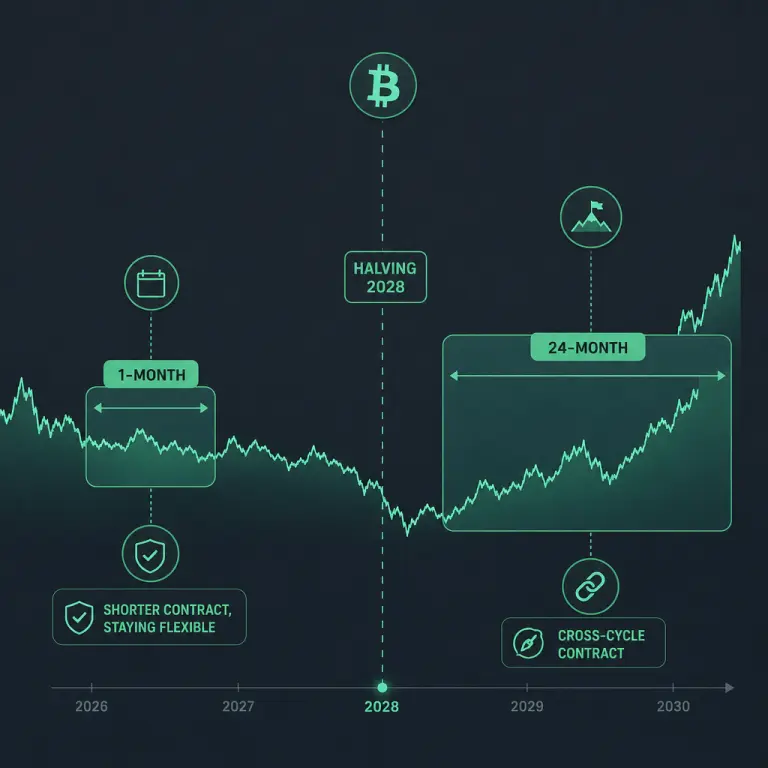
Term Length Is a Market-Timing Decision
This is the part of term-length analysis almost no vendor page will tell you: the right term depends on where BTC currently sits in its cycle, not just on your personal conviction. The discount ladder is static; the market is not. A 24-month term signed at a cycle top has a very different payoff profile than the same term signed 18 months later at a cycle bottom.
The mechanical reason is simple. A cloud mining rental pays a fixed USD fee and produces a variable amount of BTC whose USD value drifts with price. When BTC is ripping higher, the fixed USD fee looks cheap relative to the mined-BTC USD value — but you are also less likely to still be paying the cheapest rate months later. When BTC is bleeding, the fixed USD fee feels expensive because the mined BTC is worth less — yet that is often when long-term locks have the highest expected value if you truly believe in the recovery.
A practical heuristic: shorten the term one step during visible downtrends, lengthen it one step coming out of a clear trough. If BTC is in a sustained drawdown, a 12-month renter might pick 6 months instead and re-evaluate. If BTC has stabilized post-capitulation and you expect a multi-quarter recovery, that is the moment a 24-month lock captures maximum upside for minimum monthly cost. The cycle modifies the term; it does not determine the tier you already chose.
Halving-Crossing — The Hidden Clause in 24-Month Terms
Bitcoin's next halving is scheduled for April 2028, when the block reward drops from 3.125 BTC to 1.5625 BTC per block. Every 24-month contract signed from roughly mid-2026 through 2027 will span that event — and a 12-month contract signed from spring 2027 onward will cross it too. That is not a risk unique to cloud mining (spot holders face the same on-chain mechanics), but it matters more for renters because your fee schedule is fixed in USD while your output gets mechanically halved on a single block.
The historical pattern is that BTC price has risen materially in the 12–18 months after each prior halving (2012, 2016, 2020) — enough to more than offset the reward cut over time. That pattern is not guaranteed to repeat, but if you are signing a 24-month term you should at least be explicit with yourself about whether you are betting on it. A term that ends before April 2028 avoids the question entirely; a term that straddles it is the bet.
The pragmatic decision tree is short. If you are confident in the post-halving cycle thesis and have the capital tolerance, 24 months at 20% off is a coherent way to express that view. If you are not, 12 months at 15% off is the largest discount you can take while keeping your contract on one side of the halving line — and is, for many renters, the sensible ceiling.
A Clean Decision Framework for Term Length
Ignore the discount column for a moment and answer three questions in order. Whichever term length the combined answer points to is almost always the right one — regardless of what the biggest savings badge is pulling you toward.
1. Have I mined before?
If this is your first contract, default to 1 or 3 months. The first term is learning tuition — dashboard, withdrawals, your own reaction to a bad week. Long contracts are a second-contract decision, not a first-contract one.
2. Where is BTC in its cycle?
Sideways or rising from a trough → the full term ladder is on the table. Visibly extended or topping → shorten one step. Mid-drawdown → 1 or 3 months until trend stabilizes, even if discounts look appealing.
3. Does my term cross the halving?
If yes, you must be comfortable with block reward dropping mid-contract. If that feels like too many unknowns, step down one rung — 12 months still captures 15% off without crossing April 2028 unless you sign deep into 2027.
A sane default for most renters: start on a 1 or 3-month contract, let it run to term, then re-up on 6 months once you have lived with a dashboard and a difficulty adjustment. Graduate to 12 months only with clear conviction and a budget you could genuinely lock. Reserve 24 months for the specific case of strong cross-halving accumulation thesis — not for anyone chasing the biggest discount badge on the pricing page.
Run the three questions — then try a real dashboard first
Most readers of this guide should pick 1 or 3 months for their first contract. Before even that, NoxHash's 2-day Basic Miner trial lets you watch a live ASIC run with no deposit — the lowest-stakes way to validate the framework above on a dashboard showing your own BTC accrual.
Frequently Asked Questions
Is a longer mining contract always cheaper per month?
In unit terms, yes. NoxHash discounts are 0% at 1 month, 5% at 3, 10% at 6, 15% at 12, and 20% at 24. A Pro Miner drops from $100 to $80 per month on a 24-month term. But "cheaper per month" only matters if you actually complete the term — exit early and the full-price sticker applies.
Can I cancel a 12 or 24-month contract early?
On fixed-term rentals like NoxHash, no — the discount exists precisely because operator capacity, electricity and rack space are committed to your contract. If early exit flexibility is important, start with a 1 or 3-month term and renew manually rather than chasing the steeper lock-in discount.
Should I pick a short or long term if BTC is falling?
Default short. A visible downtrend means your fixed USD fee will buy declining-value BTC for however long the trend runs. A 1 or 3-month term lets you reassess frequently. Only consider longer terms once the market has stabilized or shows a clear trough — the discount is not worth riding a drawdown you could have avoided.
What happens to a 24-month contract at the 2028 halving?
Your rented hashrate stays identical, but network block reward drops from 3.125 BTC to 1.5625 BTC — so the BTC accrued per day falls roughly in half on fundamentals alone. Historically BTC price has risen in the 12–18 months after prior halvings, but that offset is a pattern, not a guarantee.
Is a 6-month contract actually the sweet spot?
For most renters, yes. A 10% discount is meaningful — $60 saved over six months on a Pro Miner versus back-to-back monthlies — and the term rarely crosses a halving or a full BTC cycle. It is the first "real" contract that rewards commitment without the long-duration exposures of 12 or 24-month locks.
Does stacking five 1-month contracts equal one 5-month contract?
In hashrate terms roughly yes, in price terms no. Five back-to-back 1-month Pro rentals cost $500; a single 6-month term costs $540 — so you "save" $40 on sequential monthlies. But you also risk missed renewals, and you lose the psychological commitment that keeps long-cycle accumulators holding through drawdowns.
Who should actually choose a 24-month contract?
Multi-year BTC accumulators with capital they can genuinely lock, who would hold spot for the same period anyway, and who have explicit conviction in the post-halving cycle. For everyone else — first-timers, USD-yield seekers, renters uncertain about the market — 6 or 12 months is the honest ceiling.
Educational framework — not financial advice
Discount percentages, example monthly costs, and halving-cycle commentary reflect NoxHash's published term ladder and April 2026 network conditions. Block reward, difficulty, BTC price and the post-halving pattern can change — past cycles do not guarantee future outcomes. Term-length choices carry market, counterparty, regulatory and tax risk that depend on your jurisdiction. Only commit funds you can afford to lose, verify local legal and tax treatment with a qualified professional, and size any single contract so an adverse outcome is inconvenient rather than material.