Post-Halving Mining Check-In: 2 Years After the 2024 Halving
Two years after the April 2024 Bitcoin halving, we score the predictions vs reality: hashrate, price, miner margins, and the countdown to 2028.

Two years ago this week the Bitcoin block reward halved from 6.25 to 3.125 BTC. The consensus said hashrate would crater, old rigs would vanish, and miner capitulation would define 2025. Here is what actually happened by April 2026: hashrate climbed past 1,000 EH/s, hashprice hit post-halving lows, and efficiency — not price — became the real story.
A Very Short Recap
The fourth Bitcoin halving landed at block 840,000 on April 20, 2024. Every winning block stopped paying 6.25 BTC and started paying 3.125 BTC, plus transaction fees. Nothing else changed: the same rigs, the same pools, the same electricity bills. Revenue in BTC was simply cut in half overnight, and the industry had to absorb that gap.
Today is April 24, 2026 — four days past the two-year mark. We have enough distance to compare the predictions analysts made pre-halving with what actually shook out. Some calls were right. Others were very wrong. The surprises are the interesting part.
The Prediction Scorecard: Forecasts vs Reality
Before April 2024, sell-side notes and mining-media coverage clustered around a familiar playbook: hashrate would drop, weak miners would capitulate fast, price would follow the four-year cycle. Here is how those calls aged by April 2026.
| Topic | Pre-halving consensus | What actually happened |
|---|---|---|
| Network hashrate | 10–20% contraction, slow recovery | Rose to 1,000+ EH/s in Q1 2026 before pulling back |
| BTC price 12–18 months out | New all-time high, post-halving rally | Rally confirmed through 2024–2025, ~50% drawdown in late 2025/early 2026 |
| Old-gen rig retirement | S17/S19 era unplugs within 6 months | Mostly correct — ~252 EH/s of marginal capacity offline by Q1 2026 |
| Public miner bankruptcies | Wave of Chapter 11 filings | Wrong — most pivoted to AI/HPC colocation instead |
| Hashprice | Recovery to ~$80/PH/s/day by 2025 | Peaked ~$63 in July 2025, collapsed to ~$28–30 by March 2026 |
| Difficulty | Flat-to-down post-capitulation | Grinded higher for 18 months, then dropped ~11% in Feb 2026 |
The headline miss: almost nobody predicted the AI pivot. Instead of bankruptcies, 2025 and early 2026 saw public miners sign over $70 billion in aggregate GPU co-location and cloud deals with hyperscalers, per CoinShares' Q1 2026 report. The thing forecasters treated as a sidebar turned out to be the main story.
What the Hashrate Actually Did
Hashrate is the cleanest single metric for "is Bitcoin mining dead or alive" questions. The April 2024 consensus said it would dip — because pure math says halved revenue should push marginal miners offline. It did dip, briefly. Then it kept climbing for eighteen months straight, pushed up by three forces:
Efficient ASICs arrived on time
Antminer S21 Pro, S21 XP Hyd, WhatsMiner M66S and competing units shipped in volume right as the halving hit. A 15 J/TH machine earns the same BTC per kWh as two 2021-era rigs, so growth could continue on the same grid footprint.
BTC price carried hashprice
Through 2024 and 2025, rising BTC price lifted the USD value of the reduced 3.125 BTC reward. That kept even mid-efficiency rigs cash-positive despite the BTC-denominated hashprice being halved at the protocol level.
Cheap-power hubs absorbed share
Kazakhstan, Paraguay, flared-gas sites in Texas and North Dakota, and hydroelectric Canadian provinces all expanded. Whenever a $0.10/kWh operator unplugged, a $0.03–0.05/kWh operator plugged in double the hashrate with the saved watts.
Then, in late 2025 and early 2026, the direction finally broke. Hashrate peaked above 1,000 EH/s, then rolled over. CoinDesk reported a 12% drop in January 2026 — the sharpest single-month decline since China's 2021 ban — as BTC price fell about 50% from its October 2025 peak and Chinese-origin machines were simultaneously shut down in a US policy action. By April 2026, the 30-day average settled near 969 EH/s. Still enormous. Still more than at the halving. But the "hashrate only goes up" narrative was finally, officially, not true.
Winners and Losers, Two Years On
With two years of data it is easy to see which business models handled the transition and which did not. The dividing lines are almost always the same two: energy price and machine efficiency. Operational discipline is what converts those advantages into margin.
Winner: low-cost industrial operators
Anyone locked into industrial power at $0.03–0.05/kWh running S21-class machines stayed cash-positive through the entire cycle, including the hashprice lows of early 2026. That is the sweet spot that absorbed the market share vacated by older rigs.
Winner: AI-pivot miners
Public miners with usable sites, grid interconnects, and available megawatts converted part of their fleets to GPU co-location for hyperscalers. The $70B+ in AI/HPC deals signed in 2025–2026 rerated the sector — some "mining" stocks are now majority-AI businesses by revenue.
Loser: mid-tier retail rigs
Home miners on S19-era hardware paying residential rates ran out of runway in the Q1 2026 hashprice lows. With hashprice near $28–30/PH/s/day, a 30 J/TH rig on $0.10/kWh power is burning cash every hour — there is no rally thesis small enough to bridge that gap.
Loser: "set and forget" treasury thesis
Public miners who held every mined coin as treasury looked brilliant at BTC's late-2025 peak, then gave much of it back in the drawdown. CoinDesk reported listed miners collectively reducing BTC treasuries by over 15,000 BTC from the highs. Pure HODL is not a mining strategy.

Where NoxHash Operators Sit in This Picture
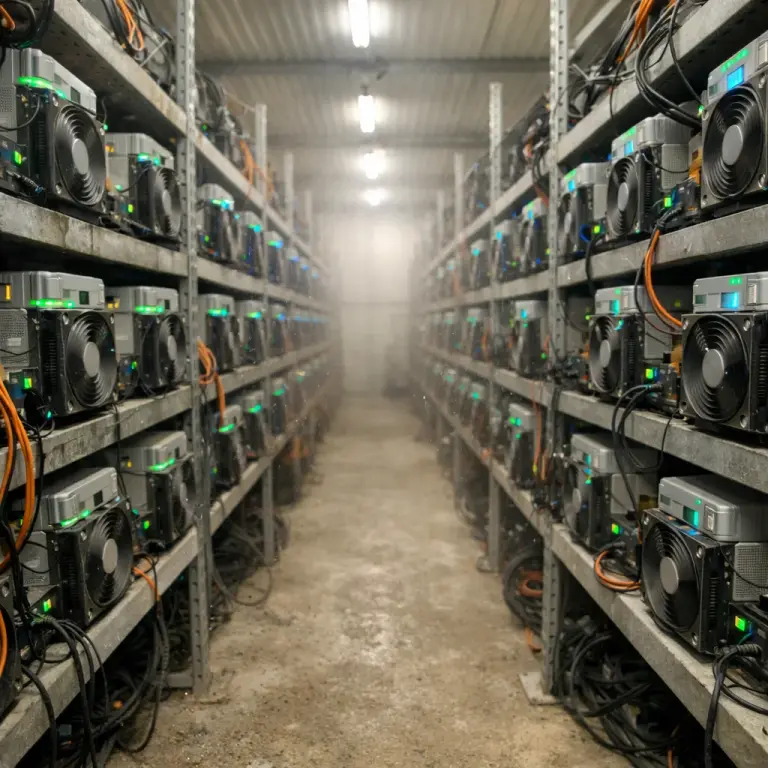
We are writing this from inside one of the structures that kept working through the full two years. NoxHash runs in Kazakhstan on an industrial grid contract of $0.03–0.04/kWh. Our fleet is built on Antminer S21 / S21 Pro / S21 XP Hyd and WhatsMiner M60S/M66S at 12–18.5 J/TH — exactly the efficiency band that survived when hashprice fell to its post-halving lows in Q1 2026.
That matters for anyone renting hashrate. The two variables that decided who stayed cash-positive for the last 24 months — grid price and machine efficiency — are the exact two variables our infrastructure was built around. When hashprice drops to $28/PH/s/day, a 30 J/TH rig on $0.10/kWh power is underwater; a 15 J/TH rig on $0.035/kWh is still making margin. That is not a forecast; it is an arithmetic property of J/TH and $/kWh.
The honest version: the same math that kept us operating through the cycle does not cancel market risk for renters. When BTC price drops sharply, BTC-denominated earnings translate to fewer dollars. Our structural cost advantage means the lower bound is further from zero than it would be on expensive power with old rigs, but it does not make mining a fixed-income product.
Rent on the side of the math that survived the last two years
You just read why grid price and machine efficiency decided winners and losers since April 2024. NoxHash is built on both — open a free account and take a 2-day Basic Miner trial before committing to a paid plan.
The Countdown to 2028
The fifth halving is approximately two years out — expected around spring 2028, when the block reward drops again from 3.125 BTC to 1.5625 BTC. That is another 50% cut in block subsidy. Every miner is already pencilling it in.
The efficiency bar keeps moving
Bitmain, MicroBT, Canaan and the newer challengers are all aiming at sub-12 J/TH for their next flagships. The unit that is competitive in 2028 will probably make today's S21 look like a 2023 rig — same as today's S21 makes the S19 Pro look obsolete.
Transaction fees get more important
With each halving the subsidy portion of block revenue shrinks relative to fees. In 2028 fees will matter more than they did in 2024. Mempool congestion events, Ordinals, Runes, and L2 anchoring all become more strategically interesting to miners every cycle.
Energy contracts get longer
The mining-AI bidding war is pushing data-center grid contracts to 7–10 year terms. Operators who locked in low rates before the AI surge are sitting on an enormous structural advantage that will carry through the 2028 halving.
Cloud mining becomes more, not less, relevant
As on-site economics get harder for small operators, access to industrial-grade power and the newest ASICs concentrates with operators who can buy them at scale. Renting hashrate from one of those operators is the only way most individuals will be on the efficient side of the 2028 halving.
Frequently Asked Questions
Was the 2024 halving really "priced in"?
Mostly for price, not for mining economics. BTC traded through the halving without a shock, helped by ETF inflows. But miner revenue was not priced in — BTC-denominated hashprice halved exactly as the code requires, and the two-year story has been margin compression working its way through the industry.
Did we see the expected "miner capitulation"?
Partially, and delayed. Old-generation rigs unplugged steadily through 2024–2025. Real capitulation across the broader industry only arrived in early 2026, when hashprice hit five-year lows and difficulty dropped ~11% in February — the sharpest adjustment since China's 2021 ban on mining.
When is the next Bitcoin halving?
The fifth halving is expected around spring 2028 — likely April or May — based on the 210,000-block cadence. Block subsidy will drop from 3.125 BTC to 1.5625 BTC. The exact date depends on how fast blocks are actually produced, but current pace points inside that window.
Why did hashrate keep rising if revenue was cut in half?
Two reasons. First, new ASICs are roughly twice as efficient as 2021-era rigs, so one new machine replaces two old ones on the same kWh. Second, BTC price rose through 2024–2025, so USD-denominated revenue held up even as BTC-denominated reward halved. Hashrate only started dropping when both of those supports weakened in late 2025.
Should I wait until after the 2028 halving to rent hashrate?
Timing the market is hard in any asset class; timing it across a multi-year halving cycle is harder. The more defensible question is whether the operator you are renting from has the right grid price and machine efficiency for a 3.125 BTC (and eventually 1.5625 BTC) world. Those structural factors matter more than exact entry timing.
Is the AI pivot the end of Bitcoin mining?
No — but it is reshaping who mines at scale. Public miners pivoting to AI/HPC still run mining sites; they added GPU revenue on top of existing SHA-256 operations. What the pivot really did was raise the cost of industrial power everywhere, which sharpens the advantage of operators already locked into long-term low-rate grid contracts.
Not financial advice
This article summarises publicly reported Bitcoin mining industry data through April 2026. Figures cited (hashrate, hashprice, BTC treasury positions, deal totals) reflect reporting from CoinDesk, CoinShares, and Hashrate Index at time of writing. This is not investment advice. Mining returns depend on Bitcoin price, network difficulty, energy costs, and market conditions — all of which can move sharply and sit outside anyone's control. Past performance does not guarantee future results. Only commit funds you can afford to lose.