How Some Users Reinvest Mining Earnings — Strategy & Risks to Consider
How some NoxHash users choose to reinvest mining earnings into additional miners — realistic trade-offs, market risks, and why compounding is never guaranteed.

A reinvestment strategy turns the BTC your miners produce into more hashrate. Instead of withdrawing every payout, you accumulate BTC, convert part of it into rental credit, and rent an additional miner — compounding your earning power month after month. Powerful in favorable markets, risky in downtrends.
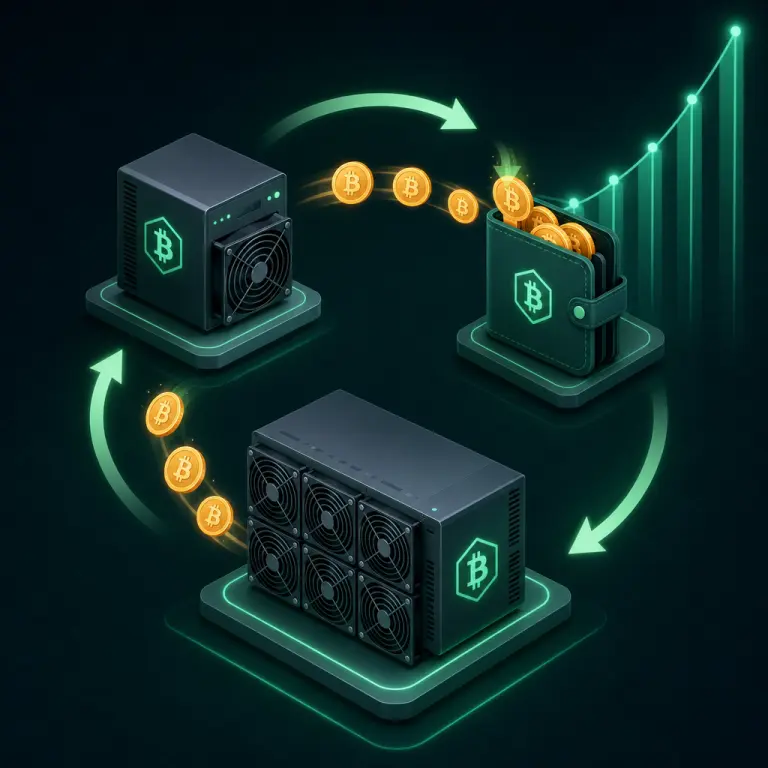
What Reinvesting Mining Earnings Actually Looks Like
On NoxHash, every miner you rent pays BTC into your on-platform wallet every minute. A reinvestment strategy means treating that BTC balance as working capital rather than spending money. You let it accumulate, convert a portion into USDT rental credit when the time is right, and use that credit to rent an additional miner — growing your total hashrate without adding fresh cash from your bank.
This is mechanically different from "HODLing" the BTC you earn. With HODL, your upside is tied 100% to BTC price. With reinvestment, your upside is tied to how much hashrate you control — which pays you in BTC regardless of whether the price goes up or down. Both approaches have merit; most experienced users blend them.
Compound hashrate
Each new miner adds to your TH/s, so next month's earnings come from a larger base. Growth stacks on top of growth.
Discount as you scale
Rental discounts scale from 5% (3 months) to 20% (24 months). Longer terms lower your effective $/TH over time.
Market-sensitive
Rental cost is fixed in USD, earnings are in BTC. When BTC falls, your margin shrinks — reinvestment amplifies both wins and losses.
An Illustrative 12-Month Compounding Timeline
Here's a hypothetical scenario to show how reinvestment could play out when market conditions cooperate. The numbers below assume a relatively stable BTC market and the NoxHash 115–125% monthly potential return range applied to rental cost. They are illustrations, not forecasts.
| Month | Active miners | Total hashrate | Est. monthly earnings | Cumulative balance* |
|---|---|---|---|---|
| 1 | 1 × Basic ($20) | 50 TH/s | ~$23–$25 | ~$24 |
| 2–3 | 1 × Basic | 50 TH/s | ~$23–$25/mo | ~$50 saved |
| 4 | 2 × Basic ($40) | 100 TH/s | ~$46–$50 | Rent 2nd Basic |
| 5–7 | 2 × Basic | 100 TH/s | ~$46–$50/mo | Build toward $50 |
| 8 | 2 × Basic + 1 × Standard | 250 TH/s | ~$103–$113 | Add Standard ($50) |
| 12 | 2 × Basic + 2 × Standard | 400 TH/s | ~$161–$175 | 8× Month 1 hashrate |
* Hypothetical only. Actual returns depend on BTC price, network difficulty, and market conditions. Each new miner is a new rental — you don't get "free" machines. The discipline is holding earnings long enough to pay for the next month's rent on an additional unit.
Three Reinvestment Styles — Pick the One That Fits You
Reinvestment is not a single playbook. Your pace should match your risk tolerance, how much of your BTC you want exposed to price movement, and whether you have other income to cover rent if markets turn.
Conservative — 50/50 split
Reinvest half of each payout, withdraw the other half as BTC. Slower hashrate growth, but you always have liquid BTC to ride out a downturn or cover a surprise expense.
Balanced — 70/30 reinvest
Reinvest 70% into rental credit, keep 30% as BTC. Decent compounding pace while keeping a reserve. Suits most users who want growth without betting everything on the platform.
Aggressive — 100% reinvest
Every payout funds the next miner. Fastest compounding on paper, but zero liquid buffer — if BTC drops or life throws a bill, you have to pull money from the outside.
How to Actually Execute Reinvestment on NoxHash
Reinvestment on NoxHash is straightforward because rent is paid in USDT and earnings are in BTC. These five steps capture the full loop — repeat each cycle:
Set a target per cycle
Decide what you're saving up for: another Basic ($20), a Standard ($50), a Pro ($100), or upgrading to a longer term for a 5–20% discount. Knowing the target keeps decisions mechanical instead of emotional.
Accumulate BTC in your wallet
Let BTC pile up on your dashboard. Do not withdraw to an external wallet yet — withdrawals cost a 1.5% fee, and you'd then need to deposit USDT back. Keeping funds on-platform is cheaper for reinvesting.
Top up with fresh USDT if needed
If your BTC balance in USD isn't quite enough to rent the next tier, deposit the gap via TRC-20 or BEP-20 USDT. Minimum deposit is $10. This is also where many users add small monthly contributions to accelerate growth.
Rent the next miner — check the market first
Before committing, glance at the BTC price trend on a source like CoinGecko's Bitcoin historical data. If BTC is clearly trending down or recently dumped, consider waiting — rental cost is fixed in USD and won't recover when BTC does.
Log, review, and adjust
Track each cycle in a simple spreadsheet: date, BTC price, miners added, total hashrate. Review monthly. If margins shrink for two cycles in a row, slow the pace or move toward the 50/50 conservative split.
Put the 5-step reinvestment loop to work
You've seen the timeline and the three styles above. Open an account, start with a Basic Miner, and set your first reinvestment target before earnings pile up. Small, disciplined cycles compound faster than big irregular bets.

When You Should NOT Reinvest — Four Clear Red Flags
Reinvestment amplifies outcomes in both directions. In a favorable market it compounds your hashrate; in a bad one it compounds your losses. Pause the loop when any of these signals show up:
-
1. BTC is in a confirmed downtrend. Rental cost is fixed in USD, earnings are in BTC. If BTC drops 30% and stays there, your USD-equivalent earnings drop 30% too — but the rent for your new miner does not. Wait for stabilization before expanding.
-
2. Network difficulty is spiking fast. If global hashrate rises sharply while BTC price is flat, each TH/s earns less BTC. Adding more hashrate into that environment delays your break-even on every new miner.
-
3. You have no emergency cash reserve. Never pour your last dollar into mining. Keep 3–6 months of personal expenses in cash outside crypto before you reinvest aggressively. Mining returns are uncertain; rent, groceries, and medical bills are not.
-
4. Two cycles in a row under-performed. If your USD-equivalent earnings missed your expected range for two consecutive months, that's your signal to pause, not double down. Withdraw a portion as BTC, re-read the market, and resume when your own data stabilizes.
Frequently Asked Questions
Is reinvesting mining earnings better than just holding BTC?
Neither is universally better — they're different bets. HODL ties your upside to BTC price only. Reinvestment compounds hashrate, paying BTC regardless of price direction, but adds exposure to fixed USD rental costs. Most experienced users blend the two: reinvest part, hold part.
How much should I reinvest starting out?
Start small and stay conservative. A single Basic Miner at $20 is enough to test the full loop. A 50/50 split — half reinvested, half withdrawn — gives you real experience with both reinvestment and BTC exposure without over-committing to either side.
Do discount tiers make longer rentals the smarter reinvestment?
Longer terms unlock 5–20% discounts, which lowers your effective cost per TH/s. But they also lock capital for longer. Only commit to 12 or 24-month terms if you're confident in your market outlook and have reserves to cover the full term if earnings dip.
Should I withdraw BTC to an external wallet between cycles?
For the portion you plan to reinvest, no — each withdrawal costs a 1.5% fee, and you'd need to deposit USDT back. For the portion you want to keep as long-term BTC, yes — move it to a wallet you control. Don't store large balances on any platform indefinitely.
What happens to my reinvestment plan around a Bitcoin halving?
Halvings cut block rewards by 50%, temporarily compressing BTC earned per TH/s until price or fees adjust. Historically, BTC has recovered over the following 12–18 months, but past performance never guarantees the future. Slow your reinvestment pace in the months immediately after a halving.
Can I stop reinvesting at any time?
Yes. Reinvestment is a personal rhythm, not a subscription. Your existing miners keep running to their rental terms regardless. You can switch to a HODL-only approach, withdraw freely, or resume reinvesting later whenever your outlook and reserves allow.
Important: Not Financial Advice
This guide is informational only and is not financial, investment, or tax advice. The numbers in the compounding table are illustrative, not guaranteed. Actual mining earnings depend on Bitcoin price, network difficulty, halvings, and broader market conditions — all of which can change quickly and are outside your control.
Rental costs are fixed in USD but earnings are paid in BTC. If BTC falls, your USD-equivalent earnings can drop below your rental cost and you can lose money. Never reinvest funds you cannot afford to lose. Keep an emergency cash reserve outside crypto. Start small, verify the strategy with your own data for several months, and consider consulting a licensed financial or tax advisor about your personal situation before committing meaningful capital.
Past performance does not guarantee future results.