How Mining Pools Distribute Block Rewards — Behind the Scenes
From share submission to your wallet: how Bitcoin mining pools split the 3.125 BTC block reward, calculate payouts, and route satoshis to miners in 2026.
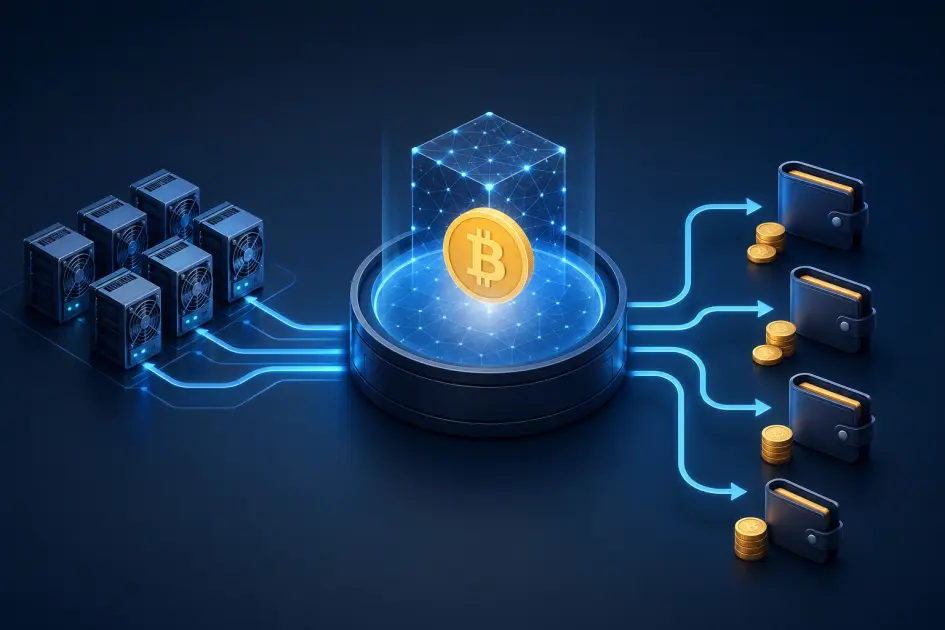
A mining pool distributes block rewards by tracking every "share" each miner submits, then splitting the 3.125 BTC block reward plus transaction fees in proportion to the work each miner contributed. The payout formula, fee model, and frequency depend on the pool's scheme — PPS, FPPS, or PPLNS — and each one moves the risk between miner and pool differently.
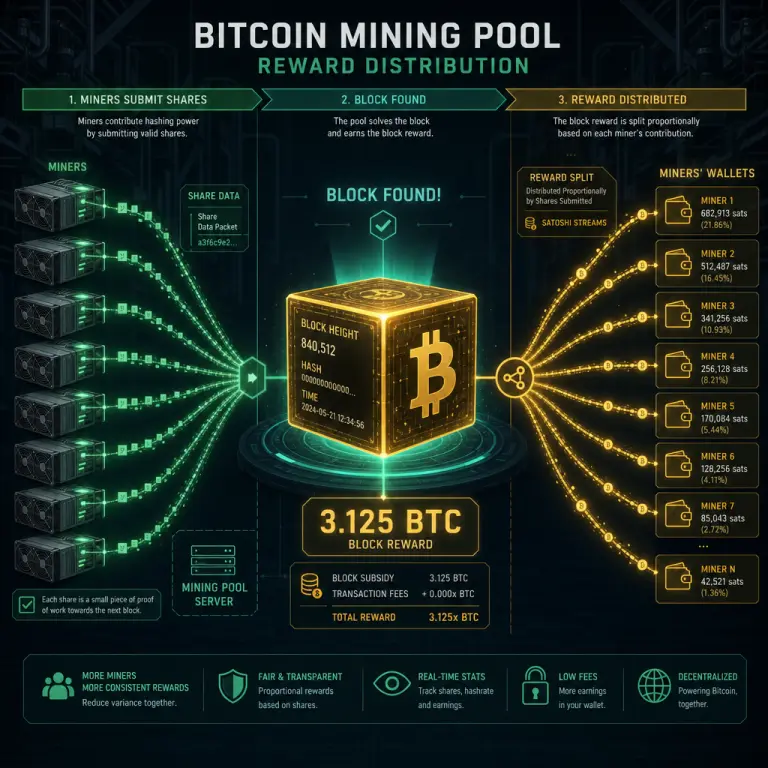
What Happens the Instant a Pool Finds a Block
A Bitcoin block is found roughly every 10 minutes. When one of the thousands of miners connected to a pool hits the winning hash, the block is broadcast to the Bitcoin network — but the economic event happens one transaction earlier, inside that same block.
Every block starts with a special transaction called the coinbase transaction. It has no inputs; it mints new bitcoin out of thin air and pays it to whoever the block builder chose. In a pool context, the pool operator is the one choosing that address — so the 3.125 BTC subsidy plus all the transaction fees from that block land in the pool's wallet first, not the miner's.
From that point, the pool becomes a bookkeeper. It reads its own share ledger for the relevant window, applies its payout formula, subtracts its fee, and queues payouts to every miner who earned a slice. The block reward never moves "from the network to the miner" directly — it always passes through the pool's settlement layer, which is the single most important thing to understand about how this system works.
Coinbase transaction
The block's first transaction mints 3.125 BTC and collects all included fees. The pool operator controls the address that receives it — that is the on-chain anchor point of every payout that follows.
Share ledger
Every valid share submitted by every miner is logged with a timestamp and a difficulty value. This ledger is the source of truth the pool consults when it decides who earns how much.
Payout batch
Once a miner crosses the payout threshold — typically 0.001 to 0.01 BTC — the pool sweeps their balance into an on-chain transaction, usually once a day, minus the pool fee and network fee.
Shares — The Unit of Work That Drives Every Payout
You cannot split a block reward based on hashrate alone, because hashrate isn't directly measurable. The only thing a pool can actually verify is a share: a proof-of-work solution that meets a lower difficulty target than the network requires. Every share is an observable, countable, cryptographically valid piece of evidence that a miner did a specific amount of work.
Here is the trick. Bitcoin's network difficulty in early 2026 sits around 135 T — finding a block hash below that target is astronomically rare. So pools set their own, much lower share difficulty, tuned so each miner submits a share roughly every few seconds. The higher a miner's hashrate, the higher the share difficulty the pool assigns to them, so they still submit at a steady cadence without overloading the pool's servers.
Each share is weighted: a share solved at difficulty D counts as D units of work. Submit a share at difficulty 1,000,000 and it's worth a thousand times a share at difficulty 1,000. When the pool divides the block reward, it divides by this difficulty-weighted share total, which is mathematically equivalent to splitting by contributed hashrate over time — but using something the pool can actually prove. Bitcoin Wiki's Mining pool reward FAQ documents the full math behind this.
A tiny worked example
Suppose a pool finds a block and its share ledger for the relevant window shows a total of 1,000,000,000 difficulty-weighted shares. Miner A submitted 2,500,000 of those shares. Miner A's entitlement is:
(2,500,000 / 1,000,000,000) × 3.125 BTC = 0.0078125 BTC
Then the pool's fee (say 2%) is subtracted, leaving ~0.00765625 BTC credited to Miner A's pool balance. In an FPPS pool, transaction fees from the block are also added to this total; in a pure PPS pool, they are not. Exact same share ledger, different take-home.
Three Ways Pools Turn Shares Into Satoshis
The share math above is only the first half of the story. What changes between pools is when and under what conditions those shares actually convert to BTC in your balance. Three models dominate Bitcoin mining in 2026.
| Model | What it pays | Risk bearer | Typical fee |
|---|---|---|---|
| PPS Pay Per Share |
Fixed rate per share based on expected block subsidy only. Paid whether or not the pool actually finds a block. | Pool absorbs all luck variance; miner has zero variance. | 2–4% |
| FPPS Full Pay Per Share |
Same as PPS, plus a theoretical share of average network transaction fees. Miner gets block subsidy + fee revenue. | Pool absorbs luck and fee variance; miner gets the smoothest curve. | 2–4% |
| PPLNS Pay Per Last N Shares |
Miners share actual block rewards (subsidy + fees) only when the pool finds a block, proportional to their shares in a rolling window. | Miner absorbs luck variance; pool just runs the books. | 0–2% |
Transaction fees matter more than they used to. Across 2024–2025, fees routinely contributed 5–15% of total block revenue, and on congestion days spiked above 40%. This is why FPPS has become the default for most industrial miners — in a PPS-only pool, every one of those fee sats quietly stays with the pool operator.
PPLNS works very differently. Instead of a daily rate, you are paid only when the pool actually mines a block, and only based on shares you submitted in the last N-block window. If you mined hard during a stretch the pool had bad luck, your shares expire unpaid. If you mined during a lucky stretch, you collect more than the average. Over thousands of blocks this evens out to roughly the same expected value as PPS — but day-to-day cash flow is much spikier. Hashrate Index has a detailed breakdown of share difficulty and hash functions that explains the variance math in depth.
The Life of One Satoshi — From Hash to Wallet
It helps to trace a single satoshi from the moment work starts to the moment it lands in a miner's wallet. This is the path every payout takes, regardless of pool or scheme.
Pool sends a job to your miner
Over the Stratum protocol, the pool pushes a block template — including the pool's own payout address in the coinbase transaction — to every connected ASIC. Your miner starts iterating through nonces to find a hash below the share difficulty target.
Your miner submits shares every few seconds
Each share is a hash below the share target. The pool validates it, logs it against your worker ID with the difficulty it was solved at, and adds it to the share ledger. This happens thousands of times per day per miner.
One share happens to also meet network difficulty
Statistically rare but inevitable: somewhere in the pool, a share is so low-value it also beats Bitcoin's 135 T network difficulty. The pool broadcasts that share as a full block. The 3.125 BTC subsidy + fees land in the pool's wallet via the coinbase transaction.
The pool credits your internal balance
Using its payout scheme, the pool calculates your cut — continuously in PPS/FPPS, per-block in PPLNS — subtracts the pool fee, and adds the result to your off-chain account balance. You can watch it tick up in the pool dashboard.
A payout transaction sweeps you out
Once your balance clears the payout threshold (commonly 0.001–0.01 BTC) and the schedule fires — usually daily — the pool batches hundreds of miners into one on-chain transaction, sending each one their owed BTC minus the network fee. Your satoshi is finally yours.
Skip the share ledger — rent a worker already connected
Now that you know shares, coinbase transactions, and payout schemes decide every satoshi, you can see why picking a pool and tuning a miner is work. NoxHash connects its fleet to FPPS pools for you and credits mining income directly to your BTC balance.
What NoxHash Does Behind the Scenes So You Don't Have To
Understanding the mechanics above is useful — managing them day to day is a different job. Our fleet of Antminer S21 series and WhatsMiner M60/M66 units (12–18.5 J/TH) at our Kazakhstan data center is pointed at FPPS-style pools, chosen because the block-subsidy + transaction-fee coverage smooths out revenue for the renters whose plans sit on top of that hashrate.
Concretely, that means a few things on your side of the wall:
Pool fees are already in the plan
The 1–2% industrial-tier pool fee is baked into the monthly plan price, not charged separately. You never see a share ledger, a threshold setting, or a "worker configuration" page.
Credits post every minute, not every batch
Instead of waiting for an on-chain payout to clear, NoxHash credits your BTC balance minute by minute while your rig runs — withdrawal happens on your schedule, not the pool's.
Auto-failover between pools
Our monitoring layer watches pool connectivity continuously. If one pool endpoint drops, the fleet reconnects to a backup automatically — miners keep submitting shares, renters keep earning.
No "luck" risk for you
Because we run FPPS on the pool side and credit renters from a smoothed internal rate, you don't see the sawtooth revenue chart that a solo PPLNS miner would. Variance is absorbed before it reaches your dashboard.
Practical Takeaways When Choosing or Evaluating a Pool
Check whether fees are included
FPPS pays out block subsidy + transaction fees; vanilla PPS pays only subsidy. In a high-fee environment, that gap can be the difference between a profitable and breakeven month.
Know what variance you can stomach
PPLNS saves you a percent or two in fees but introduces real day-to-day variance. If you can't weather a week of below-expected payouts, the fee savings are not worth it — pick an FPPS pool.
Read the payout threshold fine print
A pool that requires 0.01 BTC minimum before it pays out is fine for a 1 PH/s operator but painful for a hobbyist with 50 TH/s — you may wait weeks per payout, losing compounding and hedging flexibility.
Watch concentration, not just price
The top three pools routinely control around two-thirds of Bitcoin hashrate. Concentration is a network-health concern, not just yours — all else equal, the ecosystem benefits when miners don't all pile into the biggest pool.
Frequently Asked Questions
Who actually receives the block reward first — the miner or the pool?
The pool. The coinbase transaction in every block found by a pool points at the pool's own wallet, not individual miners. The pool then redistributes the 3.125 BTC subsidy plus fees to miners using its payout scheme, minus its fee. Miners never touch the coinbase output directly.
What exactly is a "share" and why does it have a difficulty?
A share is a hash that meets the pool's lowered difficulty target. It proves a miner did a specific amount of work. Share difficulty scales with your hashrate so you submit a share every few seconds, keeping pool servers responsive while giving a statistically reliable measure of contribution.
Why is FPPS more common than plain PPS in 2026?
Transaction fees have grown to 5–15% of block revenue on average and spike far higher during congestion. Pure PPS pays only the subsidy, so pools keep all fees. FPPS shares an average fee rate with miners, matching miner expectations after the 2024 halving cut subsidy by 50%.
How often do pools actually pay out to my wallet?
Most major pools run one on-chain sweep per day for miners who cleared the payout threshold (typically 0.001–0.01 BTC). Smaller balances accumulate until they cross the line. Pools batch hundreds of miners into one transaction to keep network fees per miner low.
Do cloud-mining renters deal with any of this directly?
No. NoxHash handles pool selection, share submission, fee negotiation, and payout reconciliation on behalf of the fleet. Renters see a simple BTC balance ticking up every minute while their rented hashrate contributes to the pool — the share ledger stays invisible.
Educational content, not investment advice
This article explains how mining pools technically distribute rewards and is for education only. Mining revenue depends on BTC price, network difficulty, transaction fee levels, and pool luck — all of which can move against you. Historical performance does not predict future results. Only allocate capital to mining you can afford to lose, and review market conditions before renting hashrate.