Hot Wallet vs Cold Wallet — Which One for Mining Payouts?
Hot wallets are connected, cold wallets aren't. For miners with recurring BTC payouts, the answer is both — a small hot wallet for flow, cold storage for savings.
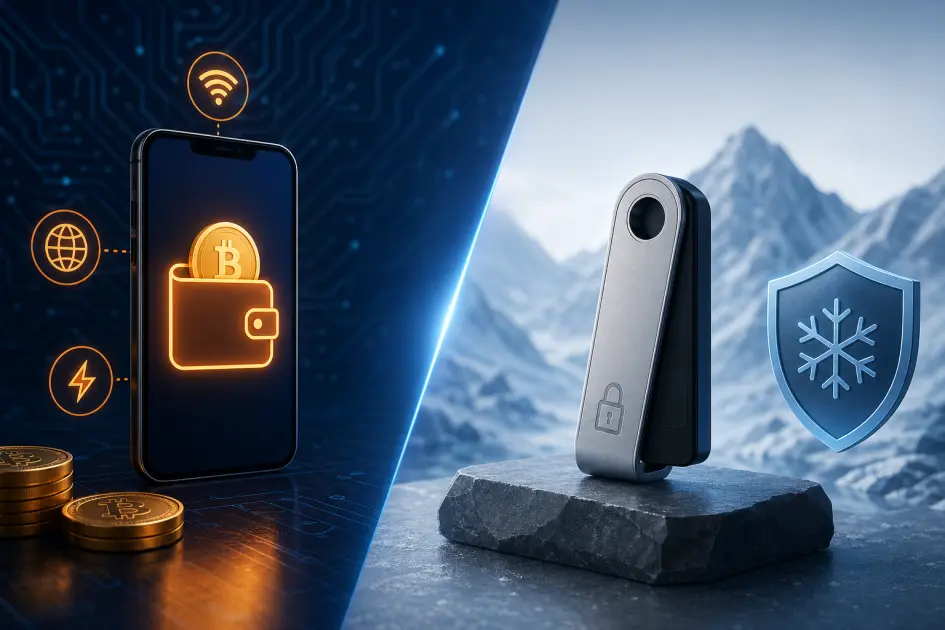
A hot wallet holds your private keys on a device connected to the internet — a phone app, browser extension, or desktop app. A cold wallet keeps keys on a device that is never online, usually a hardware device you plug in only when signing. For miners receiving recurring BTC payouts, the honest answer is not either/or: a small hot wallet handles weekly flow, a cold wallet protects the long-term stack.

Hot vs cold in plain English
The words sound dramatic, but the idea is mundane. A hot wallet is any wallet where the private keys live on a device that touches the internet — your phone with a Bitcoin app installed, a browser extension on your laptop, a desktop wallet on a PC that browses the web. The moment those keys sit on a machine capable of going online, the wallet is "hot."
A cold wallet flips the assumption. The keys live on a device that has never been connected to the internet and, ideally, never will be. The classic examples are a hardware wallet you only plug in briefly to sign a transaction, a paper wallet with keys printed and stored offline, or an air-gapped computer that never sees a network cable.
The tradeoff is convenience versus attack surface. Hot wallets let you spend in seconds. Cold wallets require a ritual — fetch the device, enter a PIN, verify the address on a screen, sign. Neither is "better." They solve different problems, and most miners end up needing both.
One more nuance: hot and cold are not a clean binary, they are a spectrum. A mobile wallet on a rooted Android with side-loaded apps is hotter than the same wallet on a locked-down, biometric-protected iPhone used only for BTC. A hardware wallet that talks to your PC over USB is hotter than one that signs transactions using air-gapped QR codes. When you hear miners argue about "hot versus cold," they are usually arguing about where on that spectrum their own setup sits — not about two separate categories.
What "connected" actually means
The most common confusion is where the line sits. A few clarifications that matter:
Your phone wallet is hot
Even with a passcode, Face ID, and biometrics, a mobile wallet is hot. The keys live on a device that runs apps, receives push notifications, and downloads updates. Convenient — but not cold.
Exchange custody is functionally hot
If an exchange holds your keys, you have IOU exposure, not self-custody. The exchange's internal wallets sit online and are targets. "Not your keys, not your coins" is the rule.
Plugged-in hardware wallet is "partially hot"
The instant you connect a hardware wallet by USB to a PC to sign, the threat model shifts. The keys still never leave the device, but malware on the host can try to swap addresses. Verify every address on the hardware screen.
Fully cold = keys never online
The gold standard: a hardware wallet set up from a sealed box, seed phrase written on paper or steel, and a signing flow that uses QR codes or microSD instead of USB. No network, ever.
Hot vs cold — side by side
The table below maps the two approaches across the dimensions miners actually care about. Neither "wins" outright — each row tells you which paradigm fits which situation.
| Criteria | Hot wallet | Cold wallet |
|---|---|---|
| Convenience | High — spend in seconds from a phone | Low — each transaction is a manual ritual |
| Attack surface | OS, app, browser, clipboard, SIM, phishing | Physical device only — no remote hack |
| If device lost or broken | Restore from seed on new phone | Restore from seed on new hardware |
| Speed to spend | Seconds — tap and confirm | Minutes — fetch device, plug in, verify |
| Best use case | Daily flow, small spending, Lightning, DCA | Long-term savings, inheritance planning |
| Typical balance range | What you can afford to lose (think: cash in pocket) | Anything meaningful — multi-month stacks |
| Cost | Free (reputable open-source apps) | ~$70–$220 for a hardware device |
Notice that cold wins on security rows and hot wins on convenience rows — exactly as expected. The question is not "which one," but "how much of my stack belongs in each."
Why miners specifically need both
A trader who buys BTC once a year can realistically pick a single wallet and be done. A miner cannot. Cloud mining produces recurring, small, predictable payouts — a trickle that eventually totals a meaningful balance.
This creates two problems that generic "hot vs cold" articles miss:
Pure-cold is too heavy for a trickle
Withdrawing $30 of weekly mining revenue directly to a cold wallet, then doing the verify-and-sign ceremony every time you want to spend, is painful. You will either stop withdrawing or stop using the coins.
Pure-hot stacks all your mining in one target
Accumulating 12 months of payouts in a mobile wallet creates a single juicy target on a device that goes to cafes, airports, and repair shops. One compromised phone loses a year of work.
The fix is the two-wallet pattern: treat the hot wallet like a checking account and the cold wallet like a savings account. Money flows in weekly, rests briefly, and gets swept to savings before it becomes worth stealing. The workflow in the next section walks through exactly how that looks in practice.
This pattern mirrors how traditional finance separates liquidity from reserves, and it is not an accident. A miner with a year of payouts ahead of them is essentially running a tiny cash-flow business: a predictable inflow, a security-sensitive balance sheet, and a need to spend some and save most. The two-wallet split gives each coin a clear role — either it is available for use, or it is in long-term protection. Coins that sit in an ambiguous middle, neither actively used nor properly protected, are the ones that tend to get lost.
The two-wallet workflow, step by step
Here is what the flow looks like for a miner who earns BTC from NoxHash each week or month. Numbers are examples — adjust the sweep threshold to match your own income and spending rhythm.
Mine — payouts accumulate on NoxHash
Your rented machines credit BTC to your platform balance every minute. Over a week, a mid-tier rig might accumulate something like $30–$50 of BTC, depending on price and difficulty. Nothing has left the platform yet.
Withdraw weekly or monthly to a hot wallet
Batch payouts. Withdrawing every minute wastes fee on small outputs and bloats your UTXO set. Once a week or once a month, pull your balance to a self-custodial mobile wallet — think of it as your BTC checking account.
Set a sweep threshold
Pick a number above which the hot wallet gets uncomfortable. A common rule: 0.01 BTC, or "one month of rent," or "what you can afford to lose without flinching." Below that, leave it hot for spending; above it, move.
Sweep the excess to cold storage
Generate a fresh receive address on your hardware wallet. Send a small test amount first (0.0001 BTC) to confirm the address works, then send the rest. Your hot wallet drops back below the threshold, and the stack grows in cold storage.
Only touch cold storage for major events
Cold storage is a one-way door. You sweep into it monthly, and you open it only for significant withdrawals — a large purchase, rebalancing, a life event. Each extra signing session is another chance for operational error. Make them rare.
Put the two-wallet workflow to work
The pattern only matters once real payouts start landing. Start mining on NoxHash to generate the recurring BTC that this hot-wallet-plus-cold-wallet routine is designed for.

When to break the two-wallet rule
The pattern is a default, not a law. Two honest exceptions:
Very small monthly income
If your total mining is under ~$100 per month and you plan to spend it on coffee-money BTC purchases, a single reputable mobile wallet is fine. Adding cold storage for $50 balances is overkill — the hardware wallet costs more than the coins it protects.
Pure-HODL miner who never spends
If you treat BTC as pure savings and never intend to spend it, a cold-only setup is legitimate. Withdraw each payout directly to the hardware wallet. You still pay the ceremony cost per withdrawal, but you avoid the hot wallet entirely.
The useful test is your actual behavior, not your intent. If you keep meaning to move BTC to cold storage and never get around to it, the two-wallet pattern fails; you effectively have one hot wallet. Honest self-assessment matters more than picking the "right" architecture on paper.
Frequently asked questions
Can a hot wallet be hacked through the internet?
Yes, indirectly. The attacker usually does not break the wallet app itself — they compromise the device. Malware, phishing pages that swap clipboard addresses, fake wallet apps in app stores, and SIM-swap attacks on recovery flows all target hot wallets. That is why small balances belong in them.
Is leaving BTC on an exchange considered a hot wallet?
Functionally yes, but worse. The exchange's hot wallets sit online and attract attackers, and you do not control the keys — you hold an IOU. If the exchange is hacked, frozen, or insolvent, your balance can disappear regardless of your own security habits. Treat it as temporary transit only.
Can I use a hot mobile wallet for large amounts?
Technically yes, practically no. A mobile wallet can hold any amount, but the risk scales with the balance while the protections do not. Once the phone loss would meaningfully hurt — a month of mining, several weeks of rent — that is the signal to sweep the excess into cold storage instead.
What is a "warm wallet"?
An informal middle ground — a wallet that is usually offline but occasionally connected, or a multi-signature setup where some keys are cold and one is hot. Warm wallets show up in businesses and custody services. For individual miners, the simpler two-wallet pattern is easier to operate correctly.
Does the Lightning Network change the hot/cold calculus?
Lightning channels are inherently hot — they require a node that is online to route payments. That reinforces the split rather than changing it: keep a small amount in a Lightning wallet for instant payments, keep savings on-chain in cold storage, and top up the Lightning side from the on-chain hot wallet as needed.
How often should I sweep from hot to cold?
Whenever the hot balance crosses your threshold — not on a calendar. Tying the sweep to an amount rather than a date means small-income months skip the ceremony, and big-income months trigger it automatically. Most miners end up sweeping monthly; heavy earners sweep weekly. Either is fine.
For the open-source protocol documentation on Bitcoin keys and addresses, the canonical reference is bitcoin.org.
Informational only — not financial or security advice
This article explains general wallet concepts and workflow patterns. It is not investment, tax, or personalized security advice. Self-custody carries responsibility: lost seed phrases, damaged hardware, and operational errors can result in permanent loss of funds. Research your own setup, test with small amounts first, and only commit balances you are prepared to manage yourself.