The Hidden Costs of Mining Bitcoin at Home
The 10 hidden costs home Bitcoin miners forget: summer AC spike, tiered power, circuit upgrades, insurance voids, noise, resale loss and more.
Home Bitcoin mining has a sticker price — and a shadow price. The sticker price is the ASIC plus electricity. The shadow price is everything else: the summer AC bill that climbs 30%, the $800 circuit upgrade, the voided homeowner's policy, the 75 dB roar at 2 AM, the fans that die every nine months. This article is the list of hidden costs most spreadsheets ignore — the ones that quietly turn a "profitable" home rig into a household argument. Cloud mining skips all of them, which is part of why the math keeps pointing in that direction.
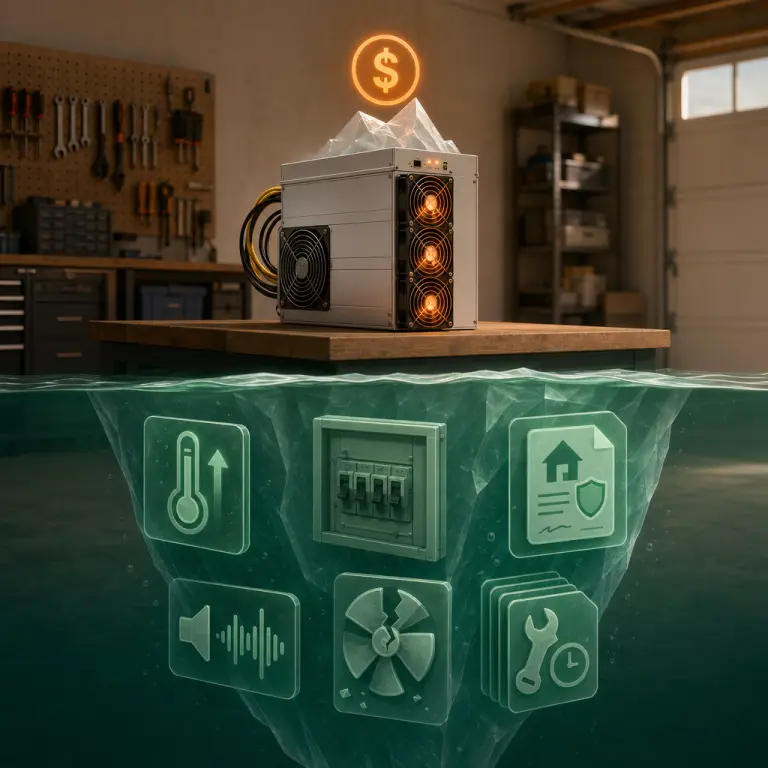
Beyond the Electricity Bill — Why the "Obvious" Costs Are Only Half the Story
Most home-mining calculators end at "hardware plus electricity equals cost". That model is clean, satisfying, and wrong by 20–40% in most real households. The problem is that an ASIC miner is not a laptop — it's a 3.5 kilowatt industrial appliance that reshapes the room, the electrical panel, the HVAC load, and sometimes the household mood. Every one of those shifts has a dollar cost attached, but almost none of them show up on a calculator page.
Sibling articles on this blog cover the full total-cost-of-ownership math and the ownership-vs-rental P&L — the numbers that are on most spreadsheets. This article is deliberately narrower. We stay inside the gap between what the spreadsheet says and what your bank account actually does over 12 months. The goal isn't to talk you out of home mining — it's to make sure that if you do it, you priced it honestly.
We'll split the hidden costs into two groups. Monetary costs show up as real dollars leaving real accounts — a bigger AC bill, an electrician's invoice, a cancelled insurance policy. Lifestyle costs don't get billed, but they compound quietly: a spouse who stops sleeping, a garage that's 40°C in August, a Sunday spent reflashing firmware. Both groups are real. Most new home miners underprice both.
The Monetary Hidden Costs — Five Bills That Don't Show on Calculators
These five line items are what the "electricity + hardware" model leaves out. Every one of them is a real dollar amount, and every one has hit somebody on the r/BitcoinMining subreddit hard enough that they wrote about it afterwards.
1. The summer AC spike
An Antminer S21 dumps roughly 12,000 BTU per hour into whatever room it lives in. In a Texas or Florida summer, your home AC fights that heat load for three to five months. Expect a 30–50% increase on summer cooling bills — easily $150–400 across a full summer in a mid-sized home.
2. Tiered electricity billing
California PG&E, ConEd in New York, and most Vietnamese and Chinese utilities use tiered rates. An S21 adds 2,520 kWh/month — enough to push your entire household into the top tier, where the rate jumps from around $0.18 to $0.35 per kWh. The hidden cost isn't on the mining kWh — it's on the family's normal consumption suddenly getting charged at the peak tier.
3. The circuit upgrade
An S21 pulls about 3,500 W — that's 16 A at 220 V or 30 A at 110 V. Most US household circuits are 15 A / 1,800 W, meaning you cannot plug an S21 into a normal wall outlet. You need a licensed electrician, a new 240 V / 30 A dedicated circuit with an L6-30 outlet, and possibly a panel inspection. Realistic budget: $500–$2,000, plus $50–350 for the permit.
4. Insurance gets complicated
Standard US homeowner policies are written for residential use, not 24/7 commercial equipment. Running a mining operation can void coverage — including fire liability, the part that matters most given ASICs' continuous heat load. A proper commercial rider costs significantly more, or the household carries uninsured fire risk. Neither option is on the calculator page.
5. ISP wear and throttling
Mining itself is low-bandwidth, but 24/7 low-bandwidth. Some consumer ISPs in the US, UK, and Australia have terms prohibiting commercial use on residential connections, and a handful throttle or flag round-the-clock usage. A business-tier upgrade to stay compliant runs about $20–60/month extra — $240–720 a year you didn't pencil in.
6. Replacement parts cycle
S21 fans typically fail every 6–12 months in hot or dusty conditions. PSUs hit their duty-cycle limit around year two to three. Budget $30–60 per fan replacement and around $150 for a PSU over a 24-month horizon. Not huge individually — but they arrive on your schedule, not a data center's, which means each one is a downtime event too.
The Lifestyle Hidden Costs — What Doesn't Get Billed but Still Costs
These don't generate invoices. They generate phone calls to marriage counselors, friction with neighbors, and Sunday afternoons lost to firmware troubleshooting. Every experienced home miner hits at least two of the four below, and nobody warned them on the spec sheet.
Noise — 75 dB, 24 hours a day
Bitmain rates the S21 at 75 dB at 1 meter — the sound of a busy vacuum cleaner, running continuously, all night. You will need an insulated shed, acoustic panels, fan dampers, or a DIY sound box. Realistic mitigation budget: $200–$1,500, and even then the compressor-style hum travels through walls.
Heat — a 40°C room in August
A single S21 raises the ambient temperature of a 20 m² room by 10–15°C above outdoor conditions when it isn't vented. In summer, an un-air-conditioned garage can sit at 38–42°C for weeks. That's the ambient your miner is trying to cool itself against — fans spin faster, parts fail faster, efficiency drops. Your HVAC compressor also runs harder, shortening its service life by one to two years.
Space and property value
An audible, industrial-looking mining setup in a garage or basement can hurt home resale. Some US HOAs explicitly ban commercial equipment; many buyers treat a mining-stained garage as a red flag. Even informally, an extra 240V outlet cluster and a lingering hum reduce showing appeal. The cost here is invisible until the day you list the house.
Time — 3–5 hours per week, every week
Firmware updates, fan cleaning, pool-connection troubleshooting, stale-share diagnostics, occasional overheat restarts. Home miners on forums routinely report 3–5 hours/week of active maintenance. At any realistic value of your time — $20/hour say — that's $3,000–$5,000 a year of labor you're donating to the rig without putting it on the P&L.
Every line item above disappears when the hardware lives in Kazakhstan
No AC spike, no tiered power jump, no electrician, no insurance workaround, no 75 dB bedroom hum, no fan-replacement weekend. NoxHash's 2-day Basic Miner trial lets you verify the infrastructure without spending a dollar — before you commit either to renting or buying.
Quantifying the Hidden Costs — Dollar Ranges You Can Plug Into a Model
Here is the consolidated hidden-cost table, with realistic low/high annual ranges for a single Antminer S21 run in a typical US suburban home in 2026. These numbers sit on top of the base hardware and electricity line items — they are not replacements for them. Read them as "what the standard mining calculator is leaving out".
| Hidden cost line | Low estimate | High estimate | Frequency |
|---|---|---|---|
| Summer AC uplift | $150 | $400 | Every summer |
| Tier jump on household power | $200 | $900 | Annually |
| 240V / 30A circuit + permit | $500 | $2,000 | One-time |
| Homeowner policy adjustment or rider | $100 | $600 | Annually |
| ISP business-tier upgrade (if required) | $0 | $720 | Annually |
| Noise mitigation (enclosure, panels) | $200 | $1,500 | One-time |
| HVAC wear (shortened compressor life) | $150 | $500 | Annual amortized |
| Replacement fans + PSU budget | $60 | $250 | Annually |
| Your time (3–5 hrs/wk @ $20/hr) | $3,120 | $5,200 | Annually |
| Property value / HOA friction | $0 | $5,000+ | One-time, at sale |
| Realistic 12-month hidden-cost total | ~$4,480 | ~$12,070 | Excludes resale loss at sale |
Even if you strip out the time line (a fair argument if mining is a hobby you enjoy), you're still looking at somewhere between $1,360 and $6,870 of costs per year that never appeared on the calculator that told you the rig was profitable. On a machine generating $1,500–2,500 of gross BTC in a middling year, that delta is the difference between "made money" and "funded a hardware purchase with your own cash".
One Real Scenario — A Texas Summer With an S21 in the Garage
Take a composite but representative household: Austin, Texas suburb, 2,100 sq ft home, existing 200 A panel, Oncor/Reliant electricity around $0.14/kWh blended summer rate, garage with no vents. The household decides to run one Antminer S21 in the garage from May through September. Here's what the hidden costs actually look like over that five-month summer.
Month 1 (May). Panel needs a new 240 V / 30 A circuit and an L6-30 outlet to the garage. Licensed electrician quotes $1,100 including permit — done over a weekend. Noise becomes obvious immediately; household spends another $350 on a DIY sound box with acoustic foam. Running total of hidden costs: $1,450, and the miner has produced roughly two weeks of BTC.
Months 2–3 (June–July). Garage ambient temperature sits at 39–42°C most afternoons. The home's central AC now runs almost continuously because 12,000 BTU/h of mining heat radiates up through the garage wall into the living room. The July electric bill comes in $280 higher than June the previous year for the same household behaviour. The family has also crossed into the top residential tier for two consecutive months; the effective rate on all household consumption for those billing cycles is $0.19, not $0.14.
Months 4–5 (August–September). One fan on the S21 starts stalling mid-August; replacement is $45 shipped but miner runs at reduced hashrate for four days waiting for delivery. The homeowner reads the fine print on their State Farm homeowner policy and discovers their commercial-activity exclusion could void fire coverage — they pay for a small business rider at an extra $42/month, retroactive to May. Firmware update in September takes a Sunday afternoon and reveals two dead hashboard LEDs that need manufacturer RMA paperwork.
Summed up for five months: circuit upgrade $1,100, sound mitigation $350, AC uplift $700, tier-jump penalty on household power $340, fan $45, insurance rider $210 retroactive, plus ~80 hours of personal time. That's roughly $2,750 of hidden dollars and 80 unpriced hours — before we count the base rental-equivalent value of the BTC produced. A NoxHash Pro Miner (350 TH/s) rented for the same five months at the 3-month term discount runs about $285/month = $1,425 total, all-in, with none of the above line items appearing anywhere.
How Cloud Mining Sidesteps Every Line Above
The structural reason cloud mining skips these costs isn't that the costs disappear — it's that an industrial operator absorbs them at scale where each one is a rounding error instead of a household crisis. NoxHash runs its fleet from a Kazakhstan data center with $0.035/kWh industrial power, natural-air cooling from the continental winter climate, 24/7 technical staff on site, and identical Antminer S21 / S21 Pro units to what a home miner would buy — just at 100× density and commercial power terms.
| Hidden cost | Home miner | NoxHash cloud rental |
|---|---|---|
| Summer AC / HVAC wear | $150–400/yr uplift + 1–2 yrs lost compressor life | None — natural-air cooling |
| Tier jump on retail power | $200–900/yr | N/A — industrial contract |
| Circuit / panel upgrade | $500–2,000 one-time | $0 |
| Insurance exposure | Policy void risk or rider cost | Operator-carried commercial coverage |
| Noise in the home | 75 dB, 24/7, in your house | You never hear it |
| Hardware failures | 3–7 day outage per failure | 4–8 hour swap SLA |
| Your time | 3–5 hrs/wk | Minutes/month (dashboard only) |
This isn't a claim that cloud is free of trade-offs — you give up hardware ownership, and the rental fee itself is the operator's margin on the stack above. The honest framing is that the household carries all of these hidden costs quietly whether they budget for them or not, while a cloud contract converts them into a single predictable line item. Whether that trade is worth it depends on your electricity rate, your tolerance for noise, and whether your partner is going to sleep through a vacuum cleaner at 3 AM.
Move the 10 hidden costs off your balance sheet — test the cloud side first
You've just read the full list of costs most home miners absorb silently. Before you decide to wire a 240V circuit and write a $1,700 hardware check, spend two days on NoxHash's free trial to verify the fleet that would carry every one of those line items for you.
Frequently Asked Questions
How much louder is an Antminer S21 than a normal household appliance?
Bitmain rates the S21 at 75 dB at 1 meter, similar to a loud vacuum cleaner or a small roadside compressor, running continuously. Most home miners report 73–76 dB in practice. That's loud enough to carry through drywall; living with an air-cooled S21 in a bedroom or home office is effectively impossible without a sound enclosure.
Will my homeowner's insurance cover a mining-related fire?
Probably not without a commercial-activity rider. Standard US homeowner policies are written for residential use, and 24/7 mining operation is frequently treated as commercial equipment — enough to void fire coverage on claim. Call your carrier before installing, get the position in writing, and budget for a rider if needed.
Do I really need a 240V circuit for an S21?
Yes. An S21 draws around 3,500 W, which exceeds a standard US 15 A / 1,800 W residential circuit. You need a dedicated 240 V / 30 A line with an L6-30 outlet, ideally installed by a licensed electrician with a permit. Expect $500–$2,000 including permit and inspection for a typical run of 20–40 feet.
How much will my AC bill actually go up running one miner?
An S21 dumps roughly 12,000 BTU/h of heat. In a hot-climate summer that translates to roughly a 30–50% increase in AC runtime and bill. In a Texas or Florida household that's commonly $150–400 extra across May–September, plus one to two years of shortened compressor life on the central unit — a cost that shows up at replacement rather than monthly.
Can my ISP throttle me or cancel service for 24/7 mining?
Technically yes, in practice rarely — mining traffic is low bandwidth. The real risk is terms-of-service language banning commercial use on residential plans. A small number of miners report flagging or forced upgrades to business tier, at roughly $20–60/month extra. Read your ISP's residential AUP before committing to long-term home mining.
How often do S21 fans and PSUs actually fail?
Fans commonly fail every 6–12 months in hot or dusty home conditions — the bearings aren't rated for residential dust loads. PSUs typically hit duty-cycle limits at 24–36 months. Each fan is $30–60 shipped; a PSU is around $150. The bigger hidden cost is the 3–7 days of missed hashrate while you wait for the replacement part.
Do these hidden costs really disappear with cloud mining?
The household costs disappear — no AC spike, no circuit, no insurance issue, no noise, no parts. The operator still carries equivalent costs in bulk at industrial rates, and their margin is baked into the rental fee. What you save is the retail-vs-industrial spread on every line, plus the lifestyle impact. That's why the math usually favours renting above about $0.06/kWh residential power.
Educational content — not financial advice
The cost ranges here reflect April 2026 public data from Compass Mining, Hashrate Index, US utility filings, Angi/Homewyse electrician quotes, and reporting from the Cambridge Bitcoin Electricity Consumption Index. Local prices, electrical code, insurance terms, and HOA restrictions all vary — verify with licensed professionals in your jurisdiction before installing mining hardware at home. Mining revenue depends on BTC price and difficulty, both volatile and outside your control. Past results do not guarantee future performance. Only commit funds you can afford to lose.