Crypto Passive Income Strategies Ranked by Risk (2026) — Where Mining Fits
Compare 7 crypto passive income strategies in 2026 — ETH staking, lending, LP farming, cloud mining, validators — ranked from lowest to highest risk with realistic APYs.
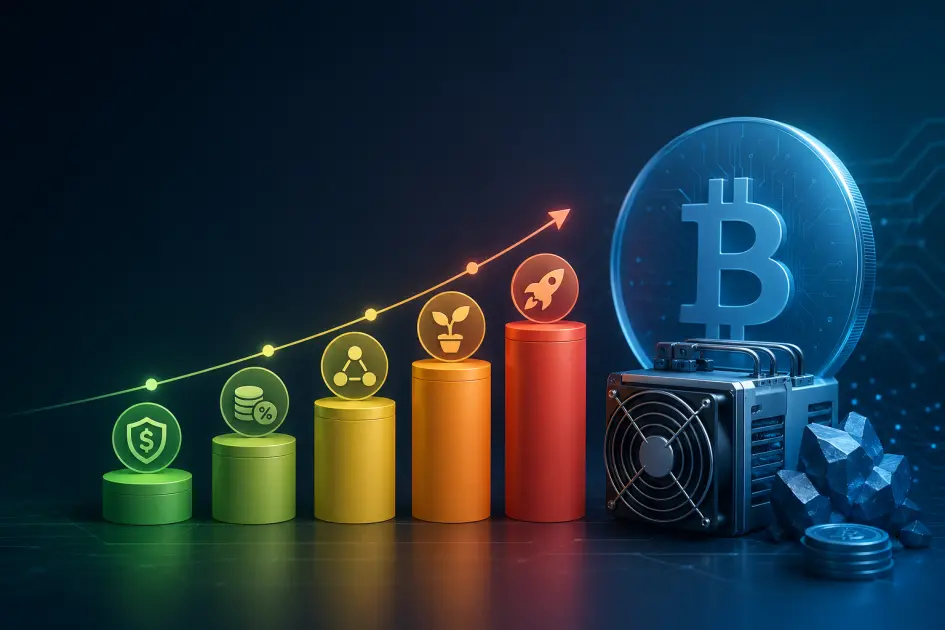
Crypto passive income in 2026 spans a wide risk spectrum — from 3-4% APY on Ethereum staking to triple-digit yields on exotic liquidity pools that often end in losses. This guide ranks seven popular strategies from lowest to highest risk, shows realistic APY ranges, and explains where cloud mining sits on that axis. Bitcoin itself cannot be staked — it uses Proof-of-Work, not Proof-of-Stake.

Why rank crypto passive income by risk, not APY
The fastest way to lose money in crypto is to sort strategies by headline APY and pick the biggest number. A 50% APY pool is not "better" than a 4% savings product — it is pricing risk the market believes the 4% product does not have. Smart contract exploits, impermanent loss, peg failures, counterparty defaults, and token emissions that dilute value are not hypothetical — they are how most high-yield crypto products end.
The ranking below uses four risk dimensions: principal risk (can you lose the underlying asset), counterparty risk (who holds your coins), smart contract risk (is code the custodian), and market risk (how sensitive are returns to crypto price moves). Every strategy has some of each — the question is how much.
The 2026 risk-ranked comparison table
Figures below are realistic ranges observed in early 2026, not marketing headlines. Cloud mining is included using NoxHash pricing as the reference point — the platform charges $20/month for a 50 TH/s Basic Miner with estimated returns of 115-125% of rental cost when market conditions are favorable.
| Rank | Strategy | Realistic APY | Main risks |
|---|---|---|---|
| 1 · Lowest | ETH staking (solo or Lido) | 3.0-4.5% | ETH price drop, slashing (rare), liquid staking depeg |
| 2 | Stablecoin lending on Aave (USDC) | 3.0-8.0% | Smart contract exploit, USDC depeg, utilization spike lockups |
| 3 | CeFi lending (centralized platforms) | 4.0-10% | Counterparty default (Celsius, BlockFi precedent), withdrawal freeze |
| 4 · Mid | Cloud mining (NoxHash, BTC) | 15-25% on rental cost | BTC price drop, difficulty increase, platform operational risk |
| 5 | Solo validator (ETH, 32 ETH required) | 3.5-5.0% | Slashing, downtime penalty, $100k+ capital lockup, hardware failure |
| 6 | LP / yield farming (Uniswap V3, Curve) | 5-30% (stable) / 10-50% (volatile) | Impermanent loss, reward token depreciation, contract risk |
| 7 · Highest | Grid-scale mining equity (public miners) | Highly variable (−80% to +300%) | Equity volatility, dilution, operational, leverage, regulatory |
Sources: Lido reports a 3.2-4.5% ETH staking reward rate and Aave V3 markets typically sit in the 3-8% range for USDC, based on DefiLlama yield data as of April 2026.
Rank 1 — ETH staking: the baseline "safe" yield
Ethereum staking is the closest thing crypto has to a risk-free rate. You lock ETH in the protocol (directly if you have 32 ETH, via Lido or a CEX otherwise), validators get paid for securing the network, and you earn a share. Realistic APY in 2026 is 3.0-4.5% after fees, down from 5-6% in 2023 as more ETH was staked.
The main risk is not the staking itself — it is holding ETH. If ETH drops 40% in USD terms, your 4% APY is a rounding error. Slashing (losing stake for validator misbehavior) is statistically negligible on professional setups. Liquid staking tokens like stETH carry an extra depeg risk, visible during the June 2022 market stress.
Note on BTC: Bitcoin cannot be staked — Proof-of-Work has no native staking mechanism. Products that advertise "BTC staking" are almost always lending in disguise (you hand over BTC, they lend it to a third party, you get yield from borrower interest). The counterparty risk is fundamentally different from ETH staking.
Ranks 2-3 — Lending: DeFi vs CeFi
DeFi lending (Aave, Compound)
Over-collateralized, permissionless, on-chain. USDC supply rates sit at 3-8% APY in 2026 depending on utilization. No one can "freeze withdrawals" — but a smart contract exploit can still drain the pool. Aave has held roughly $38B TVL without a major loss event.
CeFi lending (centralized)
Headline APY is often higher (4-10%) because the platform takes on leverage and rehypothecation you cannot see. The Celsius, BlockFi, and Voyager failures in 2022 wiped out billions. Rule of thumb: if you cannot audit how the yield is generated, treat it as counterparty-default risk priced at whatever APY they offer.
Rank 4 — Cloud mining: where it fits on the axis
Cloud mining sits in the middle of the risk spectrum — higher than staking and DeFi lending, lower than yield farming and mining equity. The structure is different from every other option above: you are not lending, staking, or pooling. You are paying a fixed USD fee for a fixed hashrate, and the platform pays you whatever BTC that hashrate mines during the contract.
With NoxHash, for example, a $20/month Basic Miner (50 TH/s) targets 115-125% of rental cost as estimated gross return when BTC price and network difficulty are favorable. That works out to roughly 15-25% net on the rental fee — expressed as return on the money you actually put in, not as APY on a large locked balance. The payout currency is BTC, so if BTC drops 30% during your contract, your USD-denominated yield drops too.
What cloud mining does not have:
- No smart contract risk — the service is a legal contract, not a pool of code holding your funds
- No impermanent loss — you are not providing liquidity to anything
- No principal lockup — you pay a rental fee, not a deposit that can be frozen
- No slashing — mining does not have validator penalties
What it does have: BTC market risk (earnings fall with BTC price), difficulty risk (network hashrate growing faster than expected shrinks per-TH income), and platform operational risk (the facility must actually run the promised hardware). NoxHash discloses the data center location (Kazakhstan), the electricity contract range ($0.03-0.04/kWh industrial), the hardware fleet (Antminer S21 series and WhatsMiner M60/M66 at 12-18.5 J/TH), and 99.9% uptime targets — the kind of operational disclosure that separates legitimate platforms from yield-only frontends.
See the mid-risk option in action from $20
If cloud mining's profile — no pool to exploit, no validator to slash, just a BTC payout tied to real hashrate — looks like the missing middle in your passive income mix, the Basic Miner plan is the lowest-commitment way to test it against your staking and lending positions.
Rank 5 — Solo validators: good APY, bad ergonomics for most
Running your own Ethereum validator earns the full 3.5-5.0% APY with no intermediary fee, but requires 32 ETH (~$100k+ in early 2026), always-on hardware, and an understanding of slashing conditions. For anyone with less than $500k in crypto, the liquid staking path (Lido, Rocket Pool) captures ~90% of the yield with ~5% of the friction. The risk is operational: one extended downtime or key mismanagement event and the APY math is gone.
Rank 6 — LP and yield farming: where APY hides the real price
Liquidity providing and yield farming advertise the headline APYs most people associate with "crypto yield". Stablecoin pools on Curve and Balancer run 4-12% APY; volatile pairs on Uniswap V3 and Sushi run 6-30%+. The catch is impermanent loss (IL): when one token in your pair moves relative to the other, you end up holding more of the loser and less of the winner. A pool with a 20% APY but 30% IL during a volatile month loses money.
Sustainable LP setups
Stablecoin-to-stablecoin pools (USDC/USDT on Curve) minimize IL because both sides track $1. Realistic 4-8% APY from trading fees without exotic token emissions.
High-APY traps
500%+ APY pools pay in newly minted governance tokens that crash as soon as rewards unlock. The APY is real on paper, the USD value almost never is.
Rank 7 — Grid-scale mining equity: the wildest card
Holding equity in public miners like Marathon, Riot, or CleanSpark gives exposure to industrial mining without running your own hardware. The APY concept does not apply — you own a stock that can move −80% in a bear cycle and +300% in a bull. Leverage on miners' balance sheets (debt-financed fleet expansion) amplifies both directions. This is the highest-risk way to get "mining exposure" and behaves more like a leveraged BTC call option than passive income.

How to build a realistic passive income mix
Anchor the base in Rank 1-2 assets
ETH staking and Aave USDC lending are the building blocks. Target 3-6% blended APY as the "boring" core — 60-70% of passive income allocation.
Use the mid-risk slot for BTC exposure
Cloud mining fills a unique gap: BTC-denominated passive income that is not lending and not equity. 15-25% of the allocation is a reasonable position for investors who believe in long-term BTC appreciation.
Cap higher-risk tails at 10-15%
LP farming, miner equities, and exotic yields go in the "lose-it-all tolerant" bucket. If you cannot write the position off entirely, do not size it as a core allocation.
Frequently asked questions
Can you stake Bitcoin for passive income?
No — Bitcoin uses Proof-of-Work, which has no staking mechanism. Products advertised as "BTC staking" are typically lending arrangements where the platform loans your BTC to third parties. The risks are counterparty default and rehypothecation, not staking.
Is cloud mining riskier than ETH staking?
Yes, slightly. Cloud mining adds platform operational risk (the facility must run the promised hardware) and BTC price sensitivity on top of market risk. In exchange, returns are typically 3-5x higher on the capital deployed and there is no principal lockup like staking.
Why do yield farms advertise 100%+ APY?
Those APYs are usually paid in newly minted governance tokens with limited demand. The token value typically falls faster than rewards accrue, turning the nominal yield into a real loss once impermanent loss and token depreciation are factored in. Trading-fee yield is a better quality signal than emission yield.
How much of a crypto portfolio should be in passive income strategies?
This is personal. A common framework is to keep a long-term spot position in BTC and ETH, then put the portion you are comfortable putting to work into the Rank 1-4 buckets. Leaving the Rank 5-7 tail at 10-15% caps downside while allowing upside. There is no universal right answer.
What makes a cloud mining platform trustworthy?
Disclosure. A serious operator publishes the data center region, electricity pricing range, hardware models and efficiency (J/TH), and uptime targets. Platforms that only show "guaranteed daily returns" without operational evidence tend to be yield-only frontends with no real hashrate behind them.
Not financial advice
APY ranges shown are observed historical values as of April 2026 and can change rapidly with market conditions, network activity, and protocol parameters. Past performance does not guarantee future results. Every strategy discussed carries risk of total loss of principal or earnings. Do your own research and only deploy capital you can afford to lose.