How Much Does It Cost to Mine 1 Bitcoin in 2026?
Electricity, depreciation, overhead, pool fees — here's the real all-in cost to mine 1 BTC in 2026, with public miner benchmarks and a rate-by-rate table.

The cost to mine 1 Bitcoin in 2026 is the total operating expense a miner spends — electricity, hardware depreciation, overhead, and pool fees — divided by the BTC actually produced. As of April 2026, industrial operations on $0.035/kWh power break even around $35,000–$45,000 per BTC, mid-cost US farms land near $55,000–$70,000, and home miners on retail rates often exceed $100,000. The weighted public-miner average is materially higher than the spot BTC price.

The Unit Economic Question Every Miner Asks
"What does it cost to mine 1 Bitcoin?" is the oldest question in the industry and still the most useful. It is the mining equivalent of oil's "cost per barrel" — a single unit economic that tells you whether the business is healthy, whether a given operator can survive the next downcycle, and whether renting hashrate through a platform is priced reasonably against the real cost curve.
The question matters because Bitcoin miners sell into a globally-priced output. Every operator on the planet — from a hydro-cooled Kazakhstan farm to a garage setup in Arizona — receives the same BTC per block reward. What differs is their cost stack. The miners with the lowest cost per BTC print money during weak markets; the high-cost operators capitulate, unplug machines, and sometimes fail. The gap between your cost and BTC's spot price is pure margin or pure pain.
In April 2026 that gap has become uncomfortably tight for much of the industry. According to the CoinShares Q1 2026 Bitcoin Mining Report, the weighted average cost of production per BTC among publicly traded miners reached roughly $80,000 in the most recent reporting quarter — which, for context, exceeded BTC's spot price during parts of Q1. That is the headline behind the wave of miner-to-AI pivots and the "mining profit crisis" narrative you may have seen this spring.
The Four Cost Components — Electricity, Depreciation, Overhead, Pool Fees
Every mining cost stack, whether it belongs to a Nasdaq-listed miner or a solo hobbyist, breaks into the same four buckets. The weights shift with scale and location, but the categories are universal.
Electricity (75–85%)
The dominant line. A single Antminer S21 at 3,500W running 24/7 burns ~2,520 kWh/month — that is the number you multiply by your $/kWh rate. Every fractional cent matters at fleet scale.
Hardware depreciation
An Antminer S21 bought at $4,500 and amortised over ~36 months adds roughly $125/month to the cost stack before it needs replacement or resale — typically 10–20% of total opex.
Overhead & labour
Data centre rent, cooling, 24/7 technicians, networking, insurance, compliance. Industrial farms run 5–10% of opex here; home miners think it's zero but usually forget their own time cost.
Pool fees
A standard FPPS pool charges 1–2% of mined BTC — the smallest bucket, but the easiest to overpay if you're on a 3%+ pool. Compounds directly against the revenue side of the equation.
The reason electricity dominates is the SHA-256 algorithm itself — it converts kWh into hashes, directly. A modern ASIC like the Antminer S21 runs at ~17.5 J/TH; the flagship S21 XP Hyd gets down to 12 J/TH. Older 2021-era S19 Pro hardware sits near 30 J/TH, which means at identical electricity cost it spends roughly 1.7× the energy per BTC mined. That is why cost-per-BTC spreads so widely across the industry even when everyone is on similar power rates.
The Formula — Cost Per BTC in One Equation
Stripped to its essentials, cost per BTC is a single division. Everything else is just how carefully you measure the numerator and denominator.
Cost per BTC (USD) =
(Electricity + Depreciation + Overhead + Pool fees)
÷ BTC produced in the period
A worked walkthrough using a single Antminer S21 (200 TH/s, 3,500W) over 30 days at $0.05/kWh — roughly a Texas industrial rate:
- Electricity: 3.5 kW × 24h × 30 days × $0.05 = ~$126/month
- Depreciation: $4,500 machine ÷ 36 months = ~$125/month
- Overhead (estimate): 7% of total opex = ~$20/month
- Pool fees (estimate): ~1.5% of gross revenue = ~$3/month
- Total opex: ~$274/month
- BTC produced: at April 2026 network conditions, a 200 TH/s S21 mines roughly ~0.0045 BTC/month (illustrative, depends on difficulty)
- Cost per BTC: $274 ÷ 0.0045 ≈ ~$61,000/BTC (illustrative)
That is a reasonable mid-cost benchmark. Swap $0.05/kWh for $0.035/kWh Kazakhstan industrial power and the electricity line drops to ~$88 — which drops total opex to ~$236 and cost per BTC to ~$52,000. Swap up to $0.12/kWh US residential and electricity alone is ~$302, total opex ~$450, cost per BTC balloons to ~$100,000. The single biggest lever is $/kWh, by a wide margin.
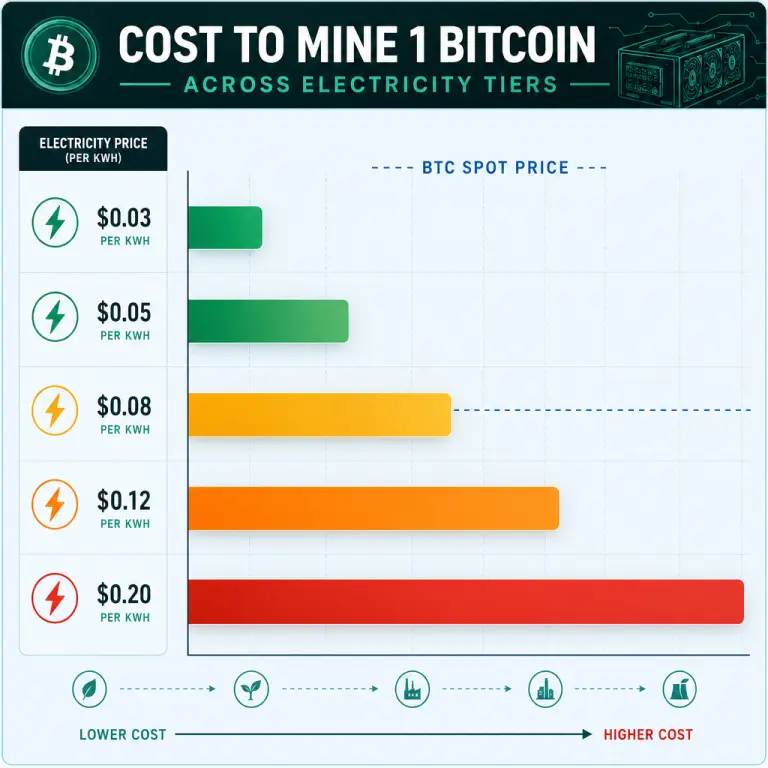
Cost to Mine 1 BTC by Electricity Rate — April 2026
The table below shows illustrative cost-per-BTC at five common electricity tiers, holding hardware (S21-class, ~17.5 J/TH), network difficulty (~135 T), and block reward (3.125 BTC) roughly constant for April 2026. All figures are illustrative as of April 2026 and move with BTC price, difficulty, and fee pressure.
| Electricity rate | Typical operator | Illustrative cost per BTC | Comment |
|---|---|---|---|
| $0.03/kWh | Tier-1 industrial (Kazakhstan, Paraguay) | ~$35,000–$45,000 | Comfortable margin vs BTC spot |
| $0.05/kWh | Mid-cost US / Canada industrial | ~$55,000–$70,000 | Workable, exposed in bear cycles |
| $0.08/kWh | Higher-cost commercial / small-scale hosting | ~$80,000–$95,000 | Thin margin, break-even sensitive |
| $0.12/kWh | US residential / retail grid | ~$100,000–$130,000 | Often underwater at current BTC price |
| $0.20/kWh | High-tariff regions (parts of EU, California) | ~$160,000–$200,000 | Structurally unprofitable at any realistic BTC |
Two things jump out. First, the spread is roughly 5–6× between the cheapest and most expensive power tiers — bigger than any other variable in mining economics. Second, the $0.12+/kWh rows are not hypothetical — they are where hobbyist home miners actually sit, and they explain why the "mining in my garage" content you see online is usually loss-making at April 2026 BTC prices even before the electricity bill hits.
See what sub-$45k cost-per-BTC economics feel like
The table above shows why power rate is the single biggest lever in mining. NoxHash runs its fleet on $0.035/kWh Kazakhstan industrial contracts — the same low-cost tier the best public miners use. Start the 2-day free trial to watch a real 50 TH/s miner accrue BTC without putting any USDT at risk.
Public Miner Benchmarks — What Marathon, Riot, and CleanSpark Report
Public mining companies are required to disclose their cost of production each quarter, which makes them the clearest ongoing reference point for real-world mining economics. Their figures come in two flavours: cash cost (electricity plus direct opex) and all-in sustaining cost (cash cost plus depreciation, stock-based compensation, and corporate overhead). Per the CoinShares Q1 2026 mining report, the picture across the cohort is roughly this (illustrative weighted averages as of April 2026):
| Metric | Q4 2025 / Q1 2026 cohort figure | Interpretation |
|---|---|---|
| Avg cash cost per BTC | ~$74,600 | Weighted average across public miners |
| Avg all-in cost per BTC | ~$80,000 (CoinShares) / ~$137,800 (incl. depreciation & SBC) | Full AISC — what the business actually costs to run |
| Reported hash price trough | ~$28/PH/day (late February 2026) | 5-year low in real terms |
| Share of older ASIC fleet unprofitable | ~20% | Machines being unplugged or sold |
| Revenue mix shifting to AI/HPC by end-2026 (projected) | ~70% of listed miner revenue | Margin pressure forcing diversification |
The individual companies vary meaningfully around that average. CleanSpark and Riot have historically reported lower cash costs thanks to Texas wind-heavy power contracts and fleet efficiency; Marathon tends to report higher all-in due to heavier corporate overhead and aggressive fleet growth. What unites all of them right now is margin compression: with the all-in cohort average around $80,000 per BTC and BTC price swinging through that level, many listed miners are cash-profitable but not fully AISC-profitable — which is exactly why the AI/HPC pivot story is dominating miner earnings calls this quarter.
Where NoxHash Sits on the Cost Curve
NoxHash's infrastructure falls on the lower-cost end of the global curve, which is the only end from which a sustainable cloud mining product can be built. Three structural reasons:
Power contract. The Kazakhstan data centre runs on $0.03–0.04/kWh industrial power — roughly in line with Paraguay and Siberia hydro, materially below Texas ($0.04–0.06) or Québec ($0.04–0.06), and 3–5× below typical retail grid pricing. Against the April 2026 public-miner cohort average near $80k per BTC, NoxHash's power line alone puts it structurally below that number.
Fleet efficiency. The fleet leans on Antminer S21 series (17.5 J/TH) and S21 XP Hyd (12 J/TH) alongside WhatsMiner M60/M66 units. Relative to 2021-era hardware at ~30 J/TH still running in parts of the industry, NoxHash extracts roughly double the BTC per kWh. Because electricity is 75–85% of cost, fleet efficiency compounds directly into cost per BTC.
Natural-air cooling. Winter temperatures of -15°C to -30°C mean the data centre avoids the HVAC overhead that burdens operations in hot climates. That alone typically saves 20–30% on cooling-related cost vs a Texas or Gulf-state peer.
Stack those three and NoxHash's estimated cost per BTC sits materially below the published CoinShares cohort average — which is the margin that funds every user rental and every fleet upgrade. That cost advantage is the reason a $20/month Basic plan can target 115–125% of rental in returned BTC value rather than a "too-good-to-be-true" 300% that falls over in the first weak month.
What Happens When Bitcoin Trades Below Cost Per BTC
The cost-per-BTC line is also a behavioural signal. Miners are rational operators of expensive hardware — what they do when BTC trades below their production cost is predictable, and the pattern repeats every cycle.
Stage 1 — Higher-cost miners stop selling. When BTC is below their all-in cost but above their cash cost, operators keep machines running but stop selling freshly-mined BTC, borrowing against treasury instead. This compresses miner-side sell pressure on the open market and is historically a bullish mid-cycle signal.
Stage 2 — Cash-unprofitable miners capitulate. When BTC drops below cash cost for a sustained period, the oldest and least-efficient machines get unplugged. Global hashrate drops. The CoinShares Q1 2026 report flagged roughly 20% of older ASIC fleet as cash-unprofitable at the late-February lows. That is machines being physically turned off and shipped to secondary markets or scrap.
Stage 3 — Difficulty adjusts down. With less hashrate competing for the same block reward, the next two-week difficulty adjustment drops. Surviving miners earn proportionally more BTC per TH/s. Hash price rises from the floor. The cycle stabilises.
Stage 4 — Treasury pivots and AI/HPC diversification. Larger listed miners move to diversify revenue — the mining-to-AI pivot dominating earnings calls this spring is the 2026 version of this stage. Reuters, CoinDesk, and Bloomberg have all covered the trend; CoinShares projects ~70% of listed miner revenue will come from AI/HPC by end-2026.
The practical takeaway for anyone watching this metric: cost per BTC behaves like a floor, not a fixed price. When BTC breaks it, the industry does not just suffer quietly — it actively adjusts through capitulation, difficulty re-adjustment, and business-model pivots until the economics rebalance. The "below cost" state is usually temporary.
How Cloud Mining Users Sit Inside This Math
If you rent hashrate through a platform, you don't see the four cost buckets directly — you pay a single monthly USD rental fee and receive BTC in return. But you are absolutely still exposed to the underlying cost-per-BTC economics. The difference is how you are exposed.
You are buying a share of the operator's unit economics. A rental plan priced at $50/month for 150 TH/s is, mathematically, a sub-lease of the operator's cost stack plus a small margin. If the operator's cost per BTC is $45,000 and you pay rentals consistent with receiving ~$60–65k of BTC value annualised per unit of rented TH, you are sharing the margin the operator earns vs its real costs. If the operator is secretly running on $0.15/kWh retail power with ancient fleet, that margin doesn't exist and the rental is a loss-leader propped up by new deposits.
You inherit the operator's resilience in a downturn. When BTC trades below cost per BTC, high-cost operators capitulate first. Low-cost operators — NoxHash at $0.035/kWh on S21-class hardware — keep running, keep paying out BTC to renters, and keep upgrading fleet. The cheaper the operator's cost stack, the more likely your contract still delivers BTC through a rough quarter. Power rate is not a marketing detail; it is the survival variable.
You carry BTC price risk, not production cost risk. The operator carries the risk that their $45k/BTC cost stack holds up (hardware degradation, power contract changes, overhead creep). You carry the risk that BTC price moves against your rental fee. Those are two different bets — and cloud mining is structured so you pay a fixed USD price and carry the BTC-side risk, not the operator-side risk.
Rent against a cost stack that stays profitable in weak markets
You've seen the full breakdown — industrial power, efficient fleet, and natural-air cooling are what separate the miners who survive a sub-$80k BTC tape from those who capitulate. NoxHash runs on all three. Open a free account and compare the Basic, Standard, Pro, and Enterprise tiers against the rate-by-rate table above.
Frequently Asked Questions
How much does it cost to mine 1 Bitcoin in April 2026?
It depends on electricity rate and hardware. At $0.035/kWh industrial power, cost per BTC runs ~$35,000–$45,000 as of April 2026. At $0.05/kWh Texas rates, ~$55,000–$70,000. At $0.12/kWh US residential, often $100,000+. Public miner weighted average all-in is near $80,000 per CoinShares Q1 2026.
What's the difference between cash cost and all-in sustaining cost?
Cash cost is electricity plus direct operating expense — the cheque you must write to keep machines running. All-in sustaining cost (AISC) adds depreciation, corporate overhead, and stock-based compensation. A miner can be cash-profitable but AISC-unprofitable, which is where much of the public mining cohort sits in Q1 2026.
Why is electricity 75–85% of the cost?
SHA-256 mining converts electricity into hashes directly — every terahash has a joule cost. Modern ASICs run at 12–17.5 J/TH, meaning a 200 TH/s machine burns ~3.5 kW continuously. Over a month that is ~2,520 kWh per machine. At fleet scale, every fractional cent per kWh compounds into a dominant share of total opex.
What happens to miners when BTC trades below cost per BTC?
Higher-cost miners stop selling freshly mined BTC, then capitulate by unplugging unprofitable machines. Global hashrate drops, the network's two-week difficulty adjustment follows it down, and surviving miners earn more BTC per TH/s. The "below cost" state is usually temporary because the network self-corrects through capitulation and difficulty adjustment.
Can a home miner ever beat industrial cost per BTC?
Rarely. The structural gap — $0.03/kWh industrial contracts vs $0.12+/kWh residential power, plus free natural-air cooling vs home HVAC, plus bulk hardware pricing — typically puts industrial cost per BTC at one-third of a home setup. Hobbyist mining can be viable in very cheap-power pockets, but not at scale against Tier-1 farms.
How does this affect a cloud mining rental?
You are effectively buying a share of the operator's unit economics. A low-cost operator — cheap power, efficient fleet, natural cooling — can pay out BTC on your rental even through weak markets. A high-cost operator running on retail grid power cannot sustain payouts when BTC trades below their cost line. Operator cost structure is the survival variable.
Will cost per BTC keep rising?
Structurally yes, because each halving cuts block reward and difficulty has trended up. The next halving around 2028 will cut block reward from 3.125 to 1.5625 BTC, doubling cost per BTC again, other things equal. Transaction fees and hardware efficiency gains partly offset this, but long-term the cost line rises through each cycle.
Illustrative figures — not financial advice, not a profit guarantee
Every cost, cost-per-BTC range, and public-miner benchmark in this article is illustrative and reflects April 2026 network conditions and publicly reported quarterly data. Bitcoin price, network difficulty, mempool fee pressure, electricity contracts, and operator fleet composition all change continuously. The $35k–$200k cost-per-BTC spread is a reference, not a quote on any specific operator. Past performance does not predict future results. Cloud mining carries market, counterparty, regulatory, and tax risks that depend on your jurisdiction. Only commit funds you can afford to lose, verify local legal and tax treatment with a qualified professional, and do not size any single contract as a make-or-break position.