Cloud Mining vs Bitcoin ETFs — Two Ways to Get BTC Exposure
Compare spot Bitcoin ETFs and cloud mining in 2026 — expense ratios, BTC yield, tax treatment, custody, liquidity, and which vehicle fits your profile.

Spot Bitcoin ETFs and cloud mining are two different wrappers around the same underlying bet: the long-term value of BTC. An ETF gives you fractional share ownership of Bitcoin held by a custodian, priced in your brokerage account during stock-market hours. Cloud mining rents hashrate that produces actual BTC you can withdraw to self-custody. Same direction of exposure, very different cash flow, tax, and control profile.

Two Very Different Wrappers Around the Same BTC Bet
Both products let you benefit if Bitcoin's price rises over the next few years. The how is where they diverge. A spot BTC ETF is a traditional security — shares trading on a regulated exchange, priced against a BTC reference index, with a custodian holding the actual coins on the fund's behalf. Cloud mining is operational exposure — you rent a piece of a live mining fleet, and the BTC that fleet produces flows to your platform wallet.
The practical difference shows up everywhere: how you pay, what you hold, how you are taxed, and what happens on a Saturday night when BTC moves 10%.
Spot BTC ETF
A share in a fund that holds real BTC. You buy it in a brokerage account during market hours. No keys, no self-custody, no BTC on-chain — just a stock ticker that tracks the BTC price minus an annual expense ratio.
- Fees: 0.15% – 1.5% / year expense ratio
- Yield: none (price exposure only)
- Hours: U.S. stock-market only
- IRA / 401(k) eligible: often yes
Cloud Mining (NoxHash)
A rental on live hashrate from a Kazakhstan data center. The fleet produces BTC, your share accrues to your platform wallet every minute, and you can withdraw to a wallet you control. Monthly rental paid in USDT.
- Fees: $20 – $250 / month rental + 1.5% withdrawal
- Yield: BTC accrual on top of price exposure
- Hours: 24/7, 365 days
- IRA / 401(k) eligible: usually no
Side-by-Side Comparison — Seven Dimensions That Matter
Both vehicles get you long BTC. The real question is how you want to be long — and which trade-offs you are willing to accept. The matrix below focuses on the decisions that actually affect after-fee, after-tax returns.
| Dimension | Spot BTC ETF | Cloud Mining |
|---|---|---|
| Ongoing cost | 0.15–0.25% expense ratio (IBIT, FBTC, Mini Trust); up to 1.5% on GBTC | Fixed monthly rental ($20–$250) + 1.5% withdrawal |
| Yield on top of price | None. NAV tracks BTC minus fees | Yes — BTC accrues continuously |
| Custody | Institutional custodian holds keys (Coinbase, Fidelity Digital Assets) | Self-custody after withdrawal to your wallet |
| Tax character (US) | Share capital gains when you sell; long-term rate after 1 year | Mined BTC = ordinary income at receipt; capital gain on later sale |
| Liquidity | Sell during U.S. market hours, T+1 settlement | Withdraw BTC on-chain any time; rental is committed |
| Trading hours | ~6.5 hours/day, weekdays only | BTC accrues every minute, 24/7 |
| Tax-advantaged account access | IRA, 401(k), taxable brokerage all eligible | Taxable only in most jurisdictions |
Expense ratios as of April 2026: IBIT and FBTC sit at 0.25%, Grayscale's Bitcoin Mini Trust is the cheapest at 0.15%, and legacy GBTC still charges 1.50% — which is why GBTC continues to bleed to newer competitors, per The Motley Fool's April 2026 ETF breakdown. Collective spot-ETF AUM recently retested roughly ~$96 billion across the 11 U.S. funds, with BlackRock's IBIT approaching ~$64 billion in cumulative net inflows, according to the Bitbo Bitcoin ETF flows tracker.
Try the mining side of the comparison with no deposit
You've just read why cloud mining produces BTC accrual while an ETF only tracks price. The cleanest way to see the difference is watching it happen: NoxHash's 2-day Basic Miner trial runs 50 TH/s in a live Kazakhstan data center and shows real BTC accumulating in the dashboard every minute.
Tax Treatment — Where the Two Wrappers Diverge Most
This is the section most comparison articles skip, and it is also where the biggest real-dollar difference hides. The same $1,000 of BTC exposure can land on completely different lines of your tax return depending on the wrapper. Rules vary by country — the notes below are U.S.-centric but the structure holds in most Western jurisdictions.
Spot BTC ETF. You own shares of a 1933-Act registered fund. Buy, hold, sell — you have a capital-gains event only when you sell. Hold longer than 12 months and long-term capital-gains rates apply (0%, 15%, or 20% federal in the U.S., plus state). No phantom taxable events while you hold. An ETF can live inside a Roth IRA, traditional IRA, or 401(k), where the gains grow tax-deferred or tax-free.
Cloud mining. Mined BTC is treated as ordinary income at fair market value on the day it is credited to your wallet — that is the IRS position in Notice 2014-21 and consistent across most G20 tax authorities. Your cost basis in that BTC equals the income you just recognized; a later sale creates a separate capital gain or loss. The ordinary-income portion gets hit at your marginal rate (up to 37% federal in the U.S.), which can materially lag an ETF's clean long-term capital-gains treatment in a high-bracket year.
Practical takeaway. If tax efficiency in a retirement account is the priority, an ETF wrapper wins nearly by default. If you want BTC you can move on-chain and are already in a lower bracket — or you plan to hold mined BTC long enough that the capital-gains portion dominates — mining is viable but demands disciplined record-keeping. Always confirm with a qualified tax professional in your jurisdiction.
When Each Vehicle Actually Wins
Neither product is objectively better. They serve different goals for different investor profiles. Below are the four scenarios where the answer is fairly clear-cut — and one where a hybrid is the best call.
ETF wins — retirement & tax-deferred accounts
If your BTC allocation is intended to sit inside a Roth IRA, traditional IRA, or 401(k), an ETF is the only practical vehicle. The wrapper matters more than the fee difference.
ETF wins — stock-first investors
If you already use a brokerage daily, want a single statement, and have no interest in managing wallets or seed phrases, the ETF removes operational friction almost entirely.
Cloud mining wins — sovereign BTC ownership
If "not your keys, not your coins" is a core belief, an ETF share does not satisfy you — it is a paper claim on BTC someone else holds. Mining produces real coins you withdraw to your own wallet.
Cloud mining wins — BTC-accrual & DCA mindset
If your goal is to stack sats every single day regardless of BTC price, mining keeps producing during nights, weekends, and holidays. An ETF cannot stack while the market is closed.
There is a fifth scenario worth naming: global access. Spot BTC ETFs listed in the U.S. are open to U.S. brokerage clients, and similar ETPs exist in Canada, Germany, and Hong Kong — but plenty of regions still have no regulated local product. Cloud mining is jurisdictionally neutral: if you can receive BTC, you can participate, which explains a meaningful chunk of mining-platform demand outside the U.S. and EU.
The Hybrid Approach — Both, With a Reason
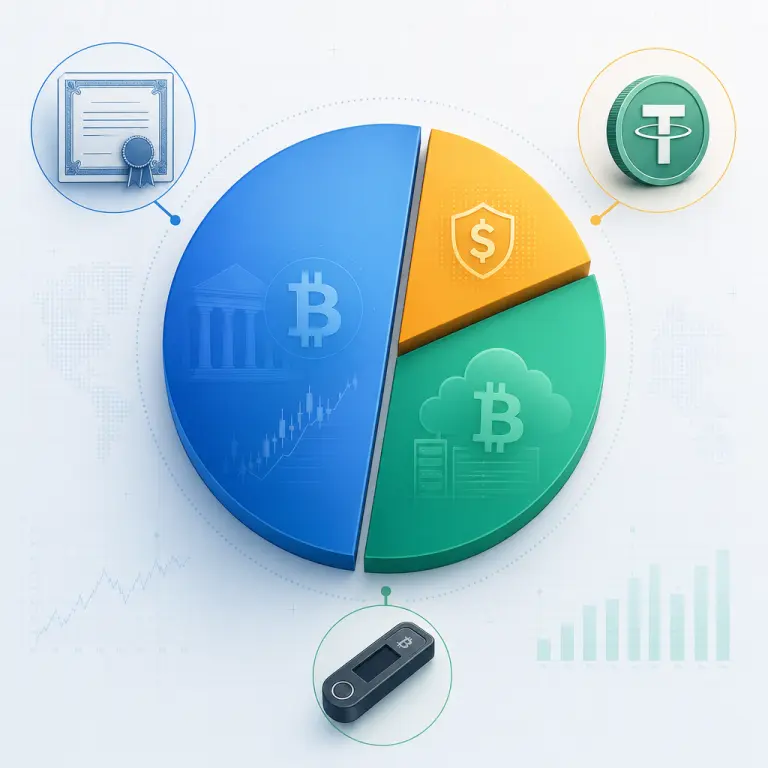
Most mature BTC allocators do not pick one wrapper forever. They split the allocation by purpose: the ETF portion lives where it fits best (retirement accounts, taxable brokerage), and the mining portion lives where it fits best (a sovereign-BTC stack, daily accrual, long-horizon self-custody).
Illustrative hybrid split for a long-horizon BTC investor
- Core retirement exposure (50–70% of BTC allocation): Low-fee spot ETF inside a Roth IRA or 401(k) where possible. Tax-free compounding wins over decades.
- Sovereign stack (20–40%): Cloud mining rental (Basic / Standard / Pro tier depending on size), withdrawn to a hardware wallet on a schedule. You own BTC you can move, regardless of any single issuer's fate.
- Tactical cash layer (5–15%): USDT on-platform ready to scale up mining rentals if BTC drops into a clear accumulation zone — or to sit flat when conditions do not warrant new risk.
The split is not a formula, it is a framework. The key principle: match the wrapper to the goal of the dollars inside it. Retirement capital belongs in a retirement-eligible wrapper. Self-custody belief belongs in a vehicle that lets you actually self-custody.
Add the mining leg to a portfolio that already holds ETFs
If you already own a spot BTC ETF, a cloud mining rental complements it rather than competes — ETF handles retirement, mining handles sovereign self-custody accrual. Start at $20/month for a Basic Miner, withdraw to your own wallet whenever you want.
Frequently Asked Questions
Is a spot Bitcoin ETF safer than cloud mining?
It is more regulated, with SEC-registered issuers and institutional custodians — but it does not remove BTC price risk. Both wrappers fully absorb a BTC drawdown. An ETF has lower operational risk; cloud mining has higher operational risk but delivers BTC accrual and self-custody in return.
Which is cheaper over a multi-year horizon?
On pure cost, an ETF at 0.15–0.25% is cheaper than most cloud mining rental ratios. But mining produces additional BTC each month, so the right comparison is cost-adjusted total BTC accumulated per dollar deployed — which depends on hashprice, rental term, and BTC trajectory over your horizon.
Can I hold cloud mining earnings in an IRA?
Generally no — mining income is treated as ordinary income to the account holder at receipt, which does not integrate cleanly with most IRA custodians. A small number of self-directed crypto IRAs accept certain structures, but the operational complexity usually outweighs the benefit for retail amounts.
Do ETFs give me any BTC yield or staking income?
No. Spot BTC ETFs hold Bitcoin passively — BTC has no native staking yield, and the funds are not permitted to lend the underlying. Your return is purely price appreciation minus expense ratio. Mining is currently the main structural way to earn additional BTC on top of BTC price exposure.
Why is GBTC's 1.5% fee so much higher than IBIT or FBTC?
GBTC was a closed-end trust before converting to an ETF in January 2024 and kept its legacy fee structure. Grayscale later launched a cheaper Bitcoin Mini Trust at 0.15% to compete. For new allocations, lower-fee alternatives like IBIT, FBTC, or the Mini Trust are typically preferred on cost alone.
Can I sell an ETF position outside of market hours?
No. ETF shares trade only during U.S. stock-market hours (including limited pre- and post-market). BTC trades 24/7 globally, so if BTC moves sharply on a Saturday, ETF holders wait until Monday to react. Holders of actual BTC — including mined BTC — can transact immediately.
Should I pick just one, or use both?
Many long-horizon investors use both. ETFs sit inside tax-advantaged accounts for compounding; cloud mining produces self-custodied BTC for sovereign ownership. The split depends on your bracket, account access, and how important self-custody is to you. Confirm with a tax professional in your jurisdiction.
Informational only — not investment, legal, or tax advice
Every figure in this article — expense ratios, AUM, inflow data, tax treatment — reflects April 2026 conditions and is provided for educational purposes only. Spot Bitcoin ETFs and cloud mining both fully absorb Bitcoin price risk and can lose substantial value. Tax treatment depends on your jurisdiction, filing status, and holding period; always verify with a qualified tax professional before acting. NoxHash does not offer securities, investment advice, or tax guidance. Past performance does not predict future results. Only commit funds you can afford to lose.