Carbon Footprint of Cloud Mining vs Home Mining — A Comparison
Head-to-head carbon comparison — facility-scale cloud mining vs at-home ASIC mining. Grid-mix, fleet efficiency, cooling load, and the honest verdict for 2026.

Is cloud mining or home mining worse for the planet? Counterintuitively, facility-scale cloud mining usually has a lower carbon footprint per TH/s than at-home ASIC mining — because modern fleet efficiency (12–17.5 J/TH) and data-center cooling (PUE 1.05–1.2) outweigh the grid-mix advantage most homes have over Kazakhstan or Texas mining hubs.
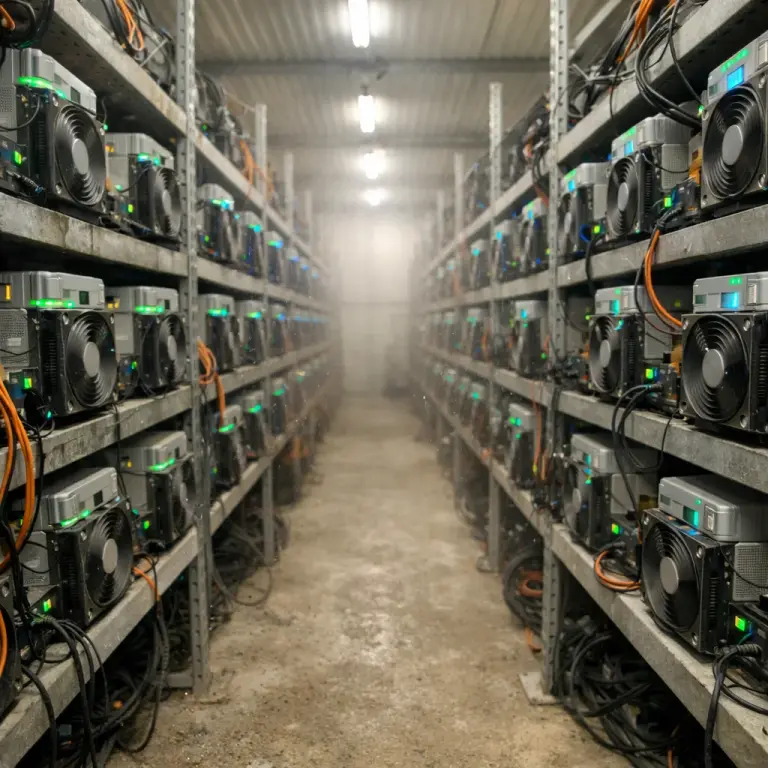
The comparison frame — three factors that multiply
Carbon footprint per TH/s mined is not one number. It is the product of three independent variables, and understanding how they multiply is the whole point of this article. The intuitive story — "cloud mining is coal, home mining is cleaner" — breaks down once you write the equation.
Carbon per TH/s per unit time = (energy efficiency, in J/TH) × (grid carbon intensity, in gCO2/kWh) × (auxiliary overhead, or PUE). Change any one factor and the answer shifts. Cloud mining operators tend to win on factors #1 and #3 through scale; home miners only win on factor #2 if their local grid is genuinely clean. In practice, the efficiency lever is so large it usually flips the verdict against the home setup — even when the home grid is cleaner on paper.
Factor #1: Fleet efficiency — the biggest lever
Efficiency (measured in joules per terahash, J/TH) is the single largest driver of carbon output. A machine that needs half the energy to produce the same hashrate emits half the CO2, regardless of grid mix. And this is where cloud operators have a structural advantage over home miners.
The reason is capex. A new Antminer S21 Pro costs roughly $3,000–$4,500 per unit, and hydro-cooled flagships like the S21 XP Hyd push toward $8,000+. Buying one of those for a garage is a bigger commitment than most hobbyists make, so a lot of home miners run what they already have — typically older S19-series units or, in some cases, aging S9s that were handed down cheaply or pulled out of storage after the 2021 China ban.
| Generation | Typical model | Efficiency | Common home or cloud? |
|---|---|---|---|
| 2024–2025 flagship | S21 XP Hyd | ~12.0 J/TH | Cloud (rare at home) |
| 2024 Pro | S21 Pro | ~15.0 J/TH | Cloud workhorse |
| 2024 standard | S21 / M66S | ~17.0–17.5 J/TH | Cloud fleet baseline |
| 2022–2023 | S19 XP / S19j Pro | ~21–30 J/TH | Common at home |
| 2016–2018 legacy | Antminer S9 | ~95 J/TH | Still running in some homes |
The efficiency ratio between a typical cloud fleet (15 J/TH) and a typical home setup running an S19 (~30 J/TH) is 2×. Against an S9, the ratio jumps to 6×. This is not a small correction. It dwarfs most grid-mix differences you will find between real-world locations.
Factor #2: Grid carbon intensity — where home miners fight back
Grid mix is the factor home miners most often point to. A home plugged into Quebec's hydro grid or an off-peak California solar mix can look spectacular on paper compared to Kazakhstan, where the power supply leans coal and natural gas.
| Location | Grid carbon intensity | Primary sources |
|---|---|---|
| Kazakhstan (cloud hub) | ~550–600 gCO2/kWh | Coal + natural gas |
| Poland | ~700 gCO2/kWh | Coal-heavy |
| Texas (ERCOT) | ~400 gCO2/kWh | Gas + wind mix |
| US average | ~385 gCO2/kWh | Mixed |
| Germany | ~350 gCO2/kWh | Gas, wind, some coal |
| California (CAISO) | ~240 gCO2/kWh | Gas + solar + hydro |
| Quebec | ~2 gCO2/kWh | Hydro (near zero) |
Most US homes plugged into the average grid are running at roughly 65% the carbon intensity of Kazakhstan. That is a real advantage — but it is a smaller advantage than the 2× gap the home miner typically loses on factor #1. And there is a second twist: home miners pay retail electricity ($0.12–$0.20/kWh) while cloud operators pay industrial contracts ($0.035/kWh). Price is not carbon, but the price gap tells you the home miner has no incentive to run the machine aggressively — they tend to run it exactly as long as they can afford to, not one kWh more.
Factor #3: Cooling overhead — the hidden multiplier

Every watt that goes into the ASIC turns into heat that has to leave the building. In a data center, that overhead is measured by PUE (Power Usage Effectiveness) — the ratio of total facility power to IT power. A PUE of 1.0 means zero overhead (impossible); a PUE of 2.0 means the facility uses as much power for cooling and distribution as for the machines themselves.
Modern purpose-built mining facilities hit PUE 1.05–1.2. NoxHash's Kazakhstan facility trends to the low end during winter, when ambient temperatures of -15°C to -30°C let the exhaust fans do most of the work with almost no active refrigeration. Hot-aisle containment, tall ceilings, and a building designed for airflow remove the heat without adding load.
A home mining setup is the opposite story. An S19 dumps about 3,000–3,500W of heat into whatever room it sits in. In winter, in a cold climate, that heat offsets home heating — effectively free. But in summer, or in any climate where you would normally run AC, every watt of miner heat becomes another watt of cooling load. Window units, central HVAC, or even just a garage exhaust fan inflate the effective PUE to 1.4–1.8. Run the numbers on a 3,500W miner for a full summer in Texas and the cooling overhead alone can add hundreds of kWh per month.
The combined calculation — a worked example
Here is the same job — 1 TH/s running continuously for one month — costed out in kilograms of CO2 for four realistic setups. The formula in each row is: (J/TH ÷ 1,000) × 730 hours × PUE × grid intensity ÷ 1,000 = kg CO2.
| Setup | J/TH | Grid (gCO2/kWh) | PUE | kg CO2 / TH / month |
|---|---|---|---|---|
| NoxHash (Kazakhstan cloud) | 15 | 575 | 1.10 | ~6.9 kg |
| Texas home (S19) | 30 | 400 | 1.50 | ~13.1 kg |
| California home (S19) | 30 | 240 | 1.50 | ~7.9 kg |
| Quebec home (S19, hydro) | 30 | 2 | 1.50 | ~0.07 kg |
Read it carefully. NoxHash cloud on a coal-plus-gas grid still beats a Texas home. It roughly ties a California home and loses badly only to a Quebec home on hydro — which is the one realistic scenario where home mining clearly outperforms. Everywhere else, the efficiency + PUE combination does the heavy lifting.
And if the home miner is running a legacy S9 instead of an S19? Multiply the home rows by roughly 3×. A Texas home with an S9 comes in near 40 kg CO2/TH/month — almost 6× worse than the cloud baseline, on a grid that is genuinely cleaner than the cloud's.
Mine on a 12–17.5 J/TH fleet instead of a 30 J/TH home setup
The comparison table above is the whole pitch — efficiency and PUE outweigh grid mix for almost every home. Rent hashrate on NoxHash's S21-series fleet and skip the HVAC math entirely.
The honest verdict — when cloud wins, when home wins
The intuition that "cloud mining is dirty, home mining is clean" is a marketing story, not a calculation. Once you put the three factors together, the verdict for 2026 looks like this:
Cloud mining usually wins per TH
On any mid-intensity grid (US average, Texas, Germany, Poland), facility-scale fleet efficiency plus PUE 1.05–1.2 outweighs whatever grid edge the home has. This includes the typical US home with an S19.
Home mining wins only on ultra-clean grids
Hydro (Quebec, Norway, Iceland), ultra-clean nuclear, or rooftop-solar-surplus setups can beat cloud mining — but only with a modern S21-class unit, not a legacy S9 or S19 running full tilt.
The worst case is a legacy home rig
An S9 or early S17 running in a mid-intensity grid with summer AC is the single worst per-TH carbon profile in this article — 3–6× worse than any cloud setup and 50–100× worse than Quebec hydro with modern hardware.
Grid mix matters less than people think
A 2× efficiency difference (15 J/TH vs 30 J/TH) can be roughly equivalent to moving from Poland's grid (~700 gCO2) to California's (~240 gCO2) — two very different locations but one hardware-replacement decision.
What this means if you care about mining's environmental footprint
If your priority is minimizing the per-BTC carbon cost of your mining, the order of levers ranked by actual impact is: (1) fleet efficiency, (2) cooling overhead, (3) grid mix. This ranking surprises a lot of people. The media framing — "is this grid green?" — picks the third most important factor.
For most people, the practical implication is counterintuitive. Unless you live somewhere with genuinely ultra-clean power (Quebec, Norway, Iceland, parts of the Pacific Northwest) and you are willing to invest $3,000+ in a modern S21-class miner and you can handle the heat without inflating your cooling bill, renting cloud hashrate on a modern fleet — even one on a coal-and-gas grid — tends to be the cleaner option per TH/s.
That is not an endorsement of coal. It is a consequence of the math: efficiency outscales grid in almost every real-world scenario. The global Bitcoin network as a whole will only get cleaner when more operators, cloud and home alike, move to modern hardware — and when the worst legacy equipment exits the mix. You can check Cambridge's live network energy estimates at the Cambridge Bitcoin Electricity Consumption Index.
Skip the math — plug into a modern fleet
If you already accepted that fleet efficiency dominates carbon per TH, the easy move is to rent on equipment that is already state-of-the-art. No S19 upgrades, no summer AC math.
Frequently asked questions
Doesn't renting cloud hashrate "lock in" demand for coal?
Marginally, yes. But the alternative scenarios are usually not "zero mining" — they are "mining on less efficient hardware somewhere else." Because efficiency dominates the equation, renting on a modern fleet on a coal-ish grid still typically emits less CO2 per TH than mining at home on older gear on a cleaner grid.
What if my home grid goes fully renewable?
Then grid mix stops being the limiting factor and efficiency + cooling take over entirely. If you are on effectively 0 gCO2/kWh with a modern S21 and winter heat recapture, home mining is genuinely cleaner per TH. That describes a small minority of households globally.
Can I offset my cloud mining separately if I worry about the grid?
Yes. Voluntary carbon markets let you retire credits equal to your share of mining output. For a 1 TH/s rental at ~7 kg CO2/month, that is roughly 84 kg/year — a few dollars in high-quality credits. Offsets do not beat direct emissions reductions, but they are an available tool.
Does efficient hardware always beat a clean grid?
Not always. If grid intensity falls below about 50 gCO2/kWh — pure hydro, geothermal, nuclear-dominant — then the grid factor shrinks to near zero and efficiency matters far less. Above that threshold, efficiency tends to dominate by the numbers. Both matter; their ratio is what flips the verdict.
Is hardware e-waste a factor in the comparison?
It is a real but smaller factor. ASIC e-waste is roughly 30–50 g of CO2-equivalent per TH per month when embodied emissions are amortized over a 3–4 year useful life. That is well below the operational emissions in every row of the main table, so it does not change the verdict — but it is non-zero.
How does winter heat recapture change the home calculation?
Significantly, if you genuinely displace heating. A miner running in a room you would otherwise heat with electric resistance essentially has a PUE of 1.0 for those months — the "waste" heat is not waste. The calculation only works during the heating season in cold climates, not year-round.
Informational content — not investment or environmental advice
Carbon estimates in this article use published grid intensity and typical hardware figures as of April 2026; your real footprint depends on your specific equipment, local grid mix at the time of use, and cooling setup. Mining profitability depends on BTC price, network difficulty, and market conditions — none of which are guaranteed. This article is for informational purposes and is not investment or environmental-impact advice. Do your own research before making financial or sustainability decisions.