How Bitcoin Price Affects Mining Revenue — A Historical Look
Four BTC cycles, four miner shakeouts. See how price crashes hit mining revenue, which operators survived, and what cloud renters should expect next.

Bitcoin mining revenue is a leveraged bet on the BTC price. Miners earn their reward in BTC, but their costs — electricity, hardware, hosting, cloud rental fees — are paid in USD. When BTC rises, margins fatten. When BTC crashes, revenue per terahash collapses overnight and the weakest operators get flushed out. Four major cycles since 2013 all tell the same story, with different body counts.
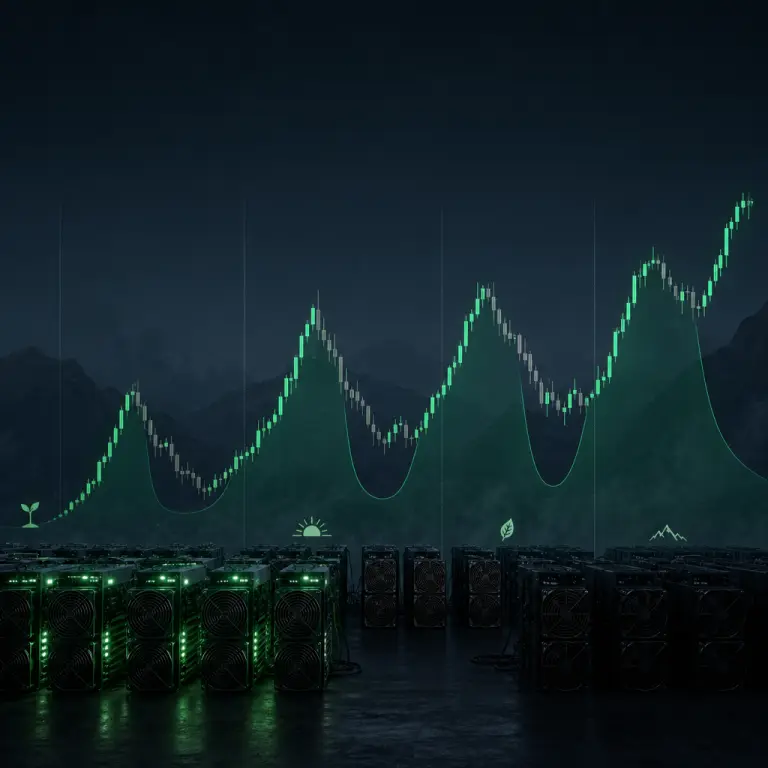
How Bitcoin Price Actually Feeds Mining Revenue
Before the history lesson, it helps to understand the plumbing. Miner revenue is not a single number — it is a three-way interaction between price, network difficulty, and the fixed halving schedule. Mess with any one and the others react, which is why every major BTC move reshapes the mining industry within months.
Price drives USD revenue per TH
Miners earn BTC. Bills are USD. A 50% BTC drawdown cuts the USD value of every satoshi you mine by 50% — without changing a single line of code or a single machine on the network.
Difficulty reacts with a lag
When price crashes, weak miners unplug. Global hashrate drops, and the protocol lowers difficulty every 2,016 blocks. Survivors end up earning more BTC per TH — a built-in subsidy for the operators still standing.
Halvings compound the squeeze
Every four years the block reward is halved. If the halving lands near a price low, revenue can be cut 70–80% in a matter of months. If it lands near a high, miners print money. Timing decides who survives.
Put those three forces together and you get the hashprice — the USD value of one terahash per day. Hashprice is the single number that summarises how mining revenue feels at any moment, and it is exquisitely sensitive to the BTC price. The chart of hashprice since 2013 is essentially the chart of BTC with every bear market amplified and every recovery delayed by the difficulty lag.
Cycle 1 — The 2013 Bubble and the End of the GPU Era
Bitcoin's first real mania took it from around $13 in January 2013 to roughly $1,127 in late November, fuelled partly by bot-driven trading on Mt. Gox that later research traced to a single actor who accumulated hundreds of thousands of BTC, according to the Royal Society analysis of Bitcoin's bubble history. China's central bank then banned Chinese financial institutions from handling Bitcoin in early December 2013, and the price began a long grind to around $172 by January 2015.
What made this cycle unique for miners was the simultaneous hardware revolution. ASICs arrived and killed GPU mining in about 18 months. Hobbyists running gaming GPUs had been the network's backbone since 2010; by 2015, purpose-built ASIC chips had rendered every GPU on the planet economically useless for Bitcoin. Miners who had not upgraded capitulated in waves, and the collapse of Mt. Gox in early 2014 took a chunk of active miners offline with it.
| 2013–2015 snapshot | What happened |
|---|---|
| BTC peak → trough | ~$1,127 (Nov 2013) → ~$172 (Jan 2015), ~85% drawdown |
| Block reward | 25 BTC (after the 2012 halving) |
| Hardware shift | GPU era ended; first-gen ASICs dominated |
| Miner takeaway | Price crash + hardware obsolescence = double capitulation. Operators who upgraded to ASICs during the bull emerged with dramatically cheaper hashrate. |
Cycle 2 — The 2017 Run and the 2018 Winter
The 2016 halving cut the reward from 25 to 12.5 BTC, and price climbed from roughly $600 that summer to just under $20,000 by December 2017 — an ICO-fuelled mania that briefly made any miner with a functional plug profitable. Then the January 2018 peak collapsed. By December 2018, BTC was trading around $3,200.
This was the first cycle in which miner bankruptcies made mainstream news. Giga Watt filed Chapter 11 in November 2018 — the first major US mining bankruptcy on record, per Norton Rose Fulbright's 2018 insolvency review. Throughout 2018, publicly available hashrate data shows network hashrate grew most of the year as 2017-ordered fleets came online, then dropped roughly 40% between October and December as the final price leg lower forced unprofitable machines offline — a pattern Hashrate Index documented in its mining bear market comparison.
The operators who survived — and could still buy cheap S9-generation machines during the panic — were the ones who compounded hardest when BTC rallied back to $14,000 by mid-2019 and eventually to new highs in 2020. Capitulation created bargains; efficiency turned those bargains into the next cycle's profits.
| 2017–2019 snapshot | What happened |
|---|---|
| BTC peak → trough | ~$19,800 (Dec 2017) → ~$3,200 (Dec 2018), ~84% drawdown |
| Hashrate Q4 2018 | ~40% drop between October and December capitulation window |
| Bankruptcies | Giga Watt (first major US miner Chapter 11), plus quiet shutdowns at dozens of smaller farms |
| Miner takeaway | Difficulty dropped hard into the lows; survivors picked up discounted S9s and rode the 2019–2021 recovery with much better unit economics. |
Cycle 3 — The 2021 Peak, the China Ban, and the 2022 Contagion
The third cycle is the one most current readers remember. BTC hit roughly $69,000 in November 2021, then fell to around $15,500 a year later. Between those two prints, three separate stress events hit miners: China's mining ban, the Terra collapse, and the Three Arrows Capital contagion that took down centralised lenders Celsius and BlockFi.
In May 2021, China banned crypto mining. China had accounted for over 60% of global hashrate. Within weeks the Bitcoin network hashrate crashed to a multi-year low near 85 EH/s as miners physically unplugged machines, boxed them, and shipped them to Kazakhstan, the US, and Russia — what Hashrate Index called "the great hashrate migration". Kazakhstan's global hashrate share climbed roughly 10 percentage points almost overnight. Surviving miners during that window earned outsized BTC per TH as difficulty crashed with the hashrate — a real-world demonstration of the difficulty lag protecting operators still online.
Eighteen months later, the picture inverted. As BTC ground from $69k toward $15k, the miner bankruptcy cluster hit. Compute North filed Chapter 11 in September 2022, crushed by rising power costs and falling BTC. Core Scientific — at the time the largest publicly traded Bitcoin miner in North America — filed Chapter 11 in December 2022. Both were dragged down by the same twin squeeze: BTC revenue falling faster than their fixed USD power contracts, at the same time that difficulty kept climbing because enough rivals stayed online.
| 2021–2022 snapshot | What happened |
|---|---|
| BTC peak → trough | ~$69,000 (Nov 2021) → ~$15,500 (Nov 2022), ~77% drawdown |
| China ban effect | Hashrate fell to ~85 EH/s low, then recovered to new ATH of ~182 EH/s by Dec 2021 |
| Major miner bankruptcies | Compute North (Sep 2022), Core Scientific (Dec 2022); contagion from Three Arrows, Celsius, BlockFi |
| Miner takeaway | Even well-funded public miners could fail if their power cost base was too high. Leverage amplified price-driven losses. |
Mine from the cost base that actually survives cycles
Every bear market kills the operators running expensive power and outdated ASICs. NoxHash's fleet sits in Kazakhstan on industrial $0.035/kWh power, running Antminer S21 series at 12–17.5 J/TH. It is built to keep paying BTC to renters through the kind of squeeze that took down Compute North and Core Scientific.

Cycle 4 — The Post-Halving Era (2024–2026)
The April 2024 halving cut the block reward from 6.25 BTC to 3.125 BTC overnight. BTC had climbed from roughly $16k in early 2023 to around $70k at the halving, and pushed past $100k in late 2024 and through 2025 — the kind of price backdrop that in prior cycles would have been outright euphoric for miners. This cycle has been different.
Hashprice compressed harder and faster than any prior era. According to Cointelegraph's 2025 mining review, hashprice fell from around $0.12/TH/day in April 2024 to roughly $0.049/TH/day by April 2025 as global hashrate raced past 800 EH/s and then touched 1 ZH/s in 2025. Network difficulty kept setting all-time highs into 2026. Only miners running sub-16 J/TH hardware on sub-$0.06/kWh power kept healthy margins.
By early 2026, reports from outlets including CoinDesk described BTC trading 20% below estimated all-in production cost for marginal operators — a classic miner stress signature. Some public miners pivoted infrastructure toward AI compute to hedge BTC exposure. Survivors in pure Bitcoin mining have converged toward the same recipe: modern S21-class hardware, sub-4-cent industrial power, and a patient BTC treasury posture.
| 2024–2026 snapshot | What happened |
|---|---|
| BTC range | ~$50k (halving) → $100k+ highs → sharp corrections |
| Hashrate | ~500 EH/s pre-halving → 800+ EH/s → 1 ZH/s crossed in 2025 |
| Hashprice | ~$0.12/TH/day (Apr 2024) → ~$0.049/TH/day (Apr 2025) |
| Miner takeaway | Price alone is no longer enough — even $100k BTC can produce margin stress when difficulty grows faster. Efficiency, not excitement, is the survival moat. |
Three Patterns That Repeat in Every Cycle
Four cycles is not a huge sample, but it is enough to pick out the signatures that keep showing up. None of these are prophecies — BTC can behave in new ways — but the similarities are strong enough to plan around.
Capitulation always follows a hard drawdown
When BTC draws down 75–85% from the local top, the weakest 20–40% of hashrate unplugs. The timing varies, but the pattern has shown up in every cycle so far.
Efficiency selection accelerates each cycle
Each bear market narrows the efficiency band that can stay profitable. 30 J/TH was fine in 2019. Sub-20 J/TH is table stakes in 2026. Older hardware dies first, cheapest power stays online longest.
Survivors compound disproportionately
Each recovery leg rewards the operators who kept mining through the low — they earned more BTC per TH during the difficulty trough, often at the lowest hardware acquisition prices of the cycle.
Lessons for Today's Miners and Cloud Renters
History does not hand out a risk-free playbook, but it does narrow the list of things worth worrying about. The most dangerous myth in mining is that a rising BTC price makes everything fine — because hashprice depends on difficulty as much as price, and difficulty has only moved one way across four cycles.
For miners who own hardware: the price a rig was purchased at matters less than the J/TH it runs at and the $/kWh power contract behind it. Plenty of the failed operators in 2022 bought the newest rigs available — they failed because their power cost floor was higher than their marginal BTC revenue in a bear tape.
For cloud mining renters: the lesson is counterintuitive but important. You do not get to skip the BTC price exposure just because you never bought a rig. Your rental fee is fixed in USD. Your output is BTC. A price crash hurts you too — it just arrives through the value of your payouts instead of an unpaid electricity bill. The rental model shifts hardware risk to the operator; it does not remove market risk, which remains firmly on you.
What Cloud Mining Users Should Expect Across a Cycle
Knowing the cycle pattern lets you set the right expectations going in. Over a 12–24 month rental, you are almost guaranteed to see at least one sharp drawdown and one recovery leg. That is not a bug; that is how this asset class has behaved every time.
Measure in BTC stacked, not daily USD
Daily USD PnL oscillates violently with price. Multi-month BTC accumulation is steadier and closer to what the model actually delivers. Renters who hold their BTC through a cycle usually come out better than renters who panic-convert every dip.
Match contract term to your horizon
A 1-month rental is a toe in the water; a 24-month rental with a 20% discount is a multi-cycle bet. Longer terms look attractive when price is calm — but they lock your USD cost through whatever the market does next, including a halving.
Do not scale up at cycle highs
The riskiest moment to sign a long-term rental is right after a vertical run. Every cycle has punished buyers who committed peak capital at peak price. Smaller initial position, more room to add on drawdowns, always.
Pick operators with the lowest cost floor
The 2022 bankruptcies were not random — they were high-cost operators meeting a low BTC tape. A provider running cheap industrial power and modern sub-20 J/TH hardware is structurally likelier to keep paying through a bear.
Risk Management in a Price-Driven Industry
The fancy risk management playbook in mining is not complicated. It is mostly the discipline to do unflashy things at unpopular moments.
Size your commitment so a bear market does not hurt. If a 70% BTC drawdown across your contract term would be ruinous, the contract is too big for your balance sheet. Size down until a full bear is annoying rather than devastating.
Do not start large positions into vertical moves. The worst cycle entries in history were all near euphoric tops. A small starter rental during a calm tape is nearly always better than a large rental during a breakout — even if you miss some upside.
Expect at least one difficulty shock per year. Whether it is a China-style regulatory event, an energy crisis, or a halving, the miner revenue line is always exposed to step changes outside the BTC chart. Budget for them rather than being surprised.
Treat cloud rentals as a BTC accumulation tool, not a short-term USD yield product. Every cycle has been kinder to the patient accumulators than to people trying to trade month-to-month USD yield. The structural tailwind — a scheduled supply cut every four years — rewards time horizon.
Test the thesis on your own timeline
You have seen how four BTC cycles reshaped mining revenue. The cheapest way to pressure-test the idea on your own numbers is the NoxHash 2-day Basic Miner trial — 50 TH/s running on the same Kazakhstan infrastructure the rental plans use, with zero deposit required.
Frequently Asked Questions
How closely does mining revenue track the BTC price?
Very closely in USD terms, but with amplification from difficulty and lag effects. If BTC drops 40%, hashprice typically falls at least as much until difficulty adjusts down. When miners capitulate and difficulty drops, BTC earned per TH rises — partly offsetting the price hit for operators still online.
Does a BTC crash always cause hashrate to fall?
Historically yes, but with a lag. Miners absorb early losses from cash reserves; hashrate tends to fall only after prolonged bear conditions or a specific stress event. The 2018, 2021, and 2022 declines all had clear hashrate drops, though the magnitude varied by cycle.
Which miner bankruptcies stand out historically?
Giga Watt in 2018 was the first major US mining Chapter 11. Compute North filed in September 2022 and Core Scientific — then the largest publicly traded North American Bitcoin miner — filed in December 2022. Each shared the same cause: high USD power costs meeting a falling BTC tape.
Are cloud mining renters immune to BTC price drops?
No. Cloud rental fees are paid in USD while payouts are in BTC. A BTC crash cuts the dollar value of payouts while leaving the monthly fee untouched. The rental model removes hardware risk, not price risk — that sits with the renter and is the single biggest variable in the outcome.
Why do survivors often earn more BTC per TH during bears?
Because difficulty adjusts down when weaker miners unplug. With less total hashrate competing, the remaining machines share the same daily block rewards. This built-in rebalancing has lifted BTC earned per TH during every prior capitulation window, even while USD value stayed depressed.
Is it safe to start cloud mining after a big BTC rally?
It is the riskiest moment historically. Starting a long contract at cycle highs locks USD cost in while output BTC can lose value fast. A smaller starter position after a parabolic move — or waiting for a consolidation — has tended to outperform chasing the breakout, across all four prior cycles.
What separates operators that survive cycles from those that don't?
Two things: power cost and fleet efficiency. Operators on sub-$0.05/kWh industrial contracts running sub-20 J/TH machines can stay cash-positive at hashprices that put higher-cost rivals underwater. Leverage is the third factor — over-levered balance sheets failed first in 2022.
Historical analysis — not financial advice
This article reviews how four Bitcoin price cycles affected mining revenue using publicly available data as of April 2026. Historical price ranges, hashrate figures, and bankruptcy events are drawn from sources including CoinDesk, Hashrate Index, Norton Rose Fulbright's 2018 insolvency review, and CoinGecko price records. Past performance does not predict future performance. Cloud mining and Bitcoin mining in general carry market risk, counterparty risk, regulatory risk, and tax obligations that depend on your jurisdiction. Only commit capital you can afford to lose, and consult a qualified financial or tax professional about your local rules before sizing any position.