What Are Bitcoin Ordinals and Runes? How They Affect Mining Fees
Learn what Bitcoin Ordinals and Runes actually are, how they work, and why fee-heavy eras quietly boost cloud mining BTC output per TH/s during peak demand.
Bitcoin Ordinals is a protocol launched in January 2023 by developer Casey Rodarmor that lets individual satoshis carry arbitrary data — text, images, or code — effectively minting NFTs directly on Bitcoin. Runes, launched alongside the April 2024 halving, is a fungible-token protocol built on Bitcoin that uses lighter OP_RETURN-style encoding. Both generate the transaction fees miners collect on top of the block subsidy — and during peak activity, those fees briefly eclipsed the subsidy itself.
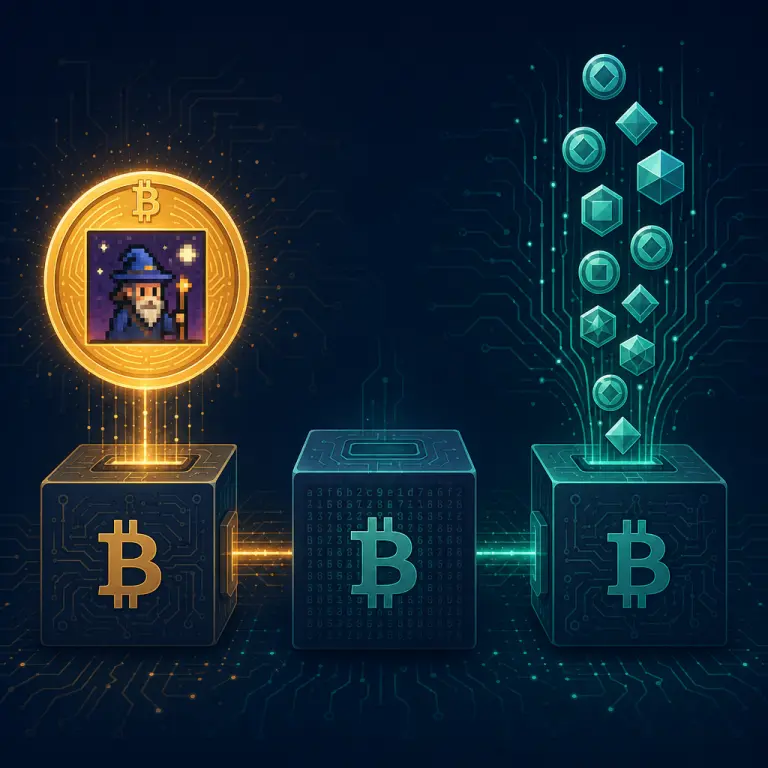
Ordinals and Runes in Plain English
Both protocols live on Bitcoin but encode different things and optimise for different use cases. Understanding the split matters because each one pushes block space in a different way.
Ordinals — inscribed satoshis
An Ordinal is a single satoshi (1/100,000,000th of a BTC) with a file embedded into its witness data — an image, piece of text, SVG, or even a small program. Each inscribed sat becomes a non-fungible artefact you can trade. In effect, NFTs native to Bitcoin.
Runes — fungible tokens
Runes are fungible tokens — think interchangeable units like dollars, not collectibles. They piggy-back on Bitcoin's OP_RETURN output, which is lighter and cheaper than inscribing a file. Built by the same developer as Ordinals, Runes are designed specifically for meme-coin-style token issuance.
The shorthand: Ordinals create collectibles, Runes create tokens. Ordinals cost more per transaction because they carry a file. Runes are cheaper per mint but generate enormous volume during popular drops. Both end up paying Bitcoin miners — the part that matters for any cloud mining user.
How Each Protocol Works — A Side-by-Side
Neither protocol required a Bitcoin fork. Both piggy-back on existing features — Ordinals on Taproot witness data, Runes on OP_RETURN — which is why they launched without community consensus, and why the debate over whether they belong on Bitcoin has been heated.
| Dimension | Ordinals | Runes |
|---|---|---|
| Launched | January 2023 | April 2024 (halving block) |
| Type of asset | Non-fungible (NFTs) | Fungible (tokens) |
| Encoding | File inscribed in witness data | OP_RETURN output metadata |
| Block-space cost | High — images can be kilobytes | Low — a few bytes per mint |
| Typical user behaviour | Mint + hold or flip on marketplaces | Mass-mint during popular drops |
| Creator | Casey Rodarmor | Casey Rodarmor |
A simpler way to visualise it: an Ordinal inscription is like shipping a small package through Bitcoin's transaction system, while a Runes mint is like stamping a label on an envelope already going out. Both take block space, but the package is heavier — which is why Ordinals have had a disproportionate effect on fee markets.
The Fee Timeline — When Ordinals and Runes Rewrote Miner Economics
For most of Bitcoin's history, fees made up a small slice of miner revenue — typically 1–5% of the block subsidy. Ordinals and Runes changed that, at least temporarily. Here is the sequence every cloud mining user should know.
January 2023 — Ordinals launches
Rodarmor's Ordinal Theory goes live. Inscription count explodes within weeks, producing sporadic fee spikes as image data floods block space for the first time.
May and December 2023 — Ordinals fee booms
BRC-20 experiments (built on Ordinals) and the holiday inscription rush push transaction fees to 20–30% of total miner revenue for weeks — a ratio not seen since the 2017 bull run.
20 April 2024 — Runes launches at the halving
Rodarmor times Runes to go live at halving block 840,000. Combined halving anticipation and minting frenzy push average transaction fees to $127.97 — about 7x the day before. Miners collect a record 37.7 BTC (~$2.4M) in the halving block alone.
Q2 2024 — Fee share hits 75%
Per CoinDesk coverage of the halving block, fees reached a historic 75% of total miner revenue in the hours after Runes launched, offsetting most of the 50% subsidy cut. Daily mining revenue peaked near $107M on 20 April 2024.
2025 — Cool-down
Fee share collapses to roughly 1% of total mining revenue as Ordinals and Runes minting activity fades. Miners return to subsidy-dependence and BTC price as the dominant revenue driver.
2026 — Stabilising around 15%
As of early 2026, fees have rebuilt to roughly 15% of miner revenue — below 2024's peak but well above the pre-2023 baseline. Ordinals and Runes still trigger short spikes around popular drops.
Get hashrate exposure before the next fee boom
Ordinals and Runes booms reward whoever is already mining when they hit — not whoever scrambles to buy an ASIC mid-spike. A cloud rental from $20/month gets you positioned now, while a 2-day free trial lets you see real hashrate before committing any capital.
Why Miners Benefit From High-Fee Eras
Miner revenue has two parts: the block subsidy (fresh BTC minted each block, currently 3.125 BTC after the April 2024 halving) and transaction fees paid by users whose transactions get included. The subsidy halves every four years. Fees don't — they float with demand for block space.
During a hot Ordinals or Runes mint, block space becomes scarce and users outbid each other, pushing per-byte fee rates up sharply. The miner who solves that block collects whatever the winning bidders paid, on top of the 3.125 BTC subsidy. On halving day 2024, that worked out to 37.7 BTC in a single block — about 12x the subsidy.
For operators, fee-heavy weeks effectively raise BTC output per TH/s. The hashrate hasn't changed — what's changed is the payout each share earns from the pool, because the pool's fee take is higher. A miner rented at 150 TH/s during a fee boom earns meaningfully more BTC per day than the same 150 TH/s during a quiet week.

The Block-Space Debate — A Balanced View
Not everyone in Bitcoin thinks Ordinals and Runes are a good development. The controversy shapes how these protocols are treated by node software and pools — and therefore how durable the fee revenue is.
Supporters — fees secure the future
As the block subsidy halves every four years, Bitcoin's long-term security budget has to transition to fees. Ordinals and Runes create organic fee demand without requiring protocol changes. Several mining industry voices (including ViaBTC) have publicly argued they help solve the post-subsidy problem.
Critics — Bitcoin is for payments
Bitcoin purists argue that inscribing JPEGs and launching meme tokens clogs block space, prices out small payment users, and bloats node storage requirements. Some node implementations have shipped optional filters to reject inscription-style transactions from their mempools.
For a cloud mining user, fee spikes from Ordinals and Runes are real revenue events when they happen, but their sustainability is uncertain — they depend on user interest, which can fade quickly. The 2024-to-2025 collapse from 75% to 1% is proof.
What This Means for Cloud Mining Users
Cloud operators typically pool their fleet's hashrate and distribute rewards pro-rata to rented shares. Fee spikes flow partially through to renters — you hold a slice of whatever block gets made.
Tailwind — higher BTC per TH/s
During an Ordinals or Runes boom, pools using FPPS payout models pass a share of elevated fee revenue to participating miners. For a renter, that usually appears as higher-than-baseline BTC accrual during those weeks — the same 150 TH/s earns more.
Timing — spikes are short
Historic fee booms have lasted days to weeks, not months. A 1-month rental can catch one; a 6- or 12-month term smooths across several quiet periods and potential spikes. Do not rent specifically hoping to catch a fee event — treat the event as upside, not a base case.
Risk — no guaranteed repeat
Ordinals and Runes popularity has clearly fluctuated. 2024's 75% fee-share was the exception, not the rule. 2025 collapsed back to 1%. There is no guarantee a future fee event matches or exceeds 2024, or that one happens on any specific timeline.
Check the operator model
Pass-through varies by operator. NoxHash runs FPPS pools where fee revenue is part of each share payout — meaning renter returns during a boom rise organically. Confirm with any platform how fees flow into user payouts before assuming a boom benefits you directly.
Be positioned when the next fee window opens
No one schedules an Ordinals or Runes boom — they just happen. NoxHash's Kazakhstan fleet runs Antminer S21-class machines into FPPS pools, so fee upside reaches renters as elevated BTC accrual. Start with the 2-day trial and keep the option open.
Frequently Asked Questions
What is the difference between Ordinals and Runes?
Ordinals are non-fungible — each inscribed satoshi carries a unique file, similar to an NFT. Runes are fungible tokens, like meme coins on Bitcoin. Both were built by Casey Rodarmor and both generate transaction fees that flow to Bitcoin miners.
How did Runes affect Bitcoin fees at launch?
On 20 April 2024, the day of both the halving and the Runes launch, average Bitcoin transaction fees hit roughly $127.97 — about 7x the day before. Miners collected 37.7 BTC in the halving block alone, and fees briefly made up 75% of total miner revenue.
Do Ordinals and Runes booms still happen in 2026?
Less intensely than in 2024. Fee revenue crashed from a 75% peak to around 1% in 2025 before stabilising near 15% in 2026. Popular drops still trigger short spikes, but the sustained mania of the launch year has not returned. Treat future events as possible upside, not a base case.
Do cloud mining renters share in fee spikes?
On operators using FPPS payout models — NoxHash included — fee revenue is baked into each share payout. During a fee boom, your rented hashrate earns more BTC per day than during quiet weeks, at no extra cost. Confirm with any platform how fee income flows into renter payouts before assuming a boom helps you.
Are Ordinals and Runes controversial among Bitcoiners?
Yes. Supporters argue they generate fee revenue to secure Bitcoin's post-subsidy future. Critics argue they congest block space and raise costs for payment users. Some node implementations have shipped optional filters against inscription-style transactions. The debate is real and ongoing.
Should I time a cloud mining rental around Ordinals or Runes?
Not really. No one can schedule a fee event, and timing a short rental around speculation usually fails. A longer-term rental (3–12 months) captures both quiet periods and any spikes that occur. Treat fee booms as unpredictable upside, not the reason to rent.
Educational content — not financial advice
This article is for education. Fee statistics and revenue ratios reflect data available as of April 2026 and will continue to change as network conditions evolve. Ordinals and Runes activity is inherently unpredictable — historic fee booms do not guarantee future ones. Cloud mining returns depend on BTC price, network difficulty, and fee markets, all outside your direct control. Only commit capital you can afford to lose, and consult a qualified tax professional for your jurisdiction.