Bitcoin Mining Energy Consumption — Facts vs Myths
Cambridge CBECI puts Bitcoin at ~138 TWh/year in 2026 with a 52.4% sustainable energy mix. We separate six common mining energy myths from what the data says.

Bitcoin's energy story is a political talking point, but the numbers tell a more nuanced picture. The Cambridge CBECI puts the network at roughly 138 TWh/year in January 2026 — about 0.5% of global electricity, with 52.4% of the mix from sustainable sources. That doesn't make every critique wrong; it does make most of the loudest myths measurably false.
The Actual Number, With a Date on It
Most of the confusion around Bitcoin's energy use comes from old numbers quoted without dates. The only credible public tracker is the Cambridge Bitcoin Electricity Consumption Index (CBECI), maintained by the Cambridge Centre for Alternative Finance. As of January 2026, CBECI's best estimate is approximately 138 TWh of annualised electricity consumption, equivalent to about 0.5% of global electricity demand.
CBECI's parallel Digital Mining Industry Report also puts the network's greenhouse gas emissions at ~39.8 MtCO2e. For scale, Google, Microsoft and Amazon combined run data centres that use several times more electricity than the entire Bitcoin network — and nobody seriously argues we should stop sending email.
The point isn't that 138 TWh is trivial. It isn't. The point is that any honest conversation has to start from that number, not from a 2021 headline or a viral tweet. The rest of this article pairs the most common claims against what the current data actually says.
Six Common Myths vs What the Data Says
We picked the six claims we hear most often. Each row shows the myth on the left, the reality from CBECI and peer-reviewed work on the right. Sources are linked once at the top to avoid cluttering the table.
| The Myth | The Reality (2026 data) |
|---|---|
| "Bitcoin uses more electricity than Argentina." | Argentina's consumption is ~130–140 TWh/year — so the comparison is roughly accurate in scale, but Bitcoin produces a verifiable global settlement network, not nothing. Scale without context isn't an argument. |
| "Bitcoin mining is all fossil fuels." | CBECI's 2025 industry report puts the mix at 52.4% sustainable (42.6% renewables + 9.8% nuclear), 38.2% natural gas, 8.9% coal. Coal share fell from 36.6% in 2022. |
| "Each Bitcoin transaction uses a swimming pool of water." | Per-transaction framing is misleading. Miners are paid to secure the network, not process transactions — throughput can scale with Lightning and other layers without changing energy use at all. |
| "Proof-of-work mining is pure waste." | Energy buys settlement assurance for a trillion-dollar, permissionless network. You can argue that cost is too high — but "waste" assumes the output is worthless, which ignores what the energy actually produces. |
| "Hashrate keeps rising, so mining will boil the oceans." | Hashrate has roughly tripled since 2022, but energy use has grown far less because efficiency improved from ~30 J/TH to ~15 J/TH. Newer ASICs offset most network growth. |
| "Miners compete with households for electricity." | Most industrial miners run interruptible contracts — they shut off during peak demand and are increasingly used for grid balancing, flared-gas capture, and soaking up stranded renewables that would otherwise be curtailed. |
Where the Energy Actually Comes From
The single biggest shift in the mining conversation over the last four years is on the fuel mix. CBECI's 2025 survey — based on 49 mining firms across 23 countries — found that coal's share fell by roughly three-quarters since 2022, while natural gas and nuclear grew. The breakdown below is the current snapshot.
42.6% renewables
Hydro, wind, and solar lead — especially in the Nordics, Paraguay, Ethiopia, and parts of North America where miners plug into otherwise curtailed capacity.
9.8% nuclear
Baseload nuclear is a steady component in US, Canadian, and Scandinavian operations — zero-carbon and dispatchable, an increasingly attractive match for always-on mining loads.
38.2% natural gas
A large share comes from flared or stranded gas at oil wells — energy that would otherwise be vented or burned for no productive output. Mining turns that waste into block rewards.
8.9% coal
Down from 36.6% in 2022 — the China ban in 2021 forced a migration away from coal-heavy provinces and toward grids with cheaper, cleaner supply.

What Critics Get Right
A credibility test for any pro-Bitcoin energy piece is whether it's willing to concede the parts that are genuinely problematic. We'll do that here.
Carbon intensity varies wildly by region. A miner on Washington State hydro and a miner on West Virginia coal both count as "Bitcoin miners," but their per-kWh emissions differ by an order of magnitude. A network-wide average hides real local impact.
Grid stress is a real local concern. Texas has seen genuine friction between miners and residential ratepayers during heat waves, even though many large miners curtail voluntarily. Policy on interruptible tariffs is still catching up.
Heat and noise are externalities. Operations sited near residential areas have created complaints about low-frequency fan noise and thermal exhaust. The industry has mostly responded by moving rural, but it's a fair criticism for legacy sites.
E-waste is non-trivial. ASICs have shorter useful lives than general-purpose hardware. The industry's answer — resale into secondary markets and refurbishment — is improving but imperfect.
These are real issues. The response isn't to deny them, it's to fix them — and progress on the fuel mix is the strongest evidence that the industry can actually move when the economics line up.
How NoxHash Fits Into That Picture
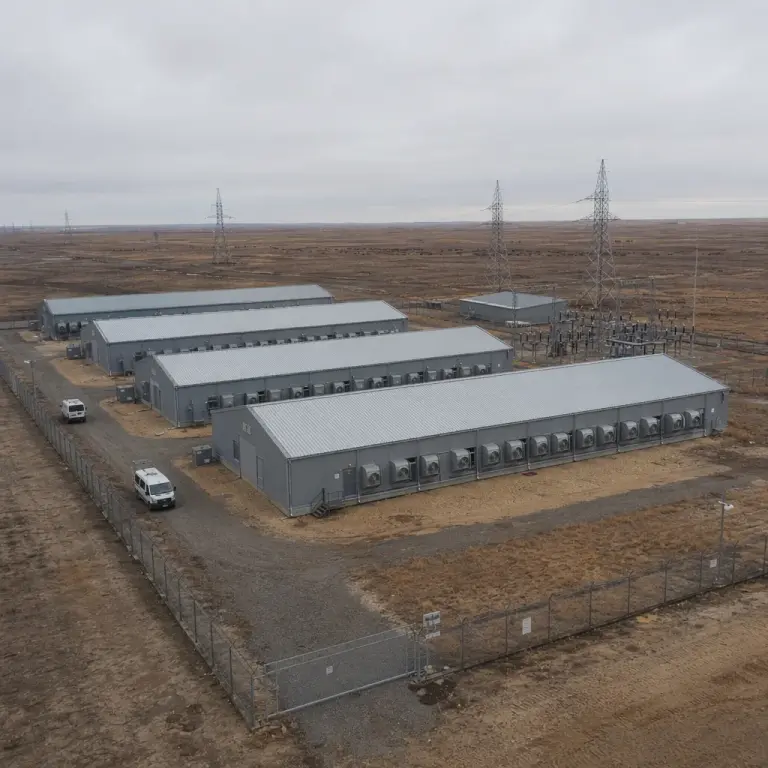
NoxHash operates a single data centre in Kazakhstan — one of the three largest Bitcoin mining jurisdictions by hashrate. The grid mix there is mixed: a historic reliance on coal and natural gas, with growing hydro and wind capacity, and a national climate plan targeting higher renewable share through the late 2020s. We don't pretend to run on 100% renewables.
Where we can make a direct contribution is efficiency per unit of work done. Our fleet runs on Antminer S21 series and WhatsMiner M60/M66 hardware at 12–18.5 J/TH — roughly twice as efficient as 2021-era S19 Pro rigs at ~30 J/TH. That means for the same block reward, we burn half the electricity compared to older fleets still active on the network. Continental winters at −15 to −30°C also let us cool most of the year with outside air instead of running HVAC chillers, which is another meaningful cut to facility-level overhead.
None of that makes Bitcoin mining "green" on its own. It does mean an individual kilowatt-hour bought from us produces more hashrate — and more BTC — than the same kilowatt-hour at an older facility. Efficiency is how an honest operator contributes to lowering the network's overall intensity while the grid itself transitions.
See the energy story for yourself, not in a headline
You've read the CBECI numbers and the six myths. The next honest step is checking what a modern fleet actually looks like — live Mining Desktop, real CGMiner output, real hashrate. A 2-day Basic Miner trial takes about two minutes to claim.
Frequently Asked Questions
Is Bitcoin bad for the climate?
It has a measurable footprint — roughly 39.8 MtCO2e/year per CBECI. That's real, but it's also declining relative to hashrate as the fuel mix shifts toward renewables and nuclear, and as ASIC efficiency roughly doubles each generation. "Bad" depends on what you think the settlement network is worth.
Is cloud mining cleaner than home mining?
Usually yes, because industrial sites run newer, more efficient ASICs and site near cheaper industrial grids. A hobbyist running a 2021-era rig on residential electricity emits roughly twice as much per TH as a modern fleet on industrial power. The facility's grid mix still matters more than the rental model itself.
How much water does Bitcoin mining use?
Direct water use is generally low — most facilities air-cool or use closed-loop liquid systems. The often-cited "swimming pool per transaction" figure is an indirect allocation of the water used by power plants upstream, and it's heavily disputed because it attributes generation water to end-users in a way that isn't done for other industries.
Why is natural gas the biggest fuel in the mix?
North America dominates reported mining at over 75% of activity, and US grids rely heavily on natural gas. A growing share is specifically flared gas — methane vented at oil wells that miners capture and combust on-site, which actually reduces net emissions compared to uncontrolled venting.
Does higher hashrate always mean more energy?
No. Hashrate has roughly tripled since 2022 while energy use has grown far less, because each new ASIC generation roughly halves joules per terahash. If ASIC efficiency gains stopped and hashrate kept climbing, energy use would rise linearly — but historically efficiency has absorbed most of the growth.
What can mining do for the grid, not just take from it?
Large miners act as a flexible, interruptible load: they can power down in seconds when demand spikes, soak up stranded wind or solar that would otherwise be curtailed, and provide revenue that underwrites new renewable buildouts in remote areas. Not every operator uses these capabilities, but the toolkit is real.
Informational only — not financial or environmental advice
This article summarises public data from the Cambridge CBECI as of January 2026 and does not constitute investment, policy, or environmental advice. Figures are point-in-time estimates that update as the network and its reporting sample evolve. Crypto mining involves market, regulatory, and technical risks — research independently and only commit funds you can afford to lose.