Bitcoin Mining Electricity Costs by Country — Full Comparison
Industrial vs residential electricity rates for Bitcoin mining across 20+ countries in 2026, with Antminer S21 monthly power cost per kWh tier.

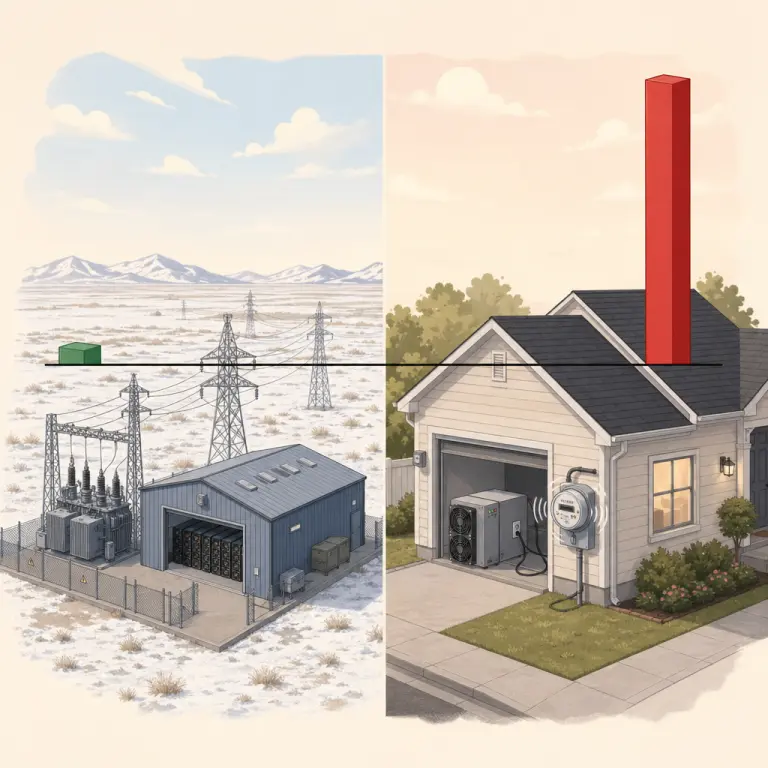
Bitcoin mining electricity costs split into two very different worlds. Industrial miners on direct power purchase agreements pay $0.03-0.07/kWh in Kazakhstan, Paraguay, Russia, Texas, Canada, and the Nordics. Residential households pay three to ten times more — roughly $0.10 in Vietnam, $0.17 in the US, $0.22 in Japan, $0.30 in the UK, and $0.38 in Germany. The country you plug into decides whether one Antminer S21 costs $76 or $950 a month to run.

Electricity Is the Margin — Everything Else Is Rounding
A Bitcoin miner's profit-and-loss statement is almost entirely one line: electricity. Hardware depreciates on a three-to-four-year curve. Pool fees run 1-2% of revenue. Maintenance is pocket change on a single rig. But the kilowatt-hours keep coming, hour after hour, for the entire life of the machine — and the price of each one is set by the country, state, or utility contract you plug the miner into.
Electricity is typically 60-75% of an industrial miner's operating cost, and close to 90% of a home miner's operating cost once the hardware is paid off. That is why the geography of Bitcoin mining is really the geography of cheap power. It is also why the same Antminer S21, running the same SHA-256 algorithm on the same network difficulty, can be wildly profitable in one country and deeply unprofitable fifty kilometres across a border.
S21 monthly power draw
An Antminer S21 pulls 3,500W × 24h × 30 days = 2,520 kWh per month. Multiply that by your local rate to get the monthly power bill for a single machine — the quickest sanity check in mining.
Two tiers, not one
Mining farms buy electricity on industrial PPAs (direct power purchase agreements) at a fraction of household prices. Residential rates are a different product entirely, with grid-maintenance and subsidy costs baked in.
Regulation matters
Some countries restrict or ban crypto mining outright — Iran runs a partial ban, China banned commercial mining in 2021, and Kazakhstan now meters miners on a regulated tariff. Power price alone doesn't tell the whole story.
Industrial Mining Rates — What Farms Actually Pay
This is the table that matters for public miners, ASIC colocation hosts, and cloud platforms like NoxHash. Industrial rates come from direct power purchase agreements, stranded-generation deals, or government-negotiated mining tariffs. The price floor you see in the news — $0.03-0.04/kWh — is real, but only inside these jurisdictions and only for multi-megawatt loads. Figures reflect April 2026 public data and industry trackers including the Cambridge Bitcoin Electricity Consumption Index and hashrate-mix reporting.
| Country / region | Industrial rate (USD/kWh) | Monthly S21 power cost | Primary generation |
|---|---|---|---|
| Kazakhstan | $0.03-0.04 | $76-101 | Coal, natural gas, regulated tariff |
| Paraguay | $0.03-0.05 | $76-126 | Itaipu hydro (surplus capacity) |
| Russia (Siberia) | $0.03-0.05 | $76-126 | Hydro + stranded natural gas |
| Ethiopia | $0.03-0.04 | $76-101 | Grand Ethiopian Renaissance Dam hydro |
| Texas (USA, ERCOT spot) | $0.04-0.06 | $101-151 | Wind + gas + demand-response credits |
| Canada (Québec) | $0.04-0.06 | $101-151 | Hydro-Québec baseload |
| UAE / Oman (stranded gas) | $0.04-0.06 | $101-151 | Flare-gas capture, sovereign projects |
| Norway | $0.04-0.07 | $101-176 | Hydropower (renewable-heavy grid) |
| Bhutan | $0.04-0.06 | $101-151 | Himalayan hydro, sovereign mining |
| Iceland | $0.06-0.09 | $151-227 | Geothermal + hydro (tight grid) |
| Sweden / Finland | $0.05-0.08 | $126-202 | Hydro + nuclear, cold climate |
| China (pre-2021 ban reference) | ~$0.03 | ~$76 | Sichuan hydro / Xinjiang coal (now banned) |
Kazakhstan, Paraguay, Russia, and Ethiopia form the current $0.03-0.05 floor — the rates that actually drive industrial mining decisions in 2026. Texas and Québec sit a notch higher but offer political stability and capital-market access, which is why public miners cluster there. Iceland and the Nordics were once the cheap-power story of the 2010s, but tight grids and green-premium tariffs have nudged their prices up since 2022.
Residential Rates — What Home Miners Actually Pay
Now flip to the household side. These are the prices an individual miner sees on their monthly utility bill — what you'd pay if you plugged an Antminer S21 into your garage socket. Figures reflect April 2026 data from GlobalPetrolPrices residential series, US EIA, and Eurostat. The world average sits around $0.17/kWh, with Europe pushing above $0.25 and Asia averaging near $0.09.
| Country | Residential rate (USD/kWh) | Monthly S21 power cost | Notes |
|---|---|---|---|
| Vietnam | $0.10-0.12 | $252-302 | EVN tiered pricing, top tier bites miners |
| India | $0.08-0.11 | $202-277 | State-by-state variance, subsidized tiers |
| China (residential) | $0.08-0.10 | $202-252 | Mining banned — rate shown for context only |
| USA (national average) | ~$0.17-0.18 | $428-454 | Huge state spread: WA $0.11, CA $0.30+ |
| South Korea | $0.12-0.15 | $302-378 | Sharply progressive residential tariff |
| Japan | $0.20-0.24 | $504-605 | Post-Fukushima import-heavy mix |
| Australia | $0.24-0.28 | $605-706 | High network + green-levy component |
| UK | $0.28-0.32 | $706-806 | Ofgem price cap + gas exposure |
| Germany | $0.35-0.40 | $882-1,008 | Renewable-levy heavy, highest in G7 |
| Italy | $0.30-0.36 | $756-907 | Gas-dependent, volatile winters |
| Mexico | $0.09-0.12 | $227-302 | CFE subsidized tiers for low usage |
| Brazil | $0.15-0.19 | $378-479 | Hydro-heavy, drought risk on rates |
The practical read: almost no residential address on Earth makes home Bitcoin mining economical on a new S21 in 2026. Vietnam and India sit at the friendly end of the spectrum but still land 3-4× above industrial rates. The US, Korea, and Japan put a home miner in break-even-or-worse territory. Germany, Italy, Australia, and the UK make it a straight net loss — the S21's monthly BTC revenue is typically $350-500 at April 2026 conditions, less than the power bill alone.
Skip the geography problem entirely
You've just seen that where you live can swing S21 power cost by 10× or more. Cloud mining sidesteps the whole map: NoxHash runs its fleet in Kazakhstan on a $0.035/kWh industrial contract, and the rental price bakes that rate in regardless of your home country.
Why Some Countries Are Cheap — Three Structural Factors
Cheap mining electricity is never an accident. The list of $0.03-0.05/kWh jurisdictions always shares some combination of three underlying drivers. If a country has two of them, it ends up on the Cambridge hashrate map. If it has all three, it leads it.
1. Surplus renewables or stranded fuel
Paraguay has more hydro than its population can consume. Texas produces wind power that is often curtailed. Siberian and Middle Eastern gas fields flare methane that can't be economically piped to cities. Bitcoin miners buy that stranded energy at marginal cost — a structural discount no household can match.
2. Cold climate = free cooling
Kazakhstan, Siberia, Canada, and the Nordics all have winter averages of -10°C or colder. Farms vent hot exhaust to the outside and pull sub-zero air across the miners, cutting HVAC load by 20-30% versus warm-climate sites. Cooling is electricity too — just hidden behind a different line on the bill.
3. Mining-friendly regulation
Kazakhstan has a formal mining tariff structure. Paraguay and Bhutan offer sovereign-backed mining leases. Texas pairs ERCOT's demand-response program with crypto-friendly legislation. Clear legal status lets operators sign 5-10 year power deals at industrial prices — something grey-market jurisdictions can't offer.
Why Some Countries Are Expensive
The mirror-image question: why do Germany, the UK, Japan, and Australia sit at $0.25-0.40/kWh for households? The answer is a mix of taxes, subsidies flowing the other direction, and grid structure.
Renewable-transition levies lead the list. Germany's EEG levy historically added €0.06-0.07/kWh on top of wholesale price to fund solar and wind buildouts — even after recent reforms, residential bills still carry grid-fee and CO2-pricing components that industrial consumers partially avoid. The UK's price cap, meanwhile, is indexed to gas, and Europe's 2022 energy shock left a sticky premium.
Network and distribution costs are the second culprit. Japan and Australia both have long transmission distances, heavy network-maintenance fees, and capacity charges that inflate residential kWh prices above the cost of generation. Progressive tariffs are the third: Vietnam, South Korea, California, and Italy use steeply tiered pricing where the top block — exactly where a 2,520 kWh/month miner lands — costs 1.5-2× the bottom block. Plug in an S21 and you push your entire household into the expensive tier.
A Quick Regulatory Footnote
Price is only half of the equation. Several jurisdictions on the cheap list also impose legal constraints on crypto mining:
| Country | Status | Practical effect |
|---|---|---|
| China | Commercial mining banned since 2021 | Residential hashrate survives quietly; industrial farms moved offshore |
| Iran | Partial / seasonal ban | Mining frozen during peak-demand months to protect the grid |
| Kazakhstan | Regulated, tiered tariff | Licensed miners pay $0.03-0.04; unregistered rates up to $0.12 |
| Russia | Legal with regional restrictions | Some oblasts cap or block mining during winter demand peaks |
| EU | Legal, MiCA-regulated | No price ceiling or carve-out for miners; full residential rate applies |
So a "cheap" country is only cheap if you can legally plug in. That caveat disappears if you rent cloud hashrate from a licensed operator — the regulatory work has already been done on your behalf.
How Cloud Mining Decouples You From Your Local Rate
Here is the key idea the tables above quietly hammer home: when you rent cloud hashrate, your home country's electricity price stops mattering. The rental fee is priced against the operator's industrial rate, not yours. NoxHash signs a direct power purchase agreement at $0.035/kWh in Kazakhstan; whether you log in from Tokyo, Munich, Melbourne, or Hanoi, that $0.035 is what your BTC is ultimately hashed with.
Put another way: NoxHash's Standard Miner rents for $50/month and delivers 150 TH/s. An Antminer S21 at home in Germany would cost you ~$882-1,008/month in electricity alone for 200 TH/s — nearly twenty times the Standard Miner price — before you even buy the $1,900 hardware. The rental is expensive relative to Kazakhstan and cheap relative to Germany. Geography is still doing the work, just on the operator's side of the ledger.
| Your country | Home S21 power / month | NoxHash effective rate | Difference |
|---|---|---|---|
| Vietnam ($0.11) | ~$277 | $0.035 (baked in) | ~3× cheaper electricity |
| USA ($0.18) | ~$454 | $0.035 (baked in) | ~5× cheaper electricity |
| Japan ($0.22) | ~$554 | $0.035 (baked in) | ~6× cheaper electricity |
| UK ($0.30) | ~$756 | $0.035 (baked in) | ~9× cheaper electricity |
| Germany ($0.38) | ~$958 | $0.035 (baked in) | ~11× cheaper electricity |
The rental doesn't negotiate with your local utility on your behalf — it replaces your local utility for this specific workload. Everything else (hardware, cooling, technicians, uptime) comes along for the ride because the operator already has to solve those problems for their own rigs.
Plug into the cheapest tier on the map, from anywhere
The country list above doesn't have to dictate your mining economics. NoxHash's Kazakhstan farm runs on a $0.035/kWh industrial contract and exposes that rate to users in any of the 20+ residential markets priced in this guide. Test with a 2-day Basic Miner trial before committing.
Frequently Asked Questions
Which country has the cheapest Bitcoin mining electricity in 2026?
On industrial contracts, Kazakhstan, Paraguay, Ethiopia, and parts of Siberia lead at $0.03-0.05/kWh. Texas and Québec sit a step higher at $0.04-0.06/kWh but offer stable regulation. Pre-2021 China held the global floor near $0.03/kWh before commercial mining was banned, pushing hashrate to these alternatives.
Why is industrial electricity so much cheaper than residential?
Industrial consumers sign long-term power purchase agreements that skip residential grid fees, retail-margin markups, progressive tariffs, and renewable levies. They also buy in the megawatts, which lets utilities offer marginal-cost pricing. The structural result is a 3-10× price gap versus household rates almost everywhere.
Can I still mine Bitcoin at home profitably anywhere in 2026?
Only in rare pockets where residential power stays under roughly $0.06/kWh — think hydro-heavy parts of Washington state, Québec, Paraguay, or Iceland. Above that threshold, an Antminer S21's monthly BTC revenue typically doesn't cover the electricity bill, let alone hardware depreciation, cooling, and noise mitigation.
Is Bitcoin mining legal in every country on the cheap list?
No. China banned commercial mining in 2021 and Iran runs seasonal bans during peak-demand months. Kazakhstan requires licensing under a regulated tariff, and some Russian oblasts restrict mining during winter. Always check local legal status before buying hardware — raw kWh price isn't a complete picture of country risk.
How much does one Antminer S21 cost per month in electricity?
An S21 draws 3,500W continuously, or 2,520 kWh per month. That's $76 on a $0.03/kWh industrial contract, $151 at Texas $0.06, $454 at US residential $0.18, $756 at UK $0.30, and almost $1,000 at German $0.38. Multiply your local rate by 2,520 to get your own figure.
Why is Iceland no longer the cheapest mining country?
Iceland's geothermal and hydro capacity is finite, and aluminium smelters already absorb most of it. As mining demand grew, new connection requests were paused and rates drifted up to $0.06-0.09/kWh — still low by global standards, but no longer competitive with Kazakhstan or Paraguay for new industrial deployments.
Does renting cloud hashrate really protect me from my local electricity price?
Yes — the rental fee is fixed in USD and the underlying power is bought on the operator's industrial contract. A German household paying $0.38/kWh locally accesses the same $0.035/kWh Kazakhstan power as a US user through NoxHash's rental price. Your own utility bill only covers the laptop you log in from.
Educational content — not financial advice
This guide compares electricity prices for educational purposes. Industrial and residential rates reflect April 2026 public data from GlobalPetrolPrices, US EIA, Eurostat, the Cambridge CBECI, and International Energy Agency trackers — all subject to change as policy, currency, and market conditions evolve. Mining profitability depends on BTC price, network difficulty, and regulatory conditions outside your control. Past performance does not guarantee future results. Check local legal status before mining in your jurisdiction and only invest what you can afford to lose.