How Lightning Network Affects Bitcoin Miner Revenue
Does Bitcoin's Lightning Network cannibalize on-chain miner fees or expand long-term demand? A balanced look at channel opens, batching, and settlement economics.
The Lightning Network moves millions of small Bitcoin payments off-chain, which sounds like it should starve miners of fees — but the reality is more nuanced. Every Lightning channel still opens and closes on-chain, each batch settles hundreds of off-chain payments into one fee-paying footprint, and wider BTC adoption — which L2 enables — historically drives more settlement demand, not less. Short-term fee pressure, long-term tailwind.
Lightning in One Paragraph — What Miners Need to Know
The Lightning Network is a Bitcoin Layer 2 — a second layer built on top of Bitcoin that moves payments off the base chain into private channels between users. Two parties lock BTC into a 2-of-2 multisig address (one on-chain transaction), then exchange as many off-chain payments as they want, and eventually settle the net balance back to the main chain (one more on-chain transaction). In between, thousands of micropayments flow at near-zero cost and near-instant speed.
For miners, the key question is simple: if millions of payments happen off-chain, does that mean fewer on-chain transactions — and therefore fewer fees — flowing to every TH/s of hashrate? The answer has a short-term piece and a long-term piece, and they point in different directions.
The Short-Term Worry — Payment Cannibalization
Before Lightning, every Bitcoin coffee, tip, or remittance paid its own miner fee. A thousand $5 purchases meant a thousand on-chain transactions bidding for block space. Fee rates in 2017 briefly hit 400+ sat/vB during the first big mempool congestion, partly because small payments had nowhere else to go.
Lightning collapses that pattern. A single channel with $500 of locked capacity can route tens of thousands of small payments over its lifetime, yet it only generates two on-chain transactions: one to open, one to close. Multiply that across the network — roughly 17,000 public nodes and ~40,000 public channels totalling ~4,900 BTC of capacity as of 2025, per Bitcoin Visuals — and the theoretical block-space demand from small payments drops sharply.
That is the cannibalization argument in its cleanest form: Lightning absorbs the cheapest, most frequent transactions and leaves the on-chain fee market thinner. And for a stretch of 2023-2024, this worry looked real. Lightning capacity was climbing, routing volumes were rising, yet on-chain fee revenue outside of Ordinals and Runes spikes was often under 3% of block reward.
The On-Chain Footprint Lightning Still Creates
The cannibalization story misses half the picture. Lightning does not eliminate on-chain activity — it concentrates it into fewer, larger, fee-paying transactions. Three mechanisms keep miners in the loop:
Channel opens and closes
Every channel requires exactly two on-chain transactions that pay standard miner fees — and force-closes (when parties disagree) pay extra fees for HTLC resolution.
Liquidity rebalancing
Routing nodes run submarine swaps and splicing operations to rebalance channel capacity — each of which touches the main chain and pays fees.
Fee-market competition
Because channel operations can wait for low-fee windows, Lightning transactions smooth the fee market — but they also defend a baseline of demand in quiet periods.
The critical framing: Lightning concentrates value per byte. A channel close that settles thousands of off-chain payments is a single ~200-400 byte transaction carrying the economic weight of all those payments. Miners charge per byte, so the absolute on-chain volume shrinks, but the willingness-to-pay for each byte of channel activity is often higher than a casual on-chain transfer.
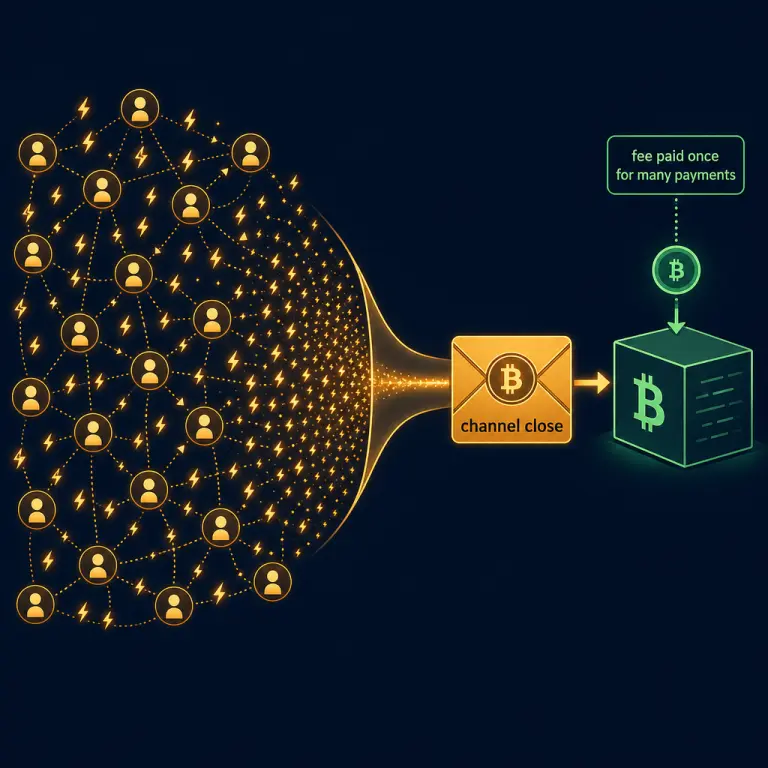
Batching Effects — Why Large Players Amplify the Concentration
When an exchange or payment processor runs Lightning infrastructure at scale, they rarely open one channel at a time. They batch multiple channel operations into a single on-chain transaction, a standard optimization described in the Lightning Engineering docs. One transaction might open 20 channels, saving 19 transactions of overhead.
On paper this sounds bad for miners — fewer transactions, fewer fees. In practice, batching is what makes large-scale Lightning deployment commercially viable at all. Without it, a payment processor running hundreds of channels would pay prohibitive on-chain overhead and give up on Lightning entirely — which means no Lightning usage, and also no on-chain settlement footprint to replace. Batching is what keeps the flywheel spinning.
A similar pattern plays out with splicing (resizing a channel without closing it) and channel factories (multiple channels sharing one funding transaction). Each is a throughput optimization that shrinks the per-payment on-chain footprint but enables far greater total Lightning adoption. Think of it like a highway: a single bus carries 50 people and pays one toll instead of 50 cars paying 50 tolls. The toll road earns less per passenger, but more people can travel.
The Payment-Volume-to-Settlement Ratio
The honest way to model Lightning's effect on miner revenue is to track the ratio between off-chain payment volume and on-chain settlement footprint. This ratio has been climbing steadily since Lightning launched in 2018.
| Era | Approx LN capacity | Est. payments / settlement tx | Miner impact |
|---|---|---|---|
| 2018-2019 | ~500-1,000 BTC | Low — hobbyist use | Negligible |
| 2020-2022 | 1,000-4,000 BTC | Moderate — El Salvador, custodial wallets | Mild cannibalization offset by bull market |
| 2023-2024 | ~4,500-5,300 BTC | High — exchanges, Taro/Taproot Assets | Quiet-period pressure, offset by Ordinals/Runes |
| 2025-2026 | ~4,900+ BTC public, plus large private | Very high — stablecoins on LN, institutional | Structural — but adoption tailwind growing |
Capacity numbers above reference Bitcoin Visuals public-node snapshots; private channel capacity (large custodians, exchanges) is likely several times larger but not directly measurable.
The pattern is clear: each unit of off-chain payment volume produces fewer and fewer on-chain settlement bytes over time. If you only look at this ratio, it reads as a miner headwind. But the ratio misses the denominator — total Lightning usage itself is growing exponentially, and so is the underlying BTC user base. The question becomes whether adoption growth outruns efficiency gains.
Every channel close, splice, and force-close pays your hashrate
Rent TH/s on NoxHash's 12-17.5 J/TH fleet and capture the full block revenue mix — subsidy, on-chain fees, and the growing Lightning settlement footprint — through FPPS pool payouts, proportional to your rented hashrate.
The Long-Term Tailwind — Why Lightning Is Bullish for Miner Revenue
Short-term accounting makes Lightning look like a zero-sum shift from on-chain fees to off-chain routing fees. Long-term, the math changes because Lightning removes the main argument against Bitcoin as a payment rail: slow, expensive base-layer transactions. Without Lightning, Bitcoin's user base was structurally capped at people willing to pay $5-50 per transfer during congestion. With Lightning, that ceiling lifts.
A larger BTC user base means:
More users eventually settling
Every Lightning user ultimately wants to touch the main chain — opening a wallet, withdrawing to cold storage, or settling a large balance. More users = more settlement demand per cycle.
Higher BTC economic value
Broader payment utility supports higher BTC valuation, which raises USD-denominated fees and subsidy even when sat-denominated fees stay flat. Miner P&L benefits.
Institutional Lightning adoption
Exchanges, payment processors, and custodians opening large-capacity channels generate large, high-fee batched on-chain transactions — a structural replacement for retail spam fees.
Post-halving fee importance
As block subsidy halves every 4 years (3.125 → 1.5625 BTC in ~2028), every source of on-chain fee demand matters more. Lightning settlement is now part of that baseline.
What This Means for Cloud Mining Users
If you are renting hashrate on NoxHash or any other cloud platform, Lightning is not something you need to trade around directly. Your payouts come from FPPS pool distributions, which average out both subsidy and fee revenue. But understanding the dynamic helps you set realistic expectations:
Expect quiet-period fees to stay modest
In non-spike months, fees may contribute 1-5% of block revenue. Lightning has structurally lowered demand for low-value on-chain spam, and this is unlikely to reverse. Plan your rental ROI assuming subsidy carries most of the payout most of the time.
Spike events still deliver bonus revenue
Bull-run congestion, major Lightning liquidity reshufflings (exchanges rebalancing hot-to-cold), Ordinals/Runes cycles, and ETF settlement days all produce fee pressure that flows to your TH/s. Lightning does not prevent these — it just raises the baseline between them.
Think in terms of network health, not payment volume
A Bitcoin network with strong Lightning adoption has more users, more economic activity, and more long-term BTC demand — all of which support price and therefore USD-denominated mining revenue. Lightning is a sign of network strength, not a threat to miner income.
Pick efficient hashrate to weather fee volatility
When fees are thin, the miners with the lowest electricity cost per TH survive quiet periods best. NoxHash's 12-17.5 J/TH fleet on $0.035/kWh industrial power is positioned for exactly this environment — you stay profitable when fees are quiet and capture upside when they spike.
Lightning — Headwind or Tailwind for Miners?
| Aspect | Short-term headwind | Long-term tailwind |
|---|---|---|
| Small retail payments | Move off-chain, eliminating fee demand | Enabled by L2 — grows total BTC user base |
| Channel ops / settlement | Batching reduces per-payment fee footprint | High willingness-to-pay per byte, defends baseline |
| BTC price effect | None short-term | Broader adoption supports higher BTC valuation |
| Post-halving fee dependence | Makes fee baseline more critical | LN settlements + spikes fill the gap |
The balanced read: Lightning creates real short-term pressure on the low-value fee market by pulling small payments off-chain, but it creates long-term structural support for miner revenue by growing the BTC user base, concentrating high-value settlement on-chain, and enabling Bitcoin to function as a global payment rail — which defends and increases BTC's economic weight, the single largest driver of USD-denominated miner income.
Frequently Asked Questions
Does Lightning Network reduce Bitcoin miner fees?
In the short term, yes — Lightning pulls small payments off-chain, reducing demand for the cheapest on-chain block space. But channel opens, closes, splices, and force-closes all pay miner fees, and Lightning's adoption growth drives broader BTC usage that indirectly supports fee revenue through higher transaction diversity and demand spikes.
How many on-chain transactions does each Lightning channel create?
A standard Lightning channel produces exactly two on-chain transactions: one to open (funding) and one to close (settlement). Force-closes during disputes add HTLC resolution transactions. Splicing and channel factories reduce the per-channel footprint when operators resize or bundle channels.
Will Lightning Network hurt cloud mining profitability?
Not materially. Cloud mining ROI is dominated by BTC price, network difficulty, and electricity cost per TH — not marginal fee income. Lightning's effect on fees is roughly 1-3% of typical miner revenue in quiet periods, dwarfed by a single BTC price move of 5-10%.
What happens to miner revenue as block subsidy keeps halving?
As subsidy drops from 3.125 BTC (2024) to 1.5625 BTC (~2028) and beyond, fees must carry more of the revenue weight. Lightning's role is ambiguous: it reduces some small-payment fee demand but adds a structural settlement baseline. Most models expect fees to rise as BTC price and adoption grow, offsetting subsidy decline.
Do miners earn routing fees on the Lightning Network itself?
No. Lightning routing fees go to node operators who provide liquidity, not to base-chain miners. These are separate roles. Miners only earn revenue when Lightning activity touches the main chain — channel opens, closes, splices, swaps, or dispute resolutions.
Informational content, not investment advice
This article discusses Bitcoin mining and Lightning Network economics for educational purposes only. It is not financial advice. Mining revenue depends on BTC price, network difficulty, fee conditions, and electricity cost — all of which can vary dramatically. Historical patterns do not guarantee future results. Only invest what you can afford to lose, and consider market timing carefully before renting hashrate.