ASIC Miner Resale Value — Depreciation & Secondary Market Guide
ASIC miner resale value guide — S19/S19j Pro/S19 XP/S21 depreciation curves, Kaboomracks and Luxor pricing, and when to sell vs run to the ground.
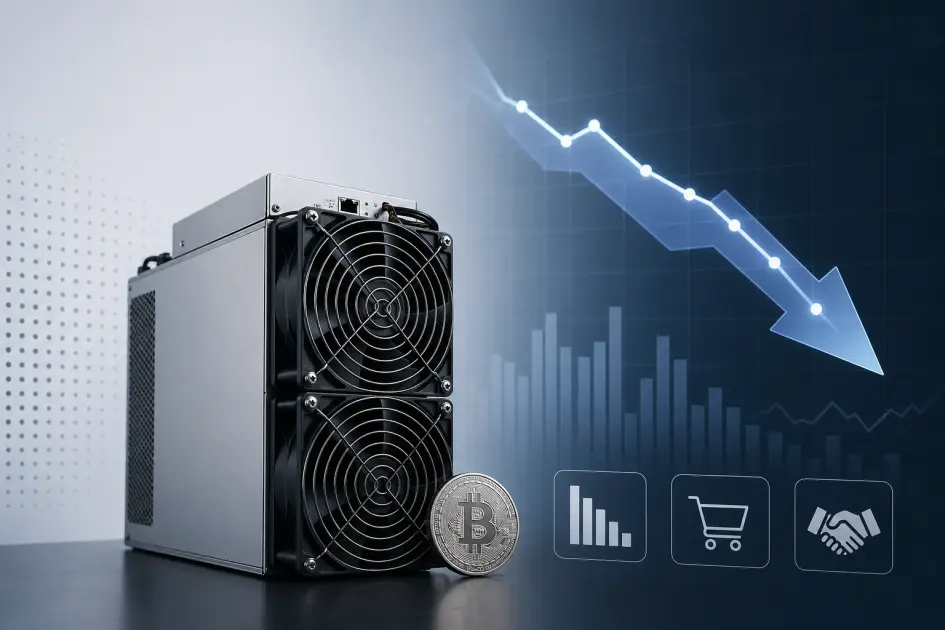
ASIC miner resale value is the price a used Bitcoin mining rig fetches on the secondary market, quoted in $/TH. Depreciation is driven by three forces — efficiency obsolescence (newer J/TH rigs arrive), hashprice compression (halvings and difficulty climbs), and physical wear. Flagships lose 50–70% of their value in the first 18 months; legacy units trade below $10/TH.

Why ASIC resale value matters — even if you never plan to sell
Every mining decision is an implicit bet on future resale value. When you buy an S21 Pro today, you're effectively choosing between two exit paths — sell in 12–24 months when the next flagship lands, or run it until the hashprice curve pushes it below the shutdown line. The resale market prices that option for you in real time.
Operators who ignore $/TH pricing discover too late that a rig they valued at "original sticker price" on the balance sheet actually fetches 30 cents on the dollar. The secondary market, dominated by desks like Kaboomracks in Texas and Luxor's trading desk, is the only honest mark-to-market signal miners have.
Efficiency obsolescence
A new 15 J/TH flagship makes 21 J/TH rigs economically older overnight — even if they still work perfectly.
Hashprice compression
Halvings and rising network difficulty cut $/TH/day revenue, pulling used rig prices down with them.
Physical wear
Hashboard micro-fractures, worn fans, degraded PSUs — used-unit risk priced into bigger $/TH discounts.
S19, S19j Pro, S19 XP, S21 — the depreciation curve by generation
The table below is a distilled view of how $/TH secondary-market pricing has tracked across four Antminer generations from launch through 2026, synthesized from Luxor ASIC Trading Desk data, Kaboomracks weekly lists, and Hashrate Index's ASIC Price Index archives. Numbers are indicative — actual quotes swing 10–20% week to week with hashprice.
| Model | Efficiency | Launch $/TH | $/TH at 2024 halving | $/TH in 2026 (indicative) |
|---|---|---|---|---|
| Antminer S19 (95 TH/s) | ~34.5 J/TH | ~$80 | ~$10 | $3–6 |
| Antminer S19j Pro (104 TH/s) | ~29.5 J/TH | ~$90 | ~$12 | $5–9 |
| Antminer S19 XP (140 TH/s) | ~21.5 J/TH | ~$34 | ~$18 | $12–16 |
| Antminer S21 (200 TH/s) | ~17.5 J/TH | ~$27 | ~$22 | $16–19 |
| Antminer S21 Pro (234 TH/s) | ~15.0 J/TH | ~$33 | n/a (post-halving launch) | $22–26 |
The pattern is blunt: each new efficiency tier pulls the tier below it down by roughly 40–55% over the following 12 months. S19 Classic — the flagship of 2020 — now trades at scrap-adjacent pricing because the hashprice it can produce barely exceeds its own electricity cost at $0.05–0.07/kWh. For data and a live feed on these curves, the Hashrate Index ASIC Price Index is the de-facto public reference.
The secondary market — who actually buys and sells
The used-ASIC market is fragmented but three routes handle the majority of institutional flow.
Kaboomracks — Texas-based OTC desk
Originally a Telegram broker, Kaboomracks became a household name for US miners. Lot sizes from 5 units to containers of 500+. Specialty is moving S19 generation stock that Chinese-hub miners unload after upgrading. Listings are often first-come-first-served on a public Telegram channel — price discovery is raw and fast.
Luxor Hardware Trading Desk
Luxor operates both a mining pool and a trading desk — they see order flow, hashprice, and inventory in one data set. Their RFQ (request-for-quote) model quotes buy and sell prices to institutional counterparties, with end-to-end logistics. The desk's weekly volumes feed into the public Hashrate Index ASIC Price Index.
Direct P2P + regional brokers
In Kazakhstan, the Gulf, and Southeast Asia, container-scale deals often clear via regional brokers or peer-to-peer between farms. Pricing skews 5–15% below US desk quotes because freight and import duty are already priced out. Due diligence risk is higher — "refurbished" can mean anything from professionally reballed to cosmetically wiped.
Hashprice sensitivity — why $/TH prices move with BTC
Hashprice — a metric coined by Luxor in 2019 — is the USD a miner expects to earn per TH/s per day, a function of BTC price, network difficulty, block subsidy, and transaction fees. It's the single most important lever on used-ASIC pricing. When hashprice rises, every rig's expected lifetime revenue rises, and the secondary market bids up $/TH across the board.
Rough rule of thumb from 2022–2026 desk data: a 1% move in hashprice moves used-ASIC $/TH prices by roughly 0.6–0.8%, with newer-gen rigs more sensitive than older ones. When hashprice spiked above $0.10/TH/day in late 2023 ahead of the halving, S19 XP prices jumped 40% in two months; when hashprice compressed to $0.04/TH/day in mid-2024, the entire S19 family lost another 30%.
High hashprice regime
BTC rally + low difficulty growth — resale premiums widen, flagships trade near launch pricing, even two-gen-old rigs find buyers.
Compressed hashprice
Post-halving shock or BTC drawdown — anything above ~25 J/TH becomes hard to resell. Legacy rigs trade at scrap prices; new gear still finds bids but with steep discounts.
Skip the $/TH depreciation curve entirely
You just saw how a $5,000 S19 can crater to $200 in four years. With NoxHash cloud mining, the hardware depreciation sits on our balance sheet in Kazakhstan — you rent current-gen S21 hashrate and walk away when you're done. No resale, no logistics, no refurb risk.

Sell now or run to the ground? A decision framework
This is the single question operators agonize over. The math isn't complicated — it just has to be done honestly. You have two future cash-flow streams to compare.
| Scenario | Sell today | Run to shutdown price |
|---|---|---|
| Cash inflow | Current $/TH × TH | Sum of (hashprice − power) until shutdown |
| Exposure | Zero forward risk | BTC price, difficulty, electricity rate |
| Upside if BTC pumps | Miss the rally | Captured fully |
| Downside if BTC crashes | Locked in | Negative margin + falling resale |
Rule of thumb: sell when the resale quote exceeds the next 12 months of expected free cash flow under realistic assumptions (BTC flat or down 20%, difficulty +15% YoY). Run to the ground when the rig is profitable at shutdown-price realistic electricity and a new-gen flagship launch is more than 12 months away.
The practical edge case — and the one most miners get wrong — is the 6-month window before a new flagship launch. Pre-announcement, resale for the prior gen usually holds within 10% of current levels. Post-announcement, expect a 20–35% price drop within 60 days. Selling before the announcement, if you already know you'll upgrade, is almost always the right call.
Two profiles, two strategies
Sub-$0.05/kWh industrial operator
Run to the ground makes sense. Even a 29 J/TH S19j Pro is still cash-flow positive at these rates through most hashprice regimes. Buy used on dips, sell when a generational shift arrives. Depreciation is a feature — cheap inventory.
$0.08+/kWh retail operator
Only the newest, most efficient flagship rigs make sense — and the second they're not flagship anymore, margins disappear. Selling into the resale market aggressively on upgrades (or cloud mining instead) usually beats holding depreciating 20+ J/TH inventory.
How NoxHash manages the same curve internally
Everything in this guide is why NoxHash thinks carefully about when to buy, operate, and retire ASICs in our Kazakhstan fleet. Our strategy maps directly to the frameworks above — but we execute it at scale so users renting hashrate don't have to.
Buy at scale, pay less per TH
Container-lot pricing is 15–25% below retail $/TH. That is our entry edge.
Operate at $0.035/kWh
Kazakhstan industrial power keeps the shutdown price low for the whole fleet, so we get more useful life out of each rig.
Retire >15% efficiency gain
When a new flagship improves efficiency by more than 15%, we sell into the secondary market while residual $/TH is still healthy.
From the user's perspective, renting hashrate on NoxHash means you get S21-tier efficiency (12–17.5 J/TH) without ever touching a $/TH depreciation curve. The resale risk — the thing every owner-operator loses sleep over — sits on NoxHash's balance sheet, not yours.
Rent the hashrate, not the depreciation
If the sell-vs-run-to-ground math feels too volatile for you, let NoxHash handle it. You get current-gen fleet access from $20/month; we absorb the resale and retirement curve. Try 2 days of Basic Miner hashrate free before committing a single dollar.
Frequently asked questions
How fast does a new ASIC miner lose value?
A flagship ASIC typically loses 50–70% of its $/TH value in the first 18 months, then another 30–50% over the next two years as a new generation replaces it. Rate of decline accelerates sharply in the 60 days after a next-gen launch announcement.
Is an S19j Pro still worth buying in 2026?
Only if your all-in electricity cost is under $0.05/kWh and you buy at the $5–9/TH floor. At $0.08/kWh or higher, a 29 J/TH S19j Pro spends most of 2026 at or below shutdown price. It's an industrial-tier machine in 2026, not a retail one.
Where can I check real-time used ASIC prices?
Hashrate Index (by Luxor) publishes a weekly ASIC Price Index covering under-38 J/TH, 38–68 J/TH, and above-68 J/TH tiers. For spot quotes, Kaboomracks' Telegram and Luxor's RFQ desk are the two deepest pools. Regional brokers exist but quotes are less transparent.
Should I sell before the next halving?
Historically, $/TH peaks 6–12 months before a halving as operators front-run a hashprice squeeze. If you own marginal-efficiency gear — say, 20+ J/TH — selling into that pre-halving premium usually beats riding the post-halving margin compression with inventory you'll struggle to offload later.
Does cloud mining skip the resale problem entirely?
Yes. When you rent hashrate from a platform like NoxHash, the hardware depreciation, resale logistics, and retirement timing all sit with the operator. You pay a monthly fee, earn BTC, and walk away at contract end — no $/TH curve to navigate, no units stacking up in a garage.
Not investment advice
ASIC resale pricing, hashprice, and mining profitability are highly volatile and depend on BTC price, network difficulty, electricity cost, and hardware cycles you cannot control. Figures in this guide are indicative and drawn from public desk data as of April 2026. Past performance does not guarantee future outcomes. Only deploy capital — in hardware or cloud mining — that you can afford to lose.