8 Habits That Help Cloud Miners Earn More BTC Over Time
Eight long-term habits — DCA rentals, compound, weekly review, self-custody, records, diversify — that can help cloud miners stack more BTC in 2026.

Cloud miners who stack the most BTC over time rarely have a single clever trick — they have eight boring habits: split rental spend into smaller monthly tranches instead of one lump sum, time new contracts around BTC weakness, reinvest mined BTC into more hashrate, check the dashboard weekly (not hourly), self-custody balances once they matter, keep clean monthly records, learn the three numbers that move their payout, and diversify across plans. None of them are hacks. All of them compound.

Why Habits Beat Timing for Cloud Miners
BTC price swings 30–50% in a quarter and network difficulty currently sits around 135 T — both numbers move whether you watch them or not. Anyone trying to trade these moves inside a mining contract is playing the wrong game. The habits below work on the parts a cloud miner can control: how rental spend is deployed, when new terms are signed, where mined BTC lives afterwards, and how attention is rationed.
The common thread is a longer horizon. A miner who holds 12 months of consistent habits out-performs a miner who chases a single well-timed lump every time we look at the dashboards inside the NoxHash facility. Difficulty cycles, halvings, and BTC drawdowns all punish inconsistency — and quietly reward the opposite.
The 8 Habits, Ranked From Easiest to Hardest
Split rental spend monthly — don't lump-sum your budget
A miner with $600 to deploy over a year will usually do better renting roughly $50 of hashrate each month than signing one $600 annual contract on day one. The reason is simple: you can't know on day one whether BTC will be at $60k or $120k by month six, and month-to-month renting lets you size later contracts into whatever price regime actually arrives. Dollar-cost-averaging your rental spend is the same logic most investors already apply to BTC itself — extended to the mining side of the balance sheet.
Sign longer terms into BTC weakness, not strength
Rental fees are denominated in USD, earnings arrive in BTC. That asymmetry means a 12-month contract (with its 15% term discount) tends to work harder when BTC is in a drawdown window than when it's printing new highs — because the same USD pays for hashrate that will credit BTC purchased later at a higher price. The habit isn't calling tops and bottoms; it's simply resisting the urge to upgrade to 24-month Enterprise during euphoria, when every metric feels like permission to size up.
Reinvest a fixed share of mined BTC into more hashrate
Every month, decide in advance what percentage of mined BTC gets converted back into the next month's rental — 30%, 50%, whatever your plan calls for — and automate the mental habit, not the BTC itself. Over 12 cycles this compounds: hashrate rented in month 1 mines the BTC that pays part of month 2's contract, which mines the BTC that pays part of month 3's, and so on. This is the closest thing cloud mining has to an interest-on-interest effect, and it only works if you're disciplined about the percentage each month.
Check the dashboard weekly — not hourly
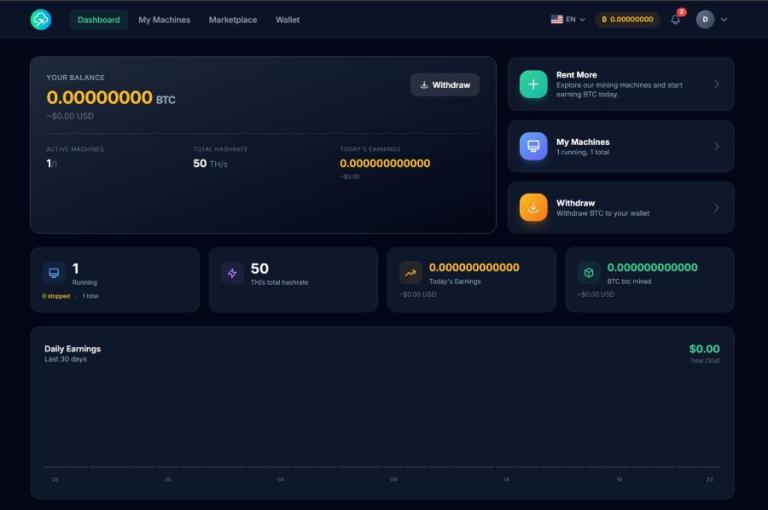
The NoxHash dashboard credits BTC every minute via FPPS accounting and shows a 30-day earnings chart. Miners who refresh it every hour usually end up stressed, over-trading between contracts, and attributing normal daily variance to machine problems. The miners who stack the most BTC in our data pick one weekly review slot — most commonly Sunday evening — read the 30-day trend, note that week's BTC balance, and close the tab. Hourly attention is noise; weekly attention is signal.
Move meaningful balances to your own wallet
Once your mined BTC crosses a balance you'd be unhappy to lose — a useful threshold is "one month of rent", but pick what's meaningful for you — withdraw it to a wallet you control. Keep a small working balance on the platform for fee-efficient top-ups, and move the rest out. Self-custody isn't a critique of any particular platform; it's the default Bitcoin operating principle. Every long-running cloud miner ends up here eventually, and it's cheaper to build the habit at 0.005 BTC than at 0.05 BTC.
Export transactions monthly for tax and record-keeping
Mining income, BTC conversions, and withdrawals are each taxable events in most jurisdictions. Miners who rebuild a year of activity in March, the week their filing is due, discover exactly one thing: it's painful. Miners who export a monthly CSV of deposits, rentals, mined BTC, and withdrawals — and file it in a dated folder — barely notice tax season. This is the least exciting habit on the list and probably the one that protects the most earnings on a multi-year horizon.
Learn the three numbers that actually move your payout
Daily BTC payout per TH/s is a function of three things: block reward (currently 3.125 BTC post-April 2024 halving), network hashrate (~1,000 EH/s as of April 2026), and BTC-USD price. A miner who understands these three can read a bad week on the dashboard and know whether it's a difficulty adjustment, a price dip, or both — instead of panicking. You don't need to forecast them; you just need to stop mistaking one for another when payouts dip.
Diversify across plans rather than one giant rental
Two Pro Miners ($100 × 2 = $200/month for 700 TH/s) carry different operational risk than one Enterprise Miner ($250 for 1,000 TH/s) — and different renewal risk, since you can roll one off at a time instead of all 1,000 TH/s together. For miners deploying meaningful capital, splitting into several mid-tier rentals makes each monthly renewal decision smaller and more reversible. Large lump rentals aren't wrong; they're just less forgiving when BTC conditions change mid-term.
Unhelpful vs Helpful — Side-by-Side
Each habit above has an easy-to-slip-into opposite. The table below names them explicitly, because most of the damage in long-term cloud mining doesn't come from catastrophic mistakes — it comes from quiet defaults nobody bothered to override.
| Area | Unhelpful default | Helpful habit |
|---|---|---|
| Budget deployment | Lump-sum annual rental on day one | Split across ~12 monthly tranches |
| Term timing | Signing 24 months into euphoria | Longer terms favoured in BTC weakness |
| Mined BTC | Withdraw all, or leave forever | Fixed % reinvested, rest self-custodied |
| Dashboard cadence | Hourly refresh, emotional trading | Weekly 10-minute review |
| Custody | Everything on the platform indefinitely | Working balance online, rest in own wallet |
| Records | Reconstruct a year in March | Monthly CSV export, dated folder |
| Network literacy | Guess why payouts moved | Know reward, hashrate, price |
| Position sizing | One Enterprise rental, all-in | Several mid-tier rentals, staggered renewals |
Practise the eight habits on the same dashboard they're written against
The weekly review, the reinvest percentage, the monthly CSV export, and the three network numbers all live inside the same NoxHash dashboard. Activate the 2-day Basic Miner trial first — no deposit, no commitment — and rehearse the habits on a small footprint before you size up.
How the Habits Compound — A Worked Example
The easiest way to see the payoff is with a small scenario. Take a miner with $50/month to spend, running a Standard Miner (150 TH/s, ~$50/month list price).
Year-one scenario. Month by month, they rent month-to-month at first (habit 1), review the 30-day chart each Sunday (habit 4), and export a CSV at month-end (habit 6). Mined BTC follows a 50% rule — half converted back towards next month's rental (habit 3), half withdrawn to a wallet they control (habit 5). Once they've seen two full quarters, they add a second Standard Miner on a 6-month term during a BTC drawdown (habits 2 + 8), which prices roughly 10% below month-to-month. Every one of these moves is small. None of them require calling a top or bottom.
Note on the math. Actual BTC earned depends on block reward, network difficulty, and BTC-USD price — none of which are knowable in advance. The point of the scenario isn't to predict a number; it's to show the shape of the decisions, and that consistent execution is what compounds, not the individual amounts.
4 Habits to Build in Your First Month
Eight habits in parallel is overwhelming. The realistic onboarding sequence is to start with the four below in month one, and layer the rest in over months two and three.
Pick one weekly review slot
Put a recurring 10-minute block on your calendar. Sunday evening works for most miners. Open the dashboard, read the 30-day chart, note the BTC balance, close the tab. Everything else waits for that slot.
Start month-to-month, not annual
Sign month-to-month for at least the first two contracts. You'll learn more about your own temperament — and BTC's behaviour during your holding window — before the term discount starts to matter.
Export your first CSV at day 30
Even if you've only mined a few dollars worth of BTC, export a transaction CSV on day 30 and file it in a folder named by year-month. The habit is what matters; you're buying yourself a painless March next year.
Learn the three numbers before month two
Block reward (3.125 BTC), network hashrate (~1,000 EH/s), BTC-USD price. Write them on a sticky note. When your payout dips, you'll be able to tell which one moved — instead of assuming the worst.
For current network numbers feeding habit 7, Blockchain.com's live hashrate chart is a clean primary source, and the Cambridge Bitcoin Electricity Consumption Index publishes the broader network context that difficulty sits inside.
Turn the four first-month habits into an actual month
The weekly review, the month-to-month first contract, the day-30 CSV export, and the three network numbers all live behind a login. Open the account, book a Sunday slot, and start the habits on a trial before they ever cost anything.
Frequently Asked Questions
Do these habits guarantee I'll earn more BTC?
No. They can help you earn more on average over long periods by improving the parts you actually control — spend pacing, term timing, reinvestment, custody, records — but mining revenue still depends on BTC price and network difficulty, which are volatile. Consistency raises the floor; nothing removes the variance.
Is it better to reinvest mined BTC or withdraw it all?
Most long-running miners do both. A fixed split — often around 50/50 between rental reinvestment and self-custodied withdrawal — avoids the two common extremes: reinvesting everything and staying exposed to a single platform, or withdrawing everything and missing the compounding effect that comes from scaling hashrate over time.
How often should I actually check my mining dashboard?
Once a week is enough for most miners. NoxHash credits BTC every minute and keeps a 30-day chart, so a weekly slot captures more signal than daily checking without the noise. Reserve more frequent checks for the first week of a new contract, when you're still calibrating expectations.
When should I move BTC off the platform into my own wallet?
A common trigger is "one month of rental spend" — once your platform balance reaches that, withdraw the excess to a wallet you control. Keep a small working balance online for fee-efficient top-ups. The exact number is personal; the habit of having a threshold at all is the important part.
Which habit should I start with if I can only pick one?
The weekly review slot. It costs nothing, takes ten minutes, and structurally prevents the most common long-term mistake — over-reacting to a daily dip and over-trading between contracts. Every other habit in the list gets easier once you have one scheduled window where your attention actually lives.
Educational content — not financial advice
This article describes habits that can help cloud miners accumulate more BTC on a multi-year horizon. It is not a promise of return. Mining revenue depends on BTC price, network difficulty, and block reward — all volatile and outside your control. Past performance does not guarantee future results. Tax treatment of mining income varies by jurisdiction, and none of the content here is tax, legal, or investment advice. Only commit funds you can afford to lose, and verify local regulations before operating any mining activity.