5 Myths About Cloud Mining — Debunked
Five cloud mining myths an operator hears weekly — all-scam, GPU rumour, fixed returns, whale-only, rug-pull — checked against Kazakhstan fleet reality.
Five cloud mining myths refuse to die: every operator is a scam, the hardware is secretly GPUs, returns are guaranteed, it's only for whales, and the provider can rug-pull your BTC any Tuesday. Each contains a kernel of truth — and each is wrong about how a legitimate tier with verifiable ASICs and variable, USD-priced, BTC-paid returns actually works.
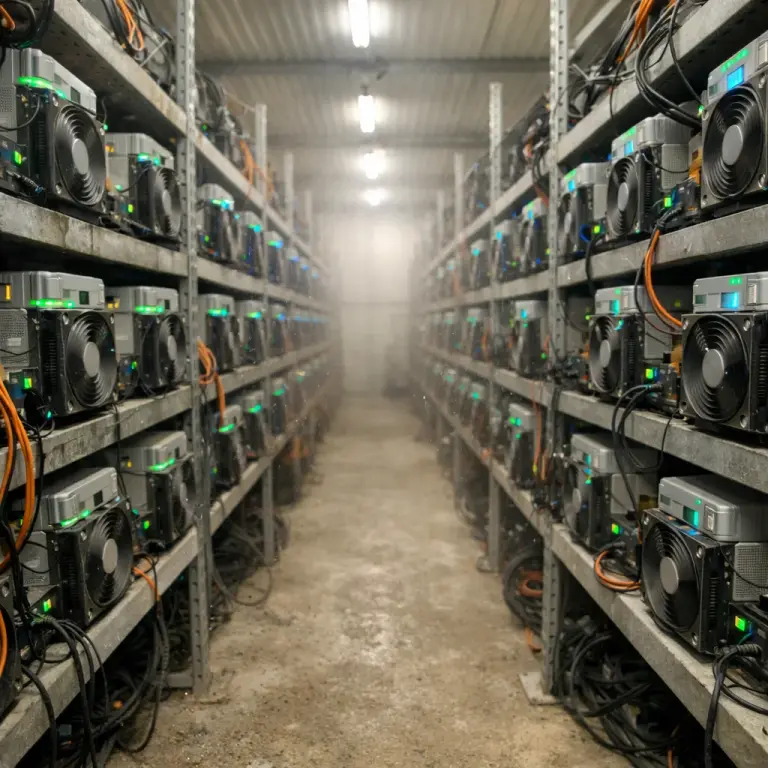
Why These Myths Are So Sticky
Cloud mining has a credibility problem that it partly earned. Between 2014 and 2019, the category produced a string of high-profile collapses — payouts stopped, domains vanished, operators blocked withdrawals. The post-mortems taught a generation of would-be miners that "cloud mining" equals "fraud," and that framing propagated faster than the news when a legitimate operator tier emerged behind it.
The myths we see repeated most often don't come from hostile critics — they come from careful people trying to avoid getting burned. They're reasonable defensive priors built on a real history. They're still wrong about how modern operators run. The five below are the ones we hear weekly, each addressed with the kernel of truth it's based on, the actual mechanics, and a concrete data point you can verify yourself.
The 5 Myths — and What Actually Happens
Myth 1: "All cloud mining is a scam"
Cloud mining is a Ponzi wrapper. Every operator pays early users from later users' deposits, disappears once inflows slow, and leaves withdrawals frozen.
A legitimate tier exists that runs on verifiable hardware, industrial power contracts, and pool-settled payouts. NoxHash operates a named Kazakhstan facility drawing ~$0.035/kWh, with BTC credited every minute via FPPS pool accounting — mechanics an outside observer can audit.
Kernel of truth: the category's 2014-2019 fraud rate was high, and unverifiable "hashrate contracts" with no facility disclosure remain common. The debunk isn't "there are no scams" — it's that the scam shape (no facility, no hardware photos, guaranteed return, no withdrawal track record) is identifiable and separates from the operator tier.
Myth 2: "They mine with cheap GPUs, not real ASICs"
Cloud operators quietly run GPU rigs or cheap last-gen machines and sell you hashrate at SHA-256 prices, pocketing the efficiency delta.
Reputable operators disclose specific public ASIC models. The NoxHash fleet runs Antminer S21 (200 TH/s, 17.5 J/TH), S21 Pro (234 TH/s, 15.0 J/TH), S21 XP Hyd (473 TH/s, 12.0 J/TH), and WhatsMiner M66S/M60S — all 2024-2025 silicon with public spec sheets.
Kernel of truth: GPUs can't mine SHA-256 profitably at all in 2026 — it's a pure tell that the provider is lying about what it runs. The weaker version of the myth, "they run outdated ASICs," is real at low-tier operators. Ask for the model name. If it isn't on the public ASIC Miner Value spec tables, it's a problem.
Myth 3: "Returns are guaranteed because contracts are fixed"
A fixed USD rental price means a fixed BTC return. Sign the contract, collect the advertised yield, done.
Only the cost is fixed. Earnings are in BTC, priced by the market, and divided by a network difficulty that ratchets up roughly every two weeks. A 12-month rental at $85/month locks the expense; the yield swings with BTC price and global hashrate.
Kernel of truth: your cost is predictable, and that's genuinely unusual compared to home mining where your electricity bill can also move. But predictable cost is not predictable return. When BTC drops 30% in a quarter, a fixed-USD contract pays the same USDT and produces meaningfully less USD-equivalent yield. Any operator promising a guaranteed BTC figure is red-flagging itself on Myth 1.
Myth 4: "Cloud mining is only for whales"
You need at least $5,000 and an industrial-scale order to get into cloud mining; retail users are locked out.
The entry point at NoxHash is a $20/month Basic Miner (50 TH/s), and a 2-day Basic Miner free trial runs without any deposit at all. The whale pricing is real — $250/month Enterprise — but it's the top of the ladder, not the floor.
Kernel of truth: home-miner hardware genuinely does have a high capex floor — a new Antminer S21 lists around $1,700, and a 100-unit farm is six-figure upfront. The myth transfers that economics to cloud mining, where the rental model exists specifically to fractionalize access. If a cloud operator demands a $5k minimum, they're optimizing for whales — not the whole category.
Myth 5: "The provider can rug-pull your BTC whenever they want"
Your BTC sits in the provider's wallet. One morning they freeze withdrawals, draft an exit post, and your balance evaporates with zero recourse.
Custodial risk is real but bounded by withdrawal mechanics. NoxHash settles BTC to any Segwit, P2PKH, or P2SH address you control, at a 1.5% fee and a 0.00001 BTC minimum. Withdraw early, withdraw often, and the on-platform balance stays small enough to survive any single provider event.
Kernel of truth: custodial platforms do fail, historically. The debunk isn't "trust us" — it's that the risk is a known category and the mitigation is operational: test a small withdrawal before scaling, move BTC off-platform on a schedule, treat the dashboard as an earnings feed rather than a savings account. "Not your keys, not your coins" applies to cloud mining too.
Verify the debunks yourself — free 2-day Basic Miner trial
You've just seen each myth paired with a concrete, checkable mechanic — named Antminer models, a Kazakhstan facility, USD-fixed rentals against BTC-variable yield, $20 entry, on-chain withdrawals. The free trial lets you watch those mechanics run against a real dashboard before you commit any USDT.

Why Each Myth Persists
The mechanics above address whether each myth is right. This table addresses why each myth keeps recycling — because a debunk that doesn't explain the persistence tends not to stick. Most of these myths survive on a genuine signal from the low end of the market that gets over-generalised to the whole category.
| What people believe | What actually happens | Why the myth persists |
|---|---|---|
| All cloud mining is a scam | Legitimate operators disclose facility + hardware + pool | 2014-2019 history trained the reflex |
| They secretly run GPUs | SHA-256 ASICs with public specs (S21, M66S, etc.) | No-disclosure operators get lumped in |
| Returns are guaranteed | Only cost is fixed in USD; BTC yield varies | Fixed rental price gets misread as fixed return |
| Only for whales | $20/month floor, free 2-day trial | Home-mining capex gets transferred mentally |
| Provider can rug-pull | Custodial risk bounded by withdrawal discipline | Real failures happened; "not your keys" applies |
For the broader picture on how much energy the industry actually consumes and where — the macro context behind Myth 2's "real ASICs" question — see the Cambridge Bitcoin Electricity Consumption Index, which tracks network hashrate and regional distribution independent of any operator's marketing.
4 Ways to Stress-Test Any Cloud Mining Operator
Ask for the ASIC model name
If the operator can't or won't name the machine running your contract (e.g. "Antminer S21 Pro, 234 TH/s"), Myth 2 just got confirmed for them. Legitimate fleets cite public model numbers.
Test a small withdrawal first
Withdraw the minimum (0.00001 BTC on NoxHash) before you scale any commitment. A provider that can't process a small withdrawal on-chain will not process a large one. Myth 5 resolves itself here.
Reject any guaranteed-BTC pitch
If the marketing promises a fixed BTC return rather than a fixed USD cost, Myth 3 has already been weaponised. Network difficulty and BTC price move — the yield has to move with them, not around them.
Start on a free trial, not a year
A 2-day Basic Miner trial with no deposit lets you verify Myths 1, 2, and 4 at once — dashboard exists, hashrate flows, the $20 floor is real — without any money at risk. 12-month terms can wait until after.
Run all four stress-tests on NoxHash before committing a cent
The four checks above — name the ASIC, test a small withdrawal, reject guaranteed-BTC pitches, start on trial — are designed to fail operators who've earned the myths. Run them on us. The fleet is S21-class, withdrawals start at 0.00001 BTC, nothing is "guaranteed," and the trial is free.
Frequently Asked Questions
Is cloud mining a scam?
Not universally. The category historically produced fraud, so the scam shape is real — no facility disclosure, no named hardware, guaranteed returns, withdrawal friction. A legitimate operator tier names its ASIC models, discloses its facility region, and processes test withdrawals on-chain. The scams and the operators aren't the same thing.
How do I know the operator actually has ASICs?
Ask for the model name. GPUs cannot mine SHA-256 profitably in 2026. The fleet should cite public SKUs — Antminer S21, S21 Pro, S21 XP Hyd, WhatsMiner M66S, M60S — each with published TH/s and J/TH figures on manufacturer spec sheets and ASIC Miner Value.
Are cloud mining returns guaranteed?
No. The rental cost is fixed in USD, but earnings are paid in BTC and depend on BTC price, network difficulty, and pool mechanics — all of which move. Any operator advertising a guaranteed BTC return is misrepresenting how mining economics work. Fixed cost, variable yield.
What's the minimum to try cloud mining?
Zero on the NoxHash free trial: 2 days of a Basic Miner, no deposit required. Paid entry starts at $20 per month for a Basic Miner (50 TH/s). Operators demanding $5,000+ minimums are targeting whales, not debunking the myth that retail access doesn't exist.
Can the provider freeze or steal my BTC?
Custodial risk is real on any hosted platform and the mitigation is operational, not philosophical. Withdraw regularly to an address you control, test a small withdrawal before scaling, and keep the on-platform balance bounded. NoxHash settles BTC at a 1.5% fee and 0.00001 BTC minimum to Segwit, P2PKH, or P2SH addresses.
Educational content — not financial advice
This article corrects commonly repeated claims about cloud mining. It does not forecast returns, guarantee profitability, or recommend any specific allocation. Mining revenue is paid in BTC and depends on BTC price and network difficulty, both volatile and outside your control. Rental costs are fixed in USD; BTC-denominated yields are not. Past performance does not guarantee future results. Commit only funds you can afford to lose, withdraw regularly to self-custody, verify local regulations before operating any mining activity, and treat the mechanics described here as April 2026 snapshots of a moving system.